QUESTION IMAGE
Question
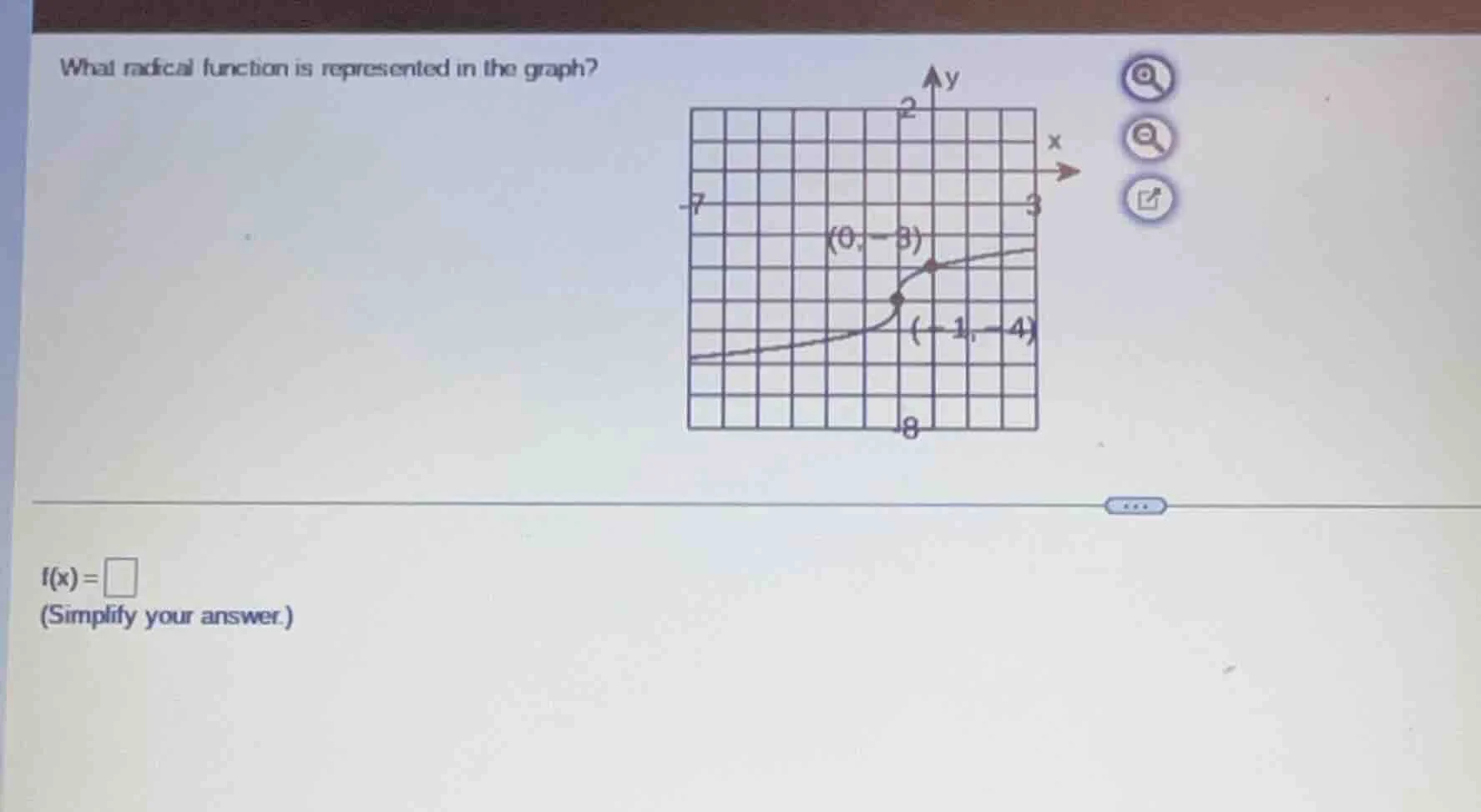
what radical function is represented in the graph?
f(x) =
(simplify your answer.)
Step1: Identify the parent function form
Radical functions often have the form \( f(x) = a\sqrt[3]{x - h} + k \) (since the graph looks like a cube root function, which has a point of inflection and is defined for all real numbers). The parent cube root function is \( y=\sqrt[3]{x} \), which has a point of inflection at \((0,0)\). Here, we need to find \(a\), \(h\), and \(k\) by using the given points.
Step2: Use the point \((-1, -4)\) and assume the inflection point (vertex - like for cube root) is \((h,k)\). Wait, maybe the inflection point is at \((h,k)\). Let's check the point \((-1, -4)\) and \((0, -8)\). Wait, maybe the general form is \( f(x) = a\sqrt[3]{x + 1} - 4 \)? Wait, no, let's test. Wait, when \(x=-1\), \( \sqrt[3]{x + 1}=0 \), so \( f(-1)=a*0 + k=-4 \), so \(k = -4\). Then the function is \( f(x)=a\sqrt[3]{x - h} - 4 \). Now use the point \((0, -8)\). Plug \(x = 0\), \(y=-8\) into \( f(x)=a\sqrt[3]{0 - h} - 4 \). Wait, maybe \(h=-1\), so the function is \( f(x)=a\sqrt[3]{x + 1} - 4 \). Then when \(x = 0\), \( f(0)=a\sqrt[3]{0 + 1} - 4=a - 4 \). We know \(f(0)=-8\), so \(a - 4=-8\), so \(a=-4\). Let's check: \( f(x)=-4\sqrt[3]{x + 1} - 4 \)? Wait, no, wait when \(x=-1\), \( f(-1)=-4\sqrt[3]{0} - 4=-4\), which matches \((-1, -4)\). When \(x = 0\), \( f(0)=-4\sqrt[3]{1} - 4=-4 - 4=-8\), which matches \((0, -8)\). Wait, is that correct? Wait, let's re - evaluate.
Wait, maybe the parent function is \( y=\sqrt[3]{x} \), and we have a horizontal shift, vertical stretch, and vertical shift. Let's define the function as \( f(x)=a\sqrt[3]{x - h}+k \). The inflection point (where the cube root function changes concavity) is at \((h,k)\). From the point \((-1, -4)\), let's assume \(h=-1\) and \(k=-4\), so the function is \( f(x)=a\sqrt[3]{x + 1}-4 \). Now use the point \((0, -8)\):
Substitute \(x = 0\), \(y=-8\) into \( f(x)=a\sqrt[3]{x + 1}-4 \):
\( -8=a\sqrt[3]{0 + 1}-4 \)
\( -8=a(1)-4 \)
Subtract \(-4\) from both sides: \( -8 + 4=a \)
So \(a=-4\)
So the function is \( f(x)=-4\sqrt[3]{x + 1}-4 \)? Wait, no, wait when \(x=-1\), \( \sqrt[3]{x + 1}=0 \), so \( f(-1)=-40 - 4=-4\), which is correct. When \(x = 0\), \( f(0)=-41 - 4=-8\), which is correct. Wait, but let's check another point? Wait, the graph seems to have the inflection point at \((-1, -4)\), so the function is a transformed cube root function. So the function is \( f(x)=-4\sqrt[3]{x + 1}-4 \)? Wait, no, maybe I made a mistake. Wait, let's think again.
Wait, the general form of a cube root function is \( y = a\sqrt[3]{x - h}+k \), where \((h,k)\) is the inflection point. Here, the inflection point is \((-1, -4)\), so \(h=-1\), \(k=-4\). Then we use the point \((0, -8)\) to find \(a\).
Substitute \(x = 0\), \(y=-8\), \(h=-1\), \(k=-4\) into \( y=a\sqrt[3]{x - h}+k \):
\( -8=a\sqrt[3]{0 - (-1)}+(-4) \)
\( -8=a\sqrt[3]{1}-4 \)
\( -8=a(1)-4 \)
\( a=-8 + 4=-4 \)
So the function is \( f(x)=-4\sqrt[3]{x + 1}-4 \)? Wait, no, that can't be. Wait, maybe the function is \( f(x)=4\sqrt[3]{x + 1}-8 \)? No, let's check \(x=-1\): \(4\sqrt[3]{0}-8=-8\), which is not \((-1, -4)\). Wait, I think I messed up the inflection point. Wait, the two points are \((-1, -4)\) and \((0, -8)\). Let's assume the function is \( f(x)=a\sqrt[3]{x}+b \). Let's plug in the two points.
For \((-1, -4)\): \( -4=a\sqrt[3]{-1}+b=-a + b \)
For \((0, -8)\): \( -8=a\sqrt[3]{0}+b=0 + b\), so \(b=-8\)
Then from the first equation: \( -4=-a-8 \), so \(a=-4\)
So the function is \( f(x)=-4\sqrt[3]{x}-8 \)? Wait, check \(x=-1\): \( -4\sqrt[3]{-1}-8=-4*(-1)-8 = 4 - 8=-4\), which matches \((-…

Snap & solve any problem in the app
Get step-by-step solutions on Sovi AI
Photo-based solutions with guided steps
Explore more problems and detailed explanations
\( f(x)=-4\sqrt[3]{x}-8 \)