QUESTION IMAGE
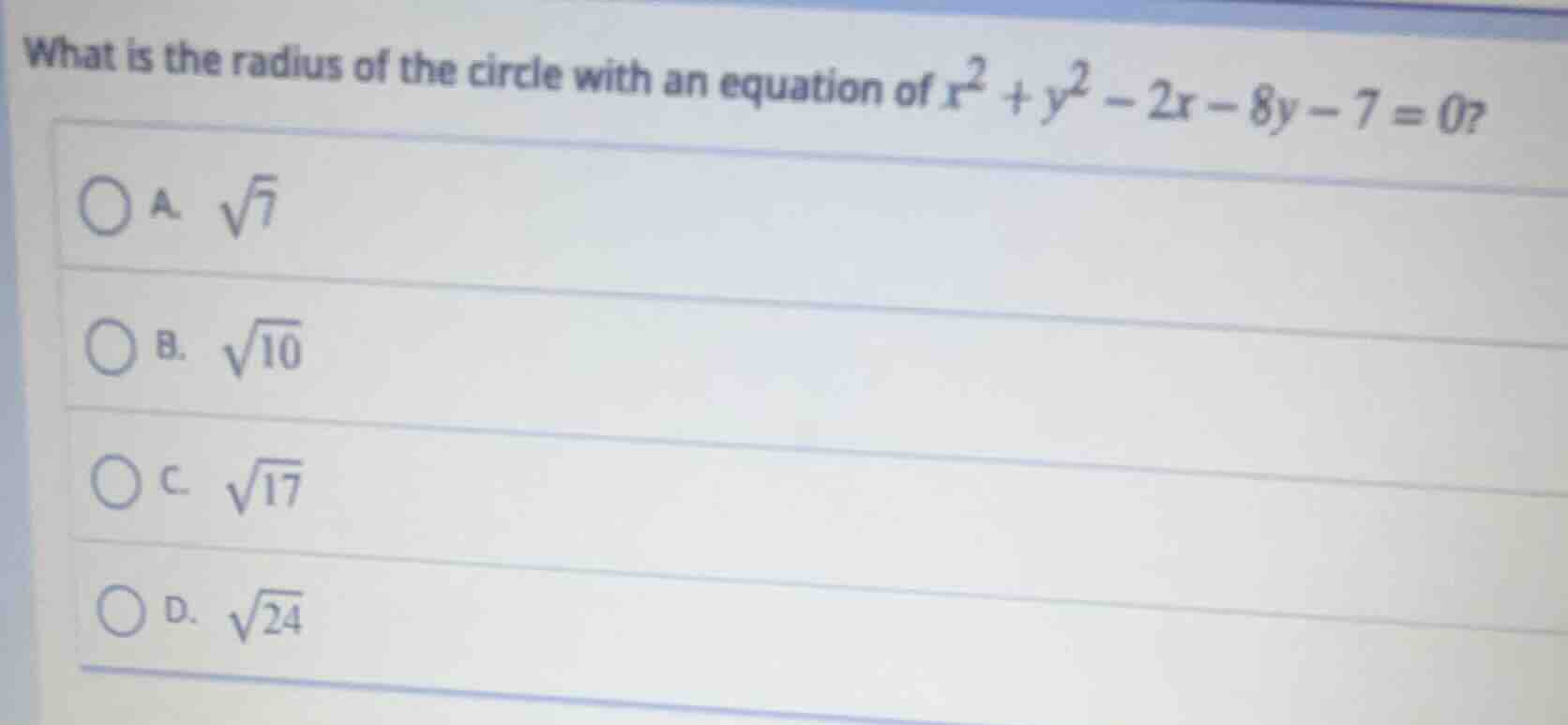
Question
what is the radius of the circle with an equation of $x^2 + y^2 - 2x - 8y - 7 = 0$?\
a. $\sqrt{7}$\
b. $\sqrt{10}$\
c. $\sqrt{17}$\
d. $\sqrt{24}$
Step1: Rewrite the equation by completing the square for x and y terms.
The general equation of a circle is \(x^2 + y^2 + Dx + Ey + F = 0\), and we can rewrite it in the standard form \((x - h)^2 + (y - k)^2 = r^2\) by completing the square. For the given equation \(x^2 + y^2 - 2x - 8y - 7 = 0\), group the x terms and y terms: \((x^2 - 2x) + (y^2 - 8y) = 7\).
Step2: Complete the square for x terms.
For \(x^2 - 2x\), take half of -2, which is -1, square it to get 1. So we add 1 to both sides: \((x^2 - 2x + 1) + (y^2 - 8y) = 7 + 1\).
Step3: Complete the square for y terms.
For \(y^2 - 8y\), take half of -8, which is -4, square it to get 16. Add 16 to both sides: \((x^2 - 2x + 1) + (y^2 - 8y + 16) = 7 + 1 + 16\).
Step4: Rewrite as standard form.
The left side becomes \((x - 1)^2 + (y - 4)^2\), and the right side is \(7 + 1 + 16 = 24\)? Wait, no, wait: 7 + 1 is 8, 8 + 16 is 24? Wait, no, wait the original equation after moving -7 to the right is \((x^2 - 2x)+(y^2 - 8y)=7\). Then adding 1 (for x) and 16 (for y) to both sides: \((x - 1)^2 + (y - 4)^2 = 7 + 1 + 16\). Wait, 7 + 1 is 8, 8 + 16 is 24? But that would make the radius \(\sqrt{24}\), but that's option D. Wait, no, maybe I made a mistake. Wait, let's recalculate:
Wait, the original equation is \(x^2 + y^2 - 2x - 8y - 7 = 0\). So moving -7 to the right: \(x^2 + y^2 - 2x - 8y = 7\). Then group x terms: \(x^2 - 2x\), y terms: \(y^2 - 8y\). Completing the square for x: \(x^2 - 2x + 1 = (x - 1)^2\), so we add 1 to both sides. For y: \(y^2 - 8y + 16 = (y - 4)^2\), so add 16 to both sides. So total added to the right is 1 + 16 = 17. So the right side becomes 7 + 1 + 16 = 24? Wait, no: 7 + 1 is 8, 8 + 16 is 24? Wait, no, 7 + 1 + 16 = 24? But 1 + 16 is 17, 7 + 17 is 24. So the equation is \((x - 1)^2 + (y - 4)^2 = 24\), so radius is \(\sqrt{24}\), which is option D. But wait, maybe I messed up the initial equation. Wait, let's check again. The equation is \(x^2 + y^2 - 2x - 8y - 7 = 0\). So moving -7 to the right: \(x^2 + y^2 - 2x - 8y = 7\). Then complete the square for x: \(x^2 - 2x + 1 = (x - 1)^2\), so add 1 to both sides. For y: \(y^2 - 8y + 16 = (y - 4)^2\), add 16 to both sides. So left side: \((x - 1)^2 + (y - 4)^2\), right side: 7 + 1 + 16 = 24. So the radius is \(\sqrt{24}\), which is option D. But wait, maybe I made a mistake in the problem. Wait, let me check the options again. Option D is \(\sqrt{24}\), so that would be the answer. But wait, maybe I miscalculated. Wait, let's do it again:
Original equation: \(x^2 + y^2 - 2x - 8y - 7 = 0\)
Bring -7 to the right: \(x^2 + y^2 - 2x - 8y = 7\)
Group x terms: \(x^2 - 2x\), y terms: \(y^2 - 8y\)
Complete the square for x: take coefficient of x, which is -2, divide by 2: -1, square: 1. So add 1 to x terms: \(x^2 - 2x + 1 = (x - 1)^2\)
Complete the square for y: coefficient of y is -8, divide by 2: -4, square: 16. Add 16 to y terms: \(y^2 - 8y + 16 = (y - 4)^2\)
Now, add these squares to both sides of the equation (since we added 1 and 16 to the left, we must add them to the right):
\((x - 1)^2 + (y - 4)^2 = 7 + 1 + 16\)
Calculate the right side: 7 + 1 = 8, 8 + 16 = 24. So the equation is \((x - 1)^2 + (y - 4)^2 = 24\), so the radius is \(\sqrt{24}\), which is option D. Wait, but maybe I made a mistake in the problem. Wait, let me check the original equation again. The user wrote: \(x^2 + y^2 - 2x - 8y - 7 = 0\). Yes. So completing the square gives radius squared 24, so radius \(\sqrt{24}\), which is option D.
Wait, but let me check the options again. Option D is \(\sqrt{24}\), so that's the answer.

Snap & solve any problem in the app
Get step-by-step solutions on Sovi AI
Photo-based solutions with guided steps
Explore more problems and detailed explanations
D. \(\sqrt{24}\)