QUESTION IMAGE
Question
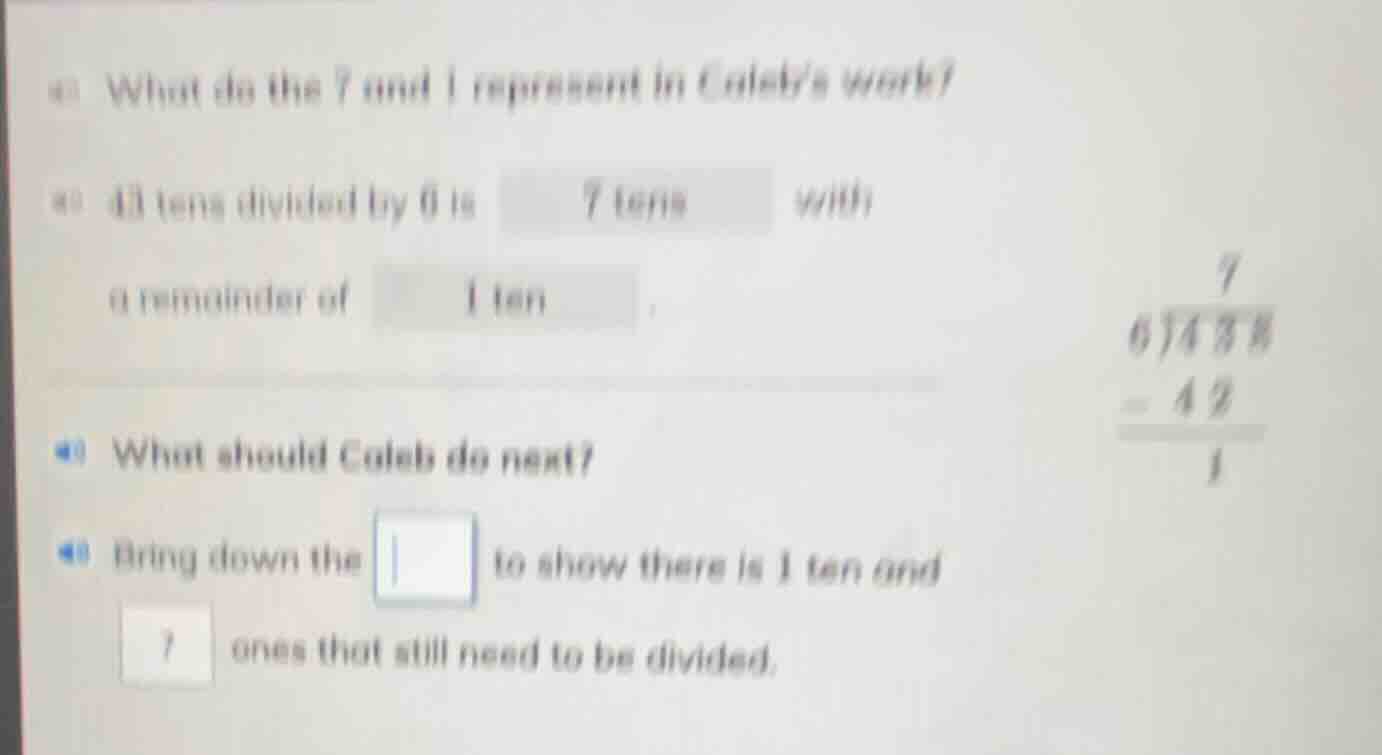
a) what do the 7 and 1 represent in caleb’s work?
a) 43 tens divided by 6 is 7 tens with a remainder of 1 ten.
- what should caleb do next?
- bring down the \boxed{} to show there is 1 ten and \boxed{7} ones that still need to be divided.
\\\
$$\begin{array}{r}7\\\\6\\overline{)438}\\\\-42\\\\\\hline1\\end{array}$$
\\
Response
Part a) Explanation for 7 and 1 in Caleb's work:
- When dividing 438 by 6, we start with the tens place (43 tens, since 4 is in hundreds and 3 in tens, so 43 tens).
- Dividing 43 tens by 6: \( 6\times7 = 42 \), so 7 (the quotient for tens place) represents the number of groups of 6 tens in 43 tens.
- The remainder is \( 43 - 42 = 1 \), so 1 represents the remaining tens after dividing 43 tens into groups of 6.
Part b) What Caleb should do next:
- In long division, after finding the remainder in the tens place, we bring down the next digit (from the ones place) to combine with the remainder.
- The dividend is 438, so after dealing with the tens place (43), we bring down the 8 (the ones digit) to combine with the remainder 1 (ten) to make 18, which we then divide by 6.
Part c) Filling the blanks:
- For "Bring down the \(\boldsymbol{\square}\) to show there is 1 ten and \(\boldsymbol{\square}\) ones that still need to be divided":
- We bring down the 8 (from 438) to combine with the remainder 1 (ten) to get 18 (1 ten and 8 ones? Wait, no—wait, 1 ten is 10, and bringing down 8 makes 18, which is 1 ten and 8 ones? Wait, no, the remainder from tens place is 1 ten (10), and bringing down 8 (ones) makes 18, so the first blank is 8 (the digit to bring down), and the second blank is 8 (since 1 ten + 8 ones = 18). Wait, the problem says "1 ten and \(\square\) ones"—so after bringing down 8, we have 1 ten (10) and 8 ones, so total 18. So the first blank is 8, the second is 8.
But let's re-express step-by-step for each part:
Step-by-Step for Part a (What do 7 and 1 represent?):
- Step 1: Analyze the division of 438 by 6, starting with the tens place (43 tens, since 4 is hundreds, 3 is tens: 43 tens).
- Step 2: Divide 43 by 6: \( 6 \times 7 = 42 \), so 7 is the quotient (number of 6s in 43 tens), and the remainder is \( 43 - 42 = 1 \), so 1 is the remaining tens after subtracting 42 from 43.
Step-by-Step for Part b (What next?):
- Step 1: After finding the remainder in the tens place (1 ten), we bring down the next digit (the ones digit of the dividend, which is 8) to combine with the remainder.
- Step 2: This forms 18 (1 ten + 8 ones), which we then divide by 6.
Step-by-Step for Part c (Filling blanks):
- Step 1: The digit to bring down is the ones digit of 438, which is 8.
- Step 2: After bringing down 8, we have 1 ten (10) and 8 ones, so the second blank is 8.

Snap & solve any problem in the app
Get step-by-step solutions on Sovi AI
Photo-based solutions with guided steps
Explore more problems and detailed explanations
s:
- Part a: 7 represents the number of 6s in 43 tens (quotient for tens place), 1 represents the remaining tens after dividing 43 by 6.
- Part b: Caleb should bring down the ones digit (8) to combine with the remainder 1 (ten) and form 18, then divide 18 by 6.
- Part c: Bring down the \(\boldsymbol{8}\) to show there is 1 ten and \(\boldsymbol{8}\) ones that still need to be divided.
(If the question expects specific blanks: first blank 8, second blank 8.)