QUESTION IMAGE
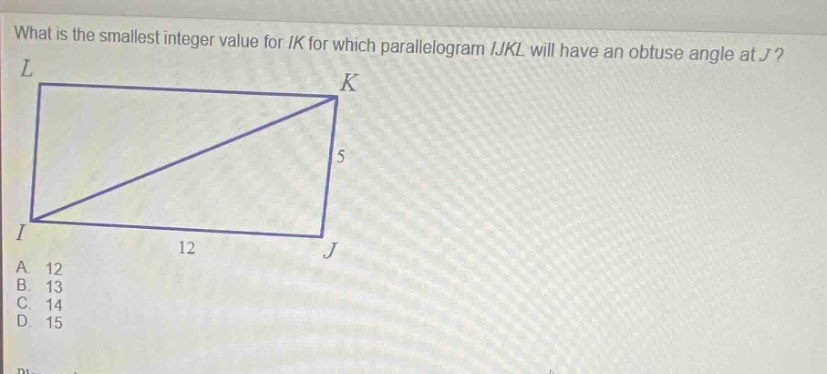
Question
what is the smallest integer value for ( ik ) for which parallelogram ( ijkl ) will have an obtuse angle at ( j )?
a. 12
b. 13
c. 14
d. 15
Step1: Recall properties of parallelograms and right triangles
In a parallelogram \(IJKL\), \(IJ = 12\) and \(JK = 5\). If we consider triangle \(IJK\), when \(\angle J\) is a right angle, by the Pythagorean theorem, \(IK=\sqrt{IJ^{2}+JK^{2}}\).
Step2: Calculate \(IK\) for right angle at \(J\)
Using the Pythagorean theorem: \(IK=\sqrt{12^{2}+5^{2}}=\sqrt{144 + 25}=\sqrt{169}=13\).
Step3: Determine when \(\angle J\) is obtuse
In a triangle, if the square of one side is greater than the sum of the squares of the other two sides, the angle opposite that side is obtuse. For \(\angle J\) to be obtuse in \(\triangle IJK\), \(IK^{2}>IJ^{2}+JK^{2}\). We know \(IJ = 12\), \(JK = 5\), so \(IJ^{2}+JK^{2}=144 + 25 = 169\). We need \(IK^{2}>169\), so \(IK>13\) (since \(IK\) is a length, it's positive). The smallest integer value of \(IK\) satisfying this is \(14\).

Snap & solve any problem in the app
Get step-by-step solutions on Sovi AI
Photo-based solutions with guided steps
Explore more problems and detailed explanations
C. 14