QUESTION IMAGE
Question
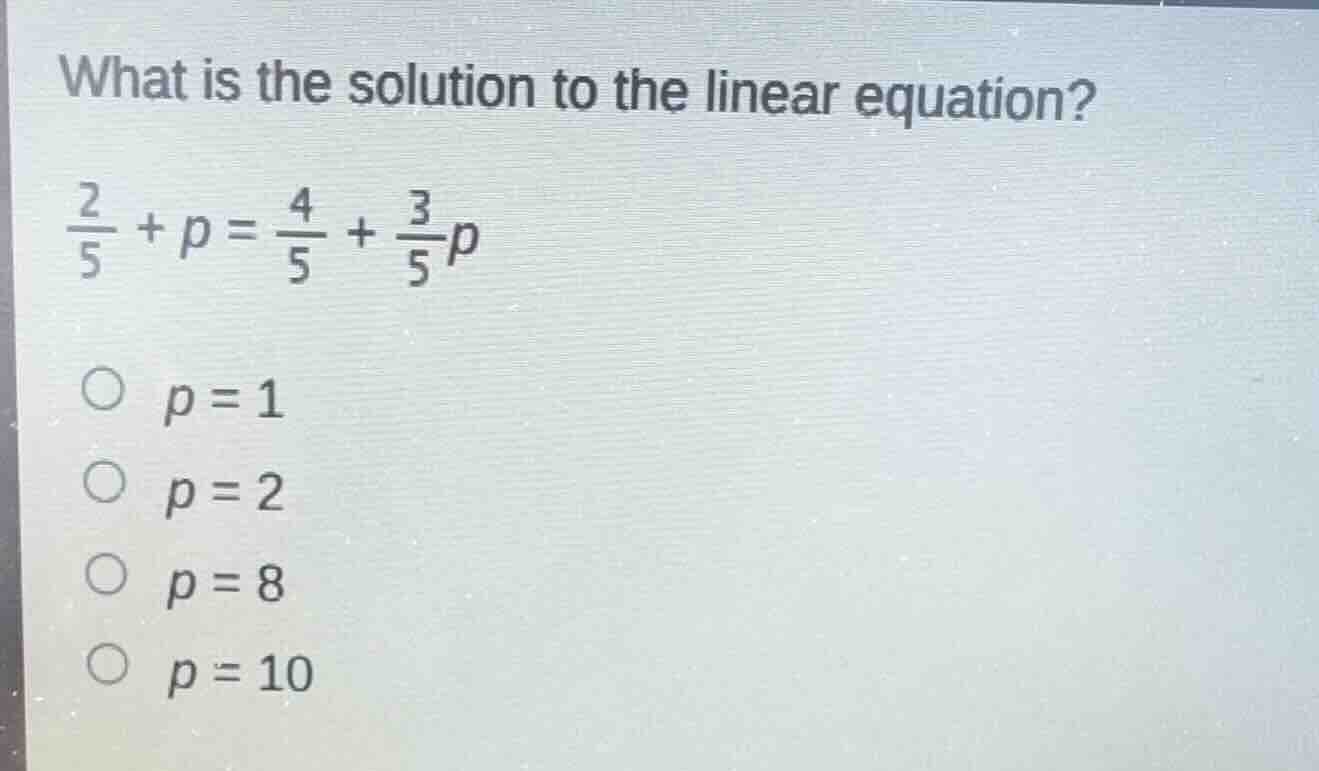
what is the solution to the linear equation?
\\(\frac{2}{5} + p = \frac{4}{5} + \frac{3}{5}p\\)
\\(\bigcirc\\ p = 1\\)
\\(\bigcirc\\ p = 2\\)
\\(\bigcirc\\ p = 8\\)
\\(\bigcirc\\ p = 10\\)
Step1: Subtract \(\frac{3}{5}p\) from both sides
\(\frac{2}{5} + p - \frac{3}{5}p = \frac{4}{5} + \frac{3}{5}p - \frac{3}{5}p\)
Simplify to get \(\frac{2}{5} + \frac{2}{5}p = \frac{4}{5}\)
Step2: Subtract \(\frac{2}{5}\) from both sides
\(\frac{2}{5} + \frac{2}{5}p - \frac{2}{5} = \frac{4}{5} - \frac{2}{5}\)
Simplify to get \(\frac{2}{5}p = \frac{2}{5}\)
Step3: Multiply both sides by \(\frac{5}{2}\)
\(\frac{2}{5}p \times \frac{5}{2} = \frac{2}{5} \times \frac{5}{2}\)
Simplify to get \(p = 1\)

Snap & solve any problem in the app
Get step-by-step solutions on Sovi AI
Photo-based solutions with guided steps
Explore more problems and detailed explanations
\(p = 1\) (corresponding to the option: \(p = 1\))