QUESTION IMAGE
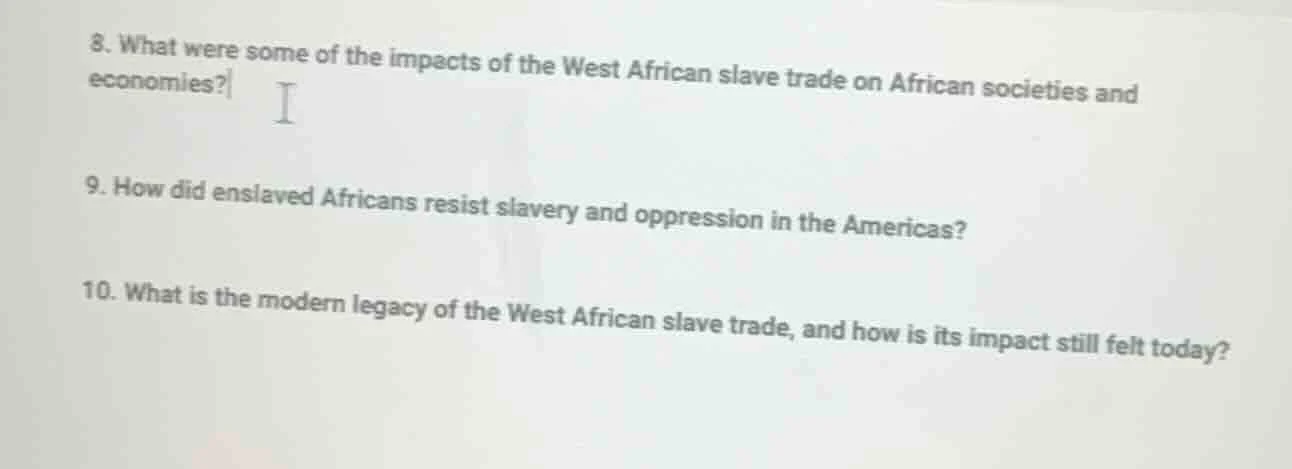
Question
- what were some of the impacts of the west african slave trade on african societies and economies?
- how did enslaved africans resist slavery and oppression in the americas?
- what is the modern legacy of the west african slave trade, and how is its impact still felt today?
Brief Explanations
For Question 8:
- Societal Impacts: Depopulation of young, able-bodied people broke family and community structures; some African groups turned to raiding neighbors for captives to sell, fueling intergroup conflict and weakening regional stability.
- Economic Impacts: Created a reliance on slave exports instead of developing sustainable local industries; distorted labor markets as skilled workers were taken, and economies became tied to the demand of European slave traders rather than local needs.
For Question 9:
- Day-to-Day Resistance: Slowdowns in work, feigning illness, breaking tools, or stealing food to disrupt plantation operations.
- Organized Resistance: Running away to form maroon communities, staging work stoppages, and in some cases, large-scale rebellions (e.g., the Haitian Revolution).
- Cultural Resistance: Preserving African languages, religious practices, and oral traditions to maintain identity despite oppression.
For Question 10:
- Racial Inequity: Laid the foundation for systemic racism, including racial wealth gaps, discriminatory policies, and structural barriers that persist in education, housing, and employment for Black communities globally.
- Cultural Legacy: Shaped African diasporic cultures (music, food, religion) in the Americas, while in West Africa, it left lasting scars on social cohesion and economic development.
- Political Reckoning: Spurred modern movements for racial justice, reparations, and public education about the slave trade's ongoing impacts.

Snap & solve any problem in the app
Get step-by-step solutions on Sovi AI
Photo-based solutions with guided steps
Explore more problems and detailed explanations
- Impacts on African societies and economies include:
- Societal: Depopulation of working-age people, broken family/community structures, increased intergroup conflict from slave raiding.
- Economic: Reliance on slave exports over local industry, distorted labor markets, economies tied to European demand.
- Enslaved Africans resisted through:
- Day-to-day acts: Work slowdowns, feigning illness, sabotaging tools.
- Organized acts: Escaping to maroon communities, staging rebellions (e.g., Haitian Revolution).
- Cultural acts: Preserving African languages, religions, and traditions.
- Modern legacy of the West African slave trade:
- Systemic racial inequities: Persistent racial wealth gaps, discriminatory policies, and structural barriers for Black communities.
- Cultural impacts: Shaped African diasporic cultures in the Americas; left social and economic scars in West Africa.
- Contemporary movements: Drives racial justice efforts, calls for reparations, and public education on its ongoing effects.