QUESTION IMAGE
Question
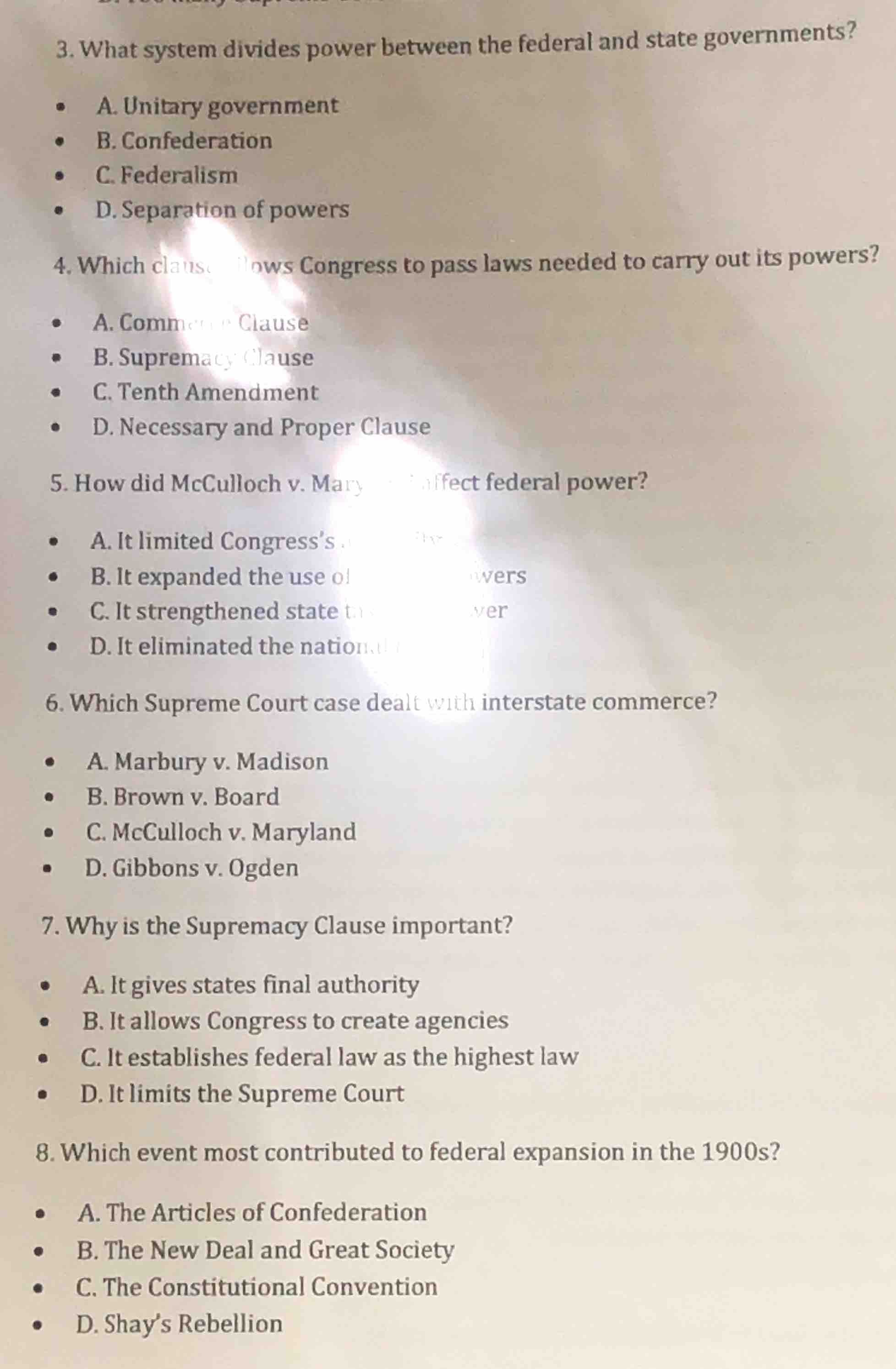
- what system divides power between the federal and state governments?
- a. unitary government
- b. confederation
- c. federalism
- d. separation of powers
- which clause allows congress to pass laws needed to carry out its powers?
- a. commerce clause
- b. supremacy clause
- c. tenth amendment
- d. necessary and proper clause
- how did mcculloch v. maryland affect federal power?
- a. it limited congress’s implied powers
- b. it expanded the use of implied powers
- c. it strengthened state tax power
- d. it eliminated the national bank
- which supreme court case dealt with interstate commerce?
- a. marbury v. madison
- b. brown v. board
- c. mcculloch v. maryland
- d. gibbons v. ogden
- why is the supremacy clause important?
- a. it gives states final authority
- b. it allows congress to create agencies
- c. it establishes federal law as the highest law
- d. it limits the supreme court
- which event most contributed to federal expansion in the 1900s?
- a. the articles of confederation
- b. the new deal and great society
- c. the constitutional convention
- d. shay’s rebellion
Brief Explanations
- Federalism is the system that splits governing power between national (federal) and state governments. Unitary systems concentrate power at the national level, confederations give most power to states, and separation of powers divides federal government branches.
- The Necessary and Proper Clause (Elastic Clause) lets Congress pass laws needed to execute its enumerated powers. The Commerce Clause regulates interstate commerce, the Supremacy Clause establishes federal law supremacy, and the 10th Amendment reserves powers to states.
- McCulloch v. Maryland upheld Congress's implied powers via the Necessary and Proper Clause, expanding federal authority over states.
- Gibbons v. Ogden established broad federal power to regulate interstate commerce, defining it broadly beyond just navigation.
- The Supremacy Clause in the U.S. Constitution sets federal law, treaties, and the Constitution itself as the supreme law of the land, overriding state laws.
- The New Deal (1930s) and Great Society (1960s) expanded federal government roles in economic regulation, social welfare, and civil rights, drastically increasing federal power in the 1900s. The other events predate the 1900s.

Snap & solve any problem in the app
Get step-by-step solutions on Sovi AI
Photo-based solutions with guided steps
Explore more problems and detailed explanations
- C. Federalism
- D. Necessary and Proper Clause
- B. It expanded the use of federal powers
- D. Gibbons v. Ogden
- C. It establishes federal law as the highest law
- B. The New Deal and Great Society