QUESTION IMAGE
Question
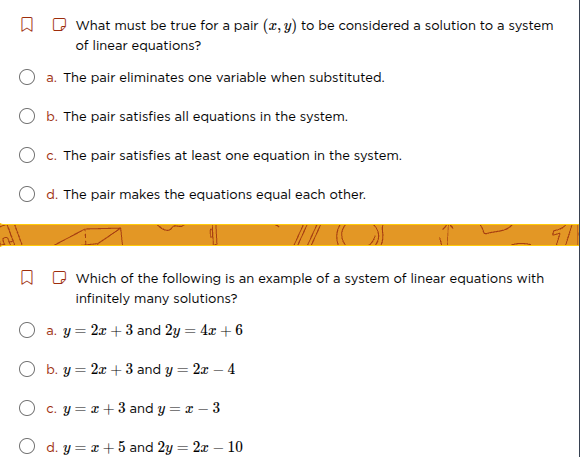
- what must be true for a pair $(x, y)$ to be considered a solution to a system of linear equations?
a. the pair eliminates one variable when substituted.
b. the pair satisfies all equations in the system.
c. the pair satisfies at least one equation in the system.
d. the pair makes the equations equal each other.
- which of the following is an example of a system of linear equations with infinitely many solutions?
a. $y=2x+3$ and $2y=4x+6$
b. $y=2x+3$ and $y=2x-4$
c. $y=x+3$ and $y=x-3$
d. $y=x+5$ and $2y=2x-10$
Brief Explanations
- By definition, a solution to a system of linear equations is a set of values that works for every equation in that system, not just some or one.
- For the pair $y=2x + 3$ and $2y=4x + 6$, if you multiply the first equation by 2, you get the second equation. This means the two equations represent the same line, so every point on the line is a solution, resulting in infinitely many solutions. The other options represent parallel distinct lines (no solutions) or intersecting lines (one solution).

Snap & solve any problem in the app
Get step-by-step solutions on Sovi AI
Photo-based solutions with guided steps
Explore more problems and detailed explanations
- b. The pair satisfies all equations in the system.
- a. $y=2x + 3$ and $2y=4x + 6$