QUESTION IMAGE
Question
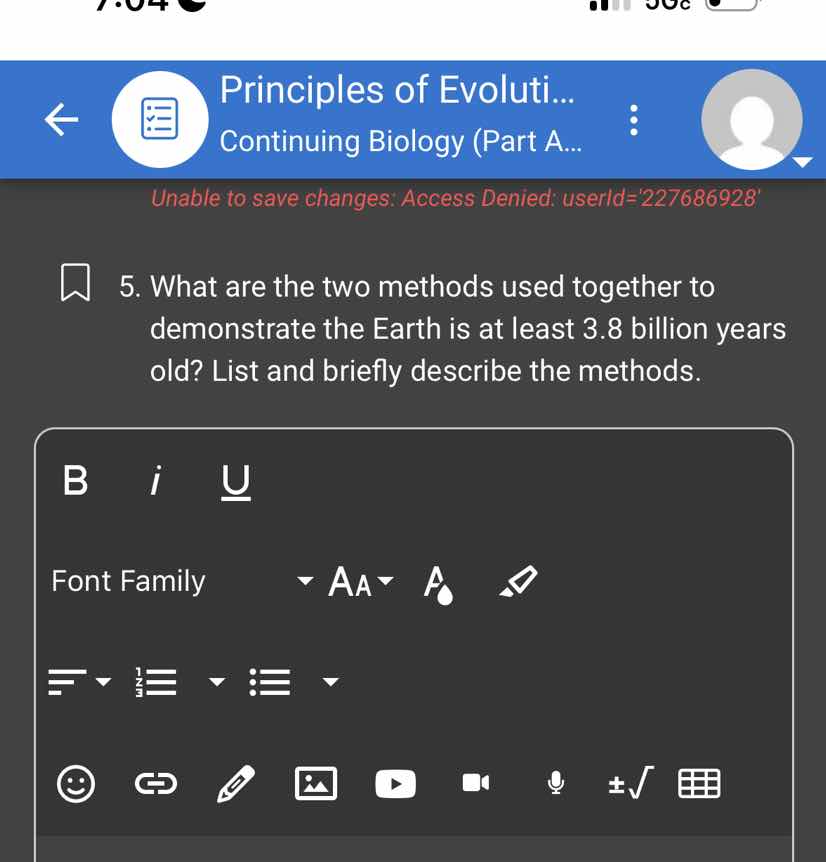
- what are the two methods used together to demonstrate the earth is at least 3.8 billion years old? list and briefly describe the methods.
Brief Explanations
To determine the age of the Earth (at least 3.8 billion years old), two key methods are used together:
- Radiometric Dating (e.g., Uranium - Lead Dating): This method relies on the radioactive decay of unstable isotopes (like uranium isotopes) into stable daughter isotopes (like lead isotopes). The half - life of the parent isotope is known (the time it takes for half of the parent isotope to decay). By measuring the ratio of parent to daughter isotopes in a rock sample (such as zircon crystals, which can trap uranium and resist chemical alteration), scientists can calculate how much time has passed since the rock formed.
- Fossil Record and Stratigraphy (Geological Column): Stratigraphy is the study of rock layers (strata). Older rock layers are generally found below younger ones (the law of superposition), unless geological processes like folding or faulting have disturbed them. The fossil record within these rock layers shows the succession of life forms over time. By correlating the ages of rock layers (determined through radiometric dating of associated volcanic ash layers, for example) with the fossils they contain, and also by looking at the distribution of fossils across different layers globally, we can build a timeline of Earth's history. When combined with radiometric dating of the oldest rocks (like the Acasta Gneiss or rocks with zircon crystals) and the dating of meteorites (which are thought to have formed around the same time as the Earth and the solar system), we can establish that the Earth is at least 3.8 billion years old. The oldest known zircon crystals, dated via radiometric methods, and the stratigraphic context of the rocks they are found in, along with the dating of meteorites, all support this age estimate.

Snap & solve any problem in the app
Get step-by-step solutions on Sovi AI
Photo-based solutions with guided steps
Explore more problems and detailed explanations
- Radiometric Dating (e.g., Uranium - Lead Dating): Uses the decay of radioactive isotopes (e.g., uranium to lead) in rocks (e.g., zircon crystals) to calculate time since rock formation, based on known half - lives and parent - daughter isotope ratios.
- Fossil Record and Stratigraphy: Studies rock layer (strata) succession (older layers below younger, unless disturbed) and fossil succession. Correlates rock layer ages (aided by radiometric dating of associated materials like volcanic ash) with fossils to build Earth's timeline, with oldest rocks/zircons and meteorite dating supporting the ≥3.8 - billion - year age.