QUESTION IMAGE
Question
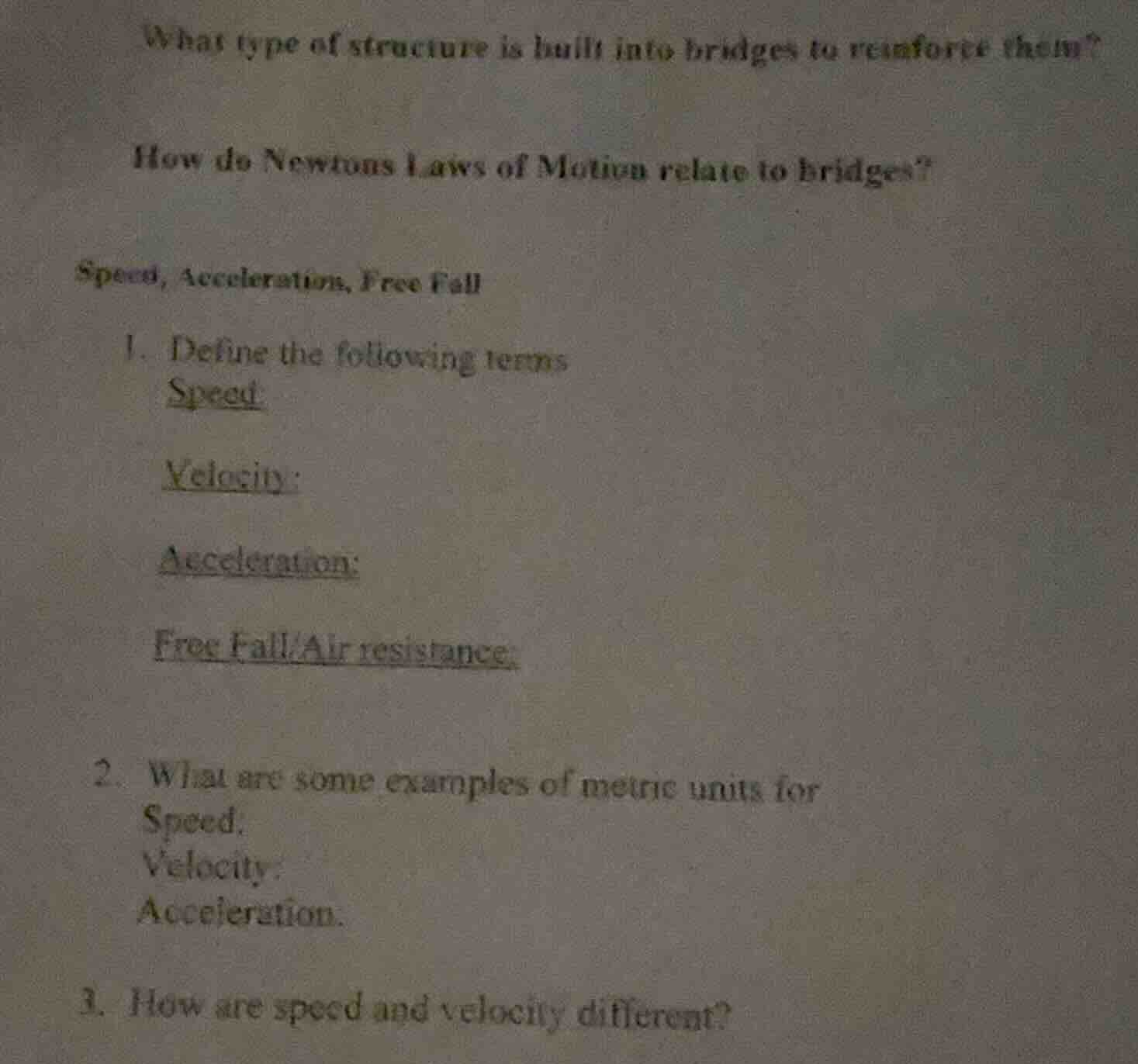
what type of structure is built into bridges to reinforce them?
how do newtons laws of motion relate to bridges?
speed, acceleration, free fall
- define the following terms
speed:
velocity:
acceleration:
free fall/air resistance:
- what are some examples of metric units for
speed:
velocity:
acceleration:
- how are speed and velocity different?
Brief Explanations
Bridge-related Questions:
- Reinforcing bridge structure: Trusses (grid-like frameworks of beams) distribute weight and tension/compression forces evenly to reinforce bridges.
- Newton's Laws & bridges:
- 1st Law: Bridges stay stable unless an external force (e.g., heavy traffic, wind) disrupts equilibrium.
- 2nd Law: Bridge supports must exert force equal to $F=ma$ to counteract the mass of traffic/structure and any acceleration from dynamic loads.
- 3rd Law: Compression (downward force on beams) creates an equal upward reaction force from bridge foundations.
Speed, Acceleration, Free Fall Section:
- Term Definitions:
- Speed: Measures distance covered over time, no direction.
- Velocity: Measures displacement over time, includes direction.
- Acceleration: Rate of change of velocity over time.
- Free Fall/Air resistance: Free fall is motion under gravity alone; air resistance is a drag force opposing this motion.
- Metric Units:
- Speed: Uses units of distance over time.
- Velocity: Same units as speed, plus direction.
- Acceleration: Uses units of velocity change over time.
- Speed vs. Velocity: Speed is a scalar (no direction), velocity is a vector (has direction).

Snap & solve any problem in the app
Get step-by-step solutions on Sovi AI
Photo-based solutions with guided steps
Explore more problems and detailed explanations
- Bridge reinforcement structure: Trusses (or load-bearing beam frameworks, arch structures, or cable-stay systems are also valid, trusses are the most common reinforcing structure)
- Newton's Laws relation to bridges:
- 1st Law: Bridges remain in static equilibrium until an external force (like traffic, wind) acts on them.
- 2nd Law: Supports exert force $F=ma$ to counteract the mass of the bridge/loads and dynamic accelerations.
- 3rd Law: Downward compression forces on bridge components create equal upward reaction forces from the ground/foundations.
---
Speed, Acceleration, Free Fall:
- Term Definitions:
- Speed: The rate of distance traveled over time
- Velocity: The rate of displacement traveled over time, with a defined direction
- Acceleration: The rate of change of velocity over time
- Free Fall/Air resistance: Free fall is motion where gravity is the only acting force; air resistance is a frictional force that opposes motion through air, reducing acceleration in non-vacuum free fall
- Metric Units:
- Speed: Meters per second ($\text{m/s}$), kilometers per hour ($\text{km/h}$)
- Velocity: Meters per second ($\text{m/s}$) [with direction, e.g., 10 $\text{m/s}$ east], kilometers per hour ($\text{km/h}$) [with direction]
- Acceleration: Meters per second squared ($\text{m/s}^2$)
- Speed and velocity difference: Speed is a scalar quantity (only has magnitude), while velocity is a vector quantity (has both magnitude and a specified direction)