QUESTION IMAGE
Question
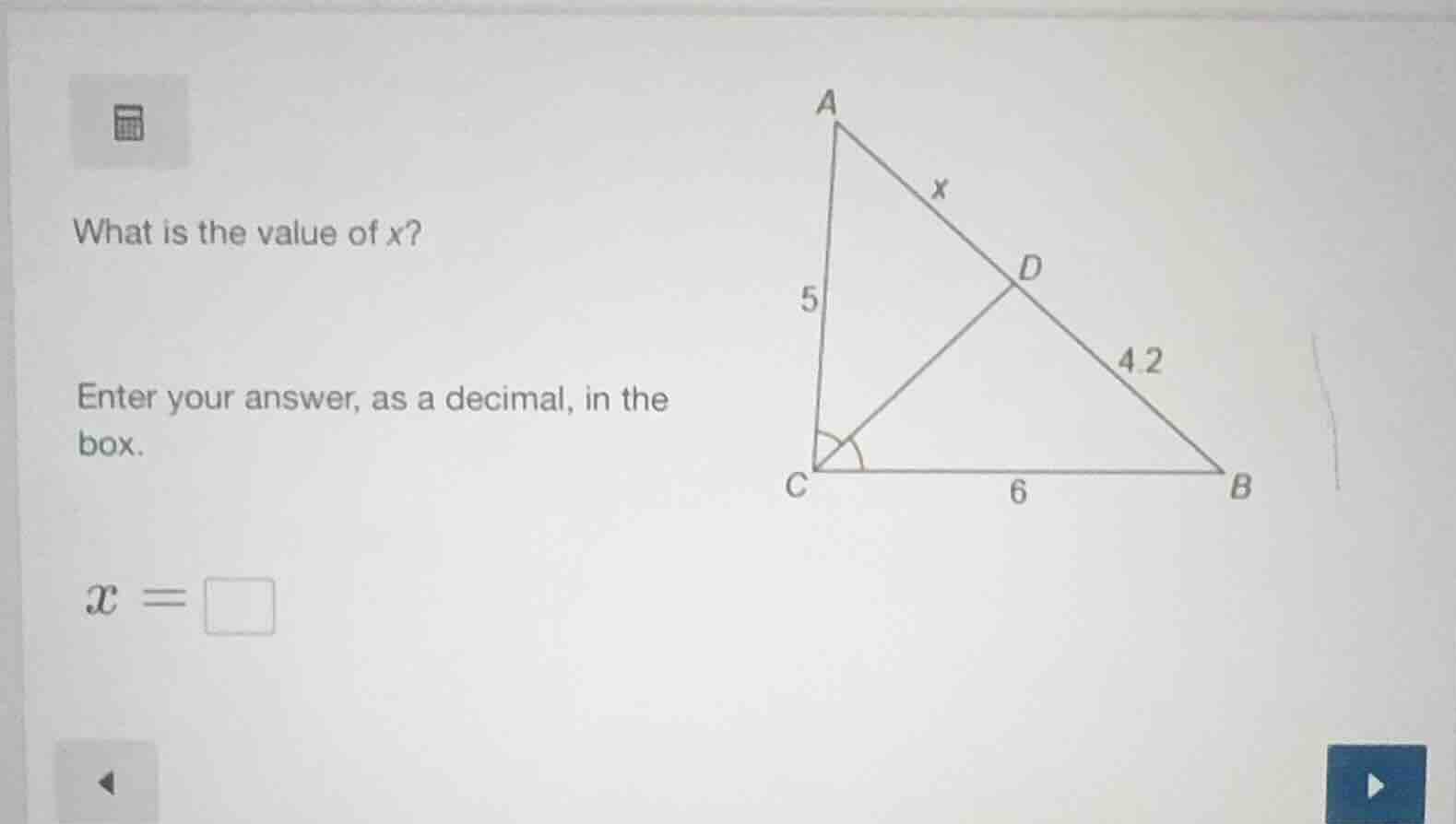
what is the value of x?
enter your answer, as a decimal, in the box.
x =
Step1: Identify similar triangles
We can see that \(\triangle ACD \sim \triangle ABC\) (by AA similarity, since \(\angle A\) is common and \(\angle ACD = \angle ABC\) as \(CD\) is an angle bisector or due to right angles, but here the key is the proportionality of sides). So, the ratio of corresponding sides is equal. That is, \(\frac{AC}{AB}=\frac{AD}{AC}\). Wait, actually, \(AB = AD + DB=x + 4.2\), \(AC = 5\), \(AD=x\), \(BC = 6\). Wait, maybe another approach: in similar triangles \(\triangle ACD\) and \(\triangle CBD\)? No, better to use the geometric mean theorem (altitude-on-hypotenuse theorem), but here \(CD\) is not an altitude, but the triangles \(\triangle ACD\) and \(\triangle ABC\) are similar. Wait, actually, the correct proportion is \(\frac{AC}{BC}=\frac{AD}{CD}\)? No, let's re - examine.
Wait, the correct similarity: \(\triangle ACD \sim \triangle ABC\) because \(\angle A=\angle A\) and \(\angle ACD=\angle B\) (since \(\angle ACB\) is split such that \(\angle ACD+\angle DCB = 90^{\circ}\) maybe? Wait, no, the diagram shows that \(CD\) is a line from \(C\) to \(AB\), and \(AC = 5\), \(BC = 6\), \(DB=4.2\), \(AD=x\).
By the theorem of similar triangles (if \(\triangle ACD\sim\triangle ABC\)), then \(\frac{AC}{AB}=\frac{AD}{AC}\), and also \(\frac{BC}{AB}=\frac{DB}{BC}\). Wait, let's use the second ratio: \(\frac{BC}{AB}=\frac{DB}{BC}\). Let \(AB=x + 4.2\), \(BC = 6\), \(DB = 4.2\). So, \(\frac{6}{x + 4.2}=\frac{4.2}{6}\). Cross - multiply: \(6\times6=4.2\times(x + 4.2)\). \(36=4.2x+17.64\). \(4.2x=36 - 17.64=18.36\). \(x=\frac{18.36}{4.2}\approx4.371\)? No, that's wrong. Wait, maybe the correct similarity is \(\triangle ACD\sim\triangle CBD\). Wait, no, let's use the ratio of sides in \(\triangle ACD\) and \(\triangle ABC\).
Wait, the correct proportion is \(\frac{AC}{BC}=\frac{AD}{CD}\)? No, let's use the formula for similar triangles: if \(\triangle ACD\sim\triangle ABC\), then \(\frac{AC}{AB}=\frac{AD}{AC}\), so \(AC^{2}=AD\times AB\). \(AC = 5\), \(AD=x\), \(AB=x + 4.2\). So, \(5^{2}=x(x + 4.2)\). \(25=x^{2}+4.2x\). \(x^{2}+4.2x - 25 = 0\). Using quadratic formula \(x=\frac{-4.2\pm\sqrt{4.2^{2}+100}}{2}=\frac{-4.2\pm\sqrt{17.64 + 100}}{2}=\frac{-4.2\pm\sqrt{117.64}}{2}=\frac{-4.2\pm10.846}{2}\). We take the positive root: \(x=\frac{-4.2 + 10.846}{2}=\frac{6.646}{2}=3.323\)? No, that's not right.
Wait, I made a mistake. The correct theorem is the angle - bisector theorem? No, the angle - bisector theorem states that \(\frac{AC}{BC}=\frac{AD}{DB}\). Yes! The angle - bisector theorem: if a line bisects an angle of a triangle, then it divides the opposite side into segments proportional to the adjacent sides. Here, \(CD\) bisects \(\angle ACB\), so \(\frac{AC}{BC}=\frac{AD}{DB}\). Given \(AC = 5\), \(BC = 6\), \(AD=x\), \(DB = 4.2\). So, \(\frac{5}{6}=\frac{x}{4.2}\).
Step2: Solve for \(x\)
Cross - multiply: \(6x=5\times4.2\). \(6x = 21\). Then \(x=\frac{21}{6}=3.5\).

Snap & solve any problem in the app
Get step-by-step solutions on Sovi AI
Photo-based solutions with guided steps
Explore more problems and detailed explanations
\(3.5\)