QUESTION IMAGE
Question
what is the value of z?
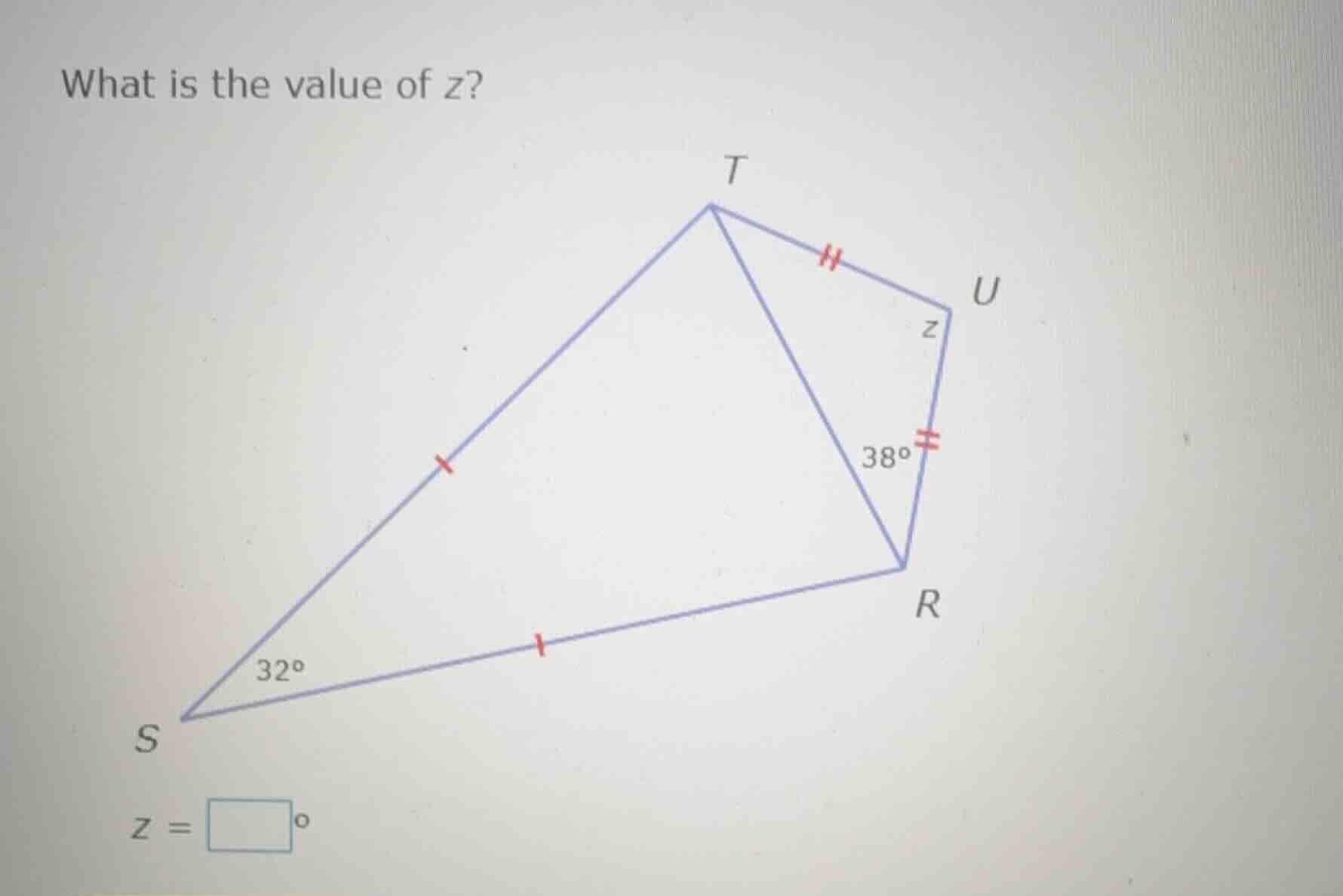
(there is a geometric figure with points s, t, r, u. triangle s t r has two equal sides (marked with red ticks) and angle at s is 32 degrees. triangle t r u has two equal sides (marked with red ticks) and angle at r is 38 degrees. we need to find the value of angle z at u.)
z = \square^\circ
Step1: Analyze triangle \( STR \)
In triangle \( STR \), \( ST = SR \) (marked with equal segments), so it is an isosceles triangle. The base angles are equal, but we know angle \( S = 32^\circ \). The sum of angles in a triangle is \( 180^\circ \), so the vertex angle \( \angle STR = 180^\circ - 2\times32^\circ = 116^\circ \)? Wait, no, wait. Wait, actually, in triangle \( STR \), sides \( ST \) and \( SR \) are equal, so angles opposite them (angles at \( R \) and \( T \))? Wait, no, angle at \( S \) is \( 32^\circ \), so the other two angles (at \( T \) and \( R \)): wait, no, \( ST = SR \), so angles at \( T \) and \( R \) (in triangle \( STR \))? Wait, no, the sides \( ST \) and \( SR \) are equal, so the base is \( TR \), so angles at \( T \) and \( R \) (angle \( \angle STR \) and \( \angle SRT \))? Wait, no, maybe I made a mistake. Wait, actually, let's look at triangle \( TRU \). Wait, \( TH = RU \)? Wait, no, the markings: \( TH \) and \( RU \) are marked equal? Wait, the diagram: \( T \) to \( H \) (on \( TU \)) and \( R \) to \( U \)? Wait, no, the red marks: \( TU \) has a mark at \( H \), and \( RU \) has two marks, and \( ST \) and \( SR \) have one mark each. Wait, maybe triangle \( TRU \) is isosceles with \( TH = RU \)? Wait, no, the key is: first, in triangle \( STR \), \( ST = SR \), so it's isosceles with \( \angle S = 32^\circ \), so the angle at \( T \) ( \( \angle STR \)) and angle at \( R \) ( \( \angle SRT \)): wait, no, \( ST = SR \), so the base is \( TR \), so the equal angles are at \( T \) and \( R \). Wait, sum of angles: \( \angle S + \angle STR + \angle SRT = 180^\circ \), and \( \angle STR = \angle SRT \) because \( ST = SR \). So \( 32^\circ + 2\angle STR = 180^\circ \), so \( 2\angle STR = 148^\circ \), so \( \angle STR = 74^\circ \). Wait, that's correct. So \( \angle STR = 74^\circ \).
Step2: Analyze triangle \( TRU \)
Now, triangle \( TRU \): \( TH = RU \) (marked) and \( TR \) is a common side? Wait, no, the markings: \( TU \) has a mark at \( H \), and \( RU \) has two marks, and \( ST \) and \( SR \) have one mark. Wait, maybe \( TR = TU \)? No, wait, the angle at \( R \) in triangle \( TRU \) is \( 38^\circ \). Wait, maybe triangle \( TRU \) is isosceles with \( TH = RU \), but actually, the key is that \( \angle TRU = 38^\circ \), and we need to find \( z \) (angle at \( U \)). Wait, but first, let's find angle \( \angle TRU \) in triangle \( STR \). Wait, no, maybe the triangles \( STR \) and \( TRU \) have some relation. Wait, alternatively, the sum of angles in a quadrilateral? No, it's two triangles. Wait, maybe the angle at \( T \) in triangle \( STR \) is \( 74^\circ \), so angle \( \angle TRU \) is related? Wait, no, let's start over.
Wait, in triangle \( STR \): \( ST = SR \), so it's isosceles with \( \angle S = 32^\circ \). Therefore, the base angles (at \( T \) and \( R \)): \( \angle STR = \angle SRT = \frac{180^\circ - 32^\circ}{2} = 74^\circ \). Now, looking at triangle \( TRU \): we have \( \angle TRU = 38^\circ \), and we need to find \( z = \angle U \). Wait, but what about the sides? \( TH = RU \) (marked) and \( TR \) is a side. Wait, maybe \( TR = TU \)? No, the markings: \( TU \) has one mark (at \( H \)) and \( RU \) has two marks. Wait, maybe triangle \( TRU \) is isosceles with \( TR = TU \)? No, the angle at \( R \) is \( 38^\circ \), so if \( TR = TU \), then angle at \( U \) would be equal to angle at \( R \), but that's not the case. Wait, maybe the key is that the sum of angles in triangle \( TRU \) is \( 180^\circ \), and we need to find the third angl…

Snap & solve any problem in the app
Get step-by-step solutions on Sovi AI
Photo-based solutions with guided steps
Explore more problems and detailed explanations
\( \boxed{68} \)