QUESTION IMAGE
Question
what is the value of v?
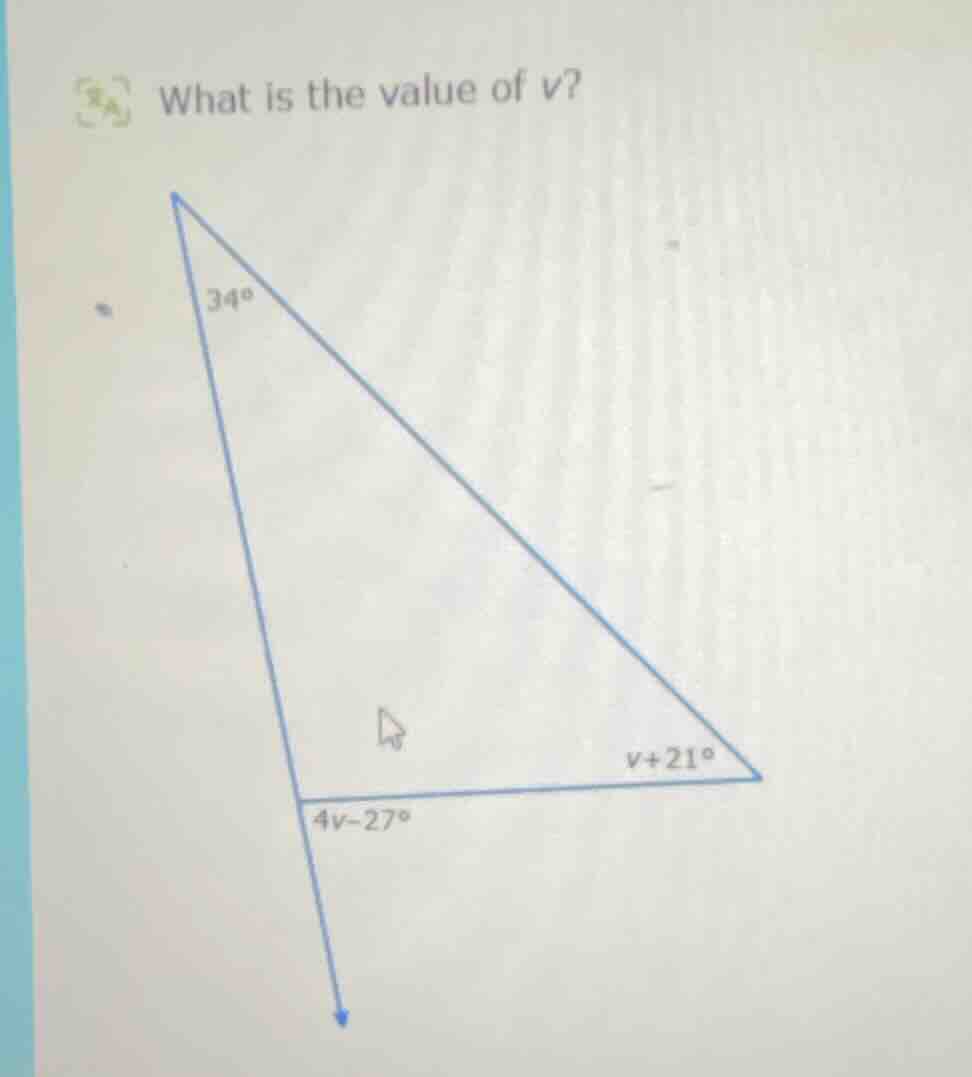
there is a triangle, with one angle being 34°, another angle being v + 21°, and an exterior angle at the third vertex being 4v - 27°.
Step1: Recall exterior angle theorem
The exterior angle of a triangle is equal to the sum of the two non - adjacent interior angles. So, \(4v - 27=34+(v + 21)\)
Step2: Simplify the right - hand side
Simplify \(34+(v + 21)\): \(34 + v+21=v + 55\). So the equation becomes \(4v-27=v + 55\)
Step3: Subtract v from both sides
Subtract \(v\) from both sides of the equation \(4v-27=v + 55\): \(4v-v-27=v - v+ 55\), which simplifies to \(3v-27 = 55\)
Step4: Add 27 to both sides
Add 27 to both sides of the equation \(3v-27 = 55\): \(3v-27 + 27=55 + 27\), so \(3v=82\)? Wait, no, 55 + 27 is 82? Wait, 34+21 is 55, correct. Wait, 4v-27=v + 55. Subtract v: 3v-27 = 55. Add 27: 3v=55 + 27=82? Wait, no, 55+27 is 82? Wait, 34 + 21 is 55, yes. Then 3v=82? No, wait, 4v-27=34 + v + 21. Let's re - do step 1. The exterior angle is equal to the sum of the two remote interior angles. So the exterior angle is \(4v - 27\), and the two remote interior angles are \(34^{\circ}\) and \(v + 21^{\circ}\). So \(4v-27=34+(v + 21)\). Combine like terms on the right: \(34+21=55\), so \(4v-27=v + 55\). Subtract \(v\) from both sides: \(3v-27 = 55\). Add 27 to both sides: \(3v=55 + 27=82\)? Wait, 55+27 is 82? Then \(v=\frac{82}{3}\)? No, that can't be. Wait, maybe I made a mistake. Wait, 34+(v + 21)=v+55. Then 4v-27 = v + 55. Subtract v: 3v=55 + 27=82. 82 divided by 3 is about 27.33? But that seems odd. Wait, maybe the triangle is a right triangle? Wait, no, the diagram shows a triangle with one exterior angle. Wait, maybe I misread the angle. Wait, maybe the exterior angle is equal to the sum of the two non - adjacent interior angles. Let me check again. The exterior angle theorem states that an exterior angle of a triangle is equal to the sum of the two opposite (non - adjacent) interior angles. So if the exterior angle is \(4v-27\), and the two non - adjacent interior angles are \(34^{\circ}\) and \(v + 21^{\circ}\), then \(4v-27=34+(v + 21)\). Let's solve again:
\(4v-27=v + 55\)
Subtract \(v\) from both sides: \(3v-27 = 55\)
Add 27 to both sides: \(3v=55 + 27=82\)
\(v=\frac{82}{3}\approx27.33\). But that seems non - integer. Wait, maybe the angle is \(4v + 27\) or another sign? Wait, maybe the exterior angle is supplementary to the adjacent interior angle? Wait, no, the exterior angle theorem is about the non - adjacent. Wait, maybe the triangle has a right angle? Wait, the diagram is not clear. Wait, maybe I made a mistake in the theorem. Wait, the exterior angle is equal to the sum of the two remote interior angles. So if the exterior angle is \(4v-27\), and the two remote angles are \(34\) and \(v + 21\), then the equation is correct. Let's check with \(v = 26\): \(4\times26-27=104 - 27 = 77\), and \(34+(26 + 21)=34 + 47=81\). Not equal. \(v = 27\): \(4\times27-27=108 - 27 = 81\), and \(34+(27 + 21)=34 + 48=82\). Close. \(v = 28\): \(4\times28-27=112 - 27 = 85\), \(34+(28 + 21)=34 + 49=83\). No. Wait, maybe the exterior angle is \(4v+27\)? Let's try. If \(4v + 27=34+(v + 21)\), then \(4v+27=v + 55\), \(3v=28\), \(v=\frac{28}{3}\approx9.33\). No. Wait, maybe the angle inside the triangle adjacent to the exterior angle is \(180-(4v - 27)=- 4v+207\). Then the sum of angles in a triangle is \(180\), so \(34+(v + 21)+(-4v + 207)=180\). Let's solve that: \(34+v + 21-4v + 207=180\), combine like terms: \((34 + 21+207)+(v-4v)=180\), \(262-3v = 180\), \(-3v=180 - 262=-82\), \(v=\frac{82}{3}\approx27.33\). So that's the same as before. So maybe the answer is \(v=\frac{82}{3}\) or approximately 27.33. But maybe I misread the problem. Wait, the original problem:…

Snap & solve any problem in the app
Get step-by-step solutions on Sovi AI
Photo-based solutions with guided steps
Explore more problems and detailed explanations
\(v=\frac{82}{3}\) (or approximately \(27.33\))