QUESTION IMAGE
Question
what are the values of a and b?
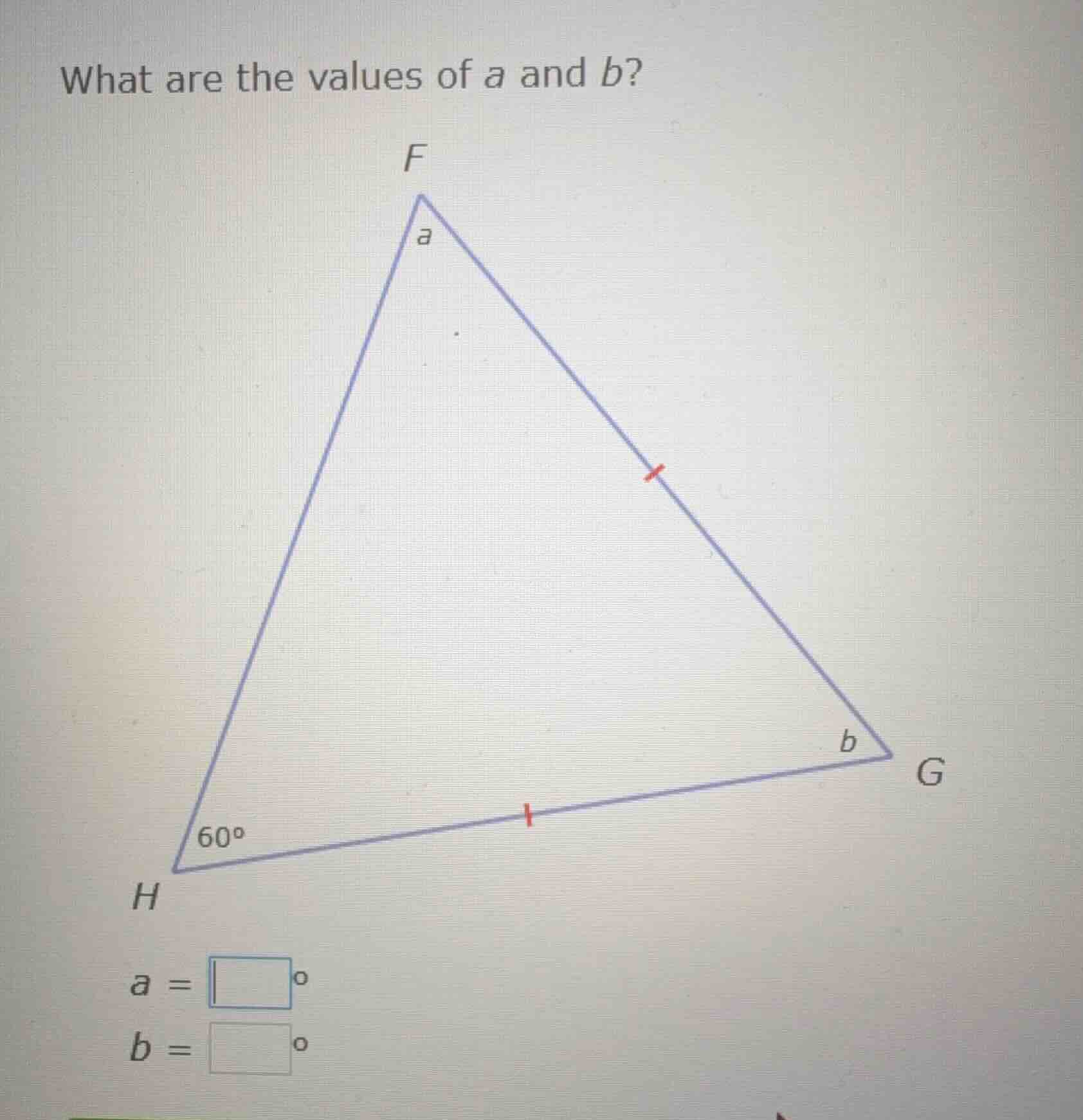
triangle fhg with h at the bottom left, f at the top, g at the bottom right. angle at h is 60 degrees. sides fh and fg have one tick mark each, side hg has one tick mark. angle at f is a, angle at g is b.
a = °
b = °
Step1: Identify the triangle type
The triangle \( \triangle FHG \) has two equal sides (marked with red ticks), so it is an isosceles triangle. In an isosceles triangle, the angles opposite the equal sides are equal. So \( \angle H = \angle F \) or \( \angle H = \angle G \)? Wait, the equal sides are \( FG \) and \( HG \)? Wait, no, the marks: one on \( FG \) and one on \( HG \)? Wait, looking at the diagram, side \( FG \) and side \( HG \)? Wait, no, the marks: \( HG \) has a tick, \( FG \) has a tick. Wait, \( H \) is at the bottom left, \( G \) at bottom right, \( F \) at top. So sides \( FH \) and \( FG \)? Wait, no, the ticks: one on \( FG \) (the right side) and one on \( HG \) (the bottom side). Wait, no, the diagram: \( H \) to \( G \) is the bottom side, with a tick, and \( F \) to \( G \) is the right side, with a tick. So \( HG = FG \), so the angles opposite them: angle at \( F \) (angle \( a \)) and angle at \( H \) (60°) are opposite \( HG \) and \( FG \) respectively? Wait, no, in a triangle, the angle opposite a side: side \( HG \) is opposite angle \( F \) (angle \( a \)), side \( FG \) is opposite angle \( H \) (60°). Since \( HG = FG \), then angle \( a = \) angle \( H = 60° \)? Wait, no, wait, maybe I got the sides wrong. Wait, the two equal sides: let's see, the ticks are on \( HG \) (bottom) and \( FG \) (right). So \( HG = FG \), so triangle is isosceles with \( HG = FG \), so angles opposite: angle \( F \) (angle \( a \)) is opposite \( HG \), angle \( H \) (60°) is opposite \( FG \). So angle \( a = \) angle \( H = 60° \). Then, since it's a triangle, sum of angles is 180°. So angle \( a + \) angle \( H + \) angle \( b = 180° \). Wait, but if \( HG = FG \), then angles opposite are equal: angle \( F \) (a) and angle \( H \) (60°) are equal? Wait, no, maybe the equal sides are \( FH \) and \( FG \). Wait, maybe I misread the ticks. Let me re-examine: the diagram has a tick on \( FG \) (right side) and a tick on \( HG \) (bottom side). Wait, no, maybe the two equal sides are \( FH \) and \( FG \)? No, the ticks are on \( HG \) (from \( H \) to midpoint?) No, the ticks are on the sides, meaning the sides are equal. So \( HG = FG \), so triangle \( FHG \) has \( HG = FG \), so it's isosceles with \( HG = FG \), so angles at \( F \) and \( H \) are equal? Wait, no, angle at \( F \) is opposite \( HG \), angle at \( H \) is opposite \( FG \). So if \( HG = FG \), then angle \( F = \) angle \( H \). So angle \( a = 60° \). Then, angle \( b = 180° - 60° - 60° = 60° \)? Wait, but that would make it equilateral. Wait, maybe the two equal sides are \( FH \) and \( HG \). Wait, maybe I made a mistake. Wait, the angle at \( H \) is 60°, and if two sides are equal, and one angle is 60°, then it's equilateral. Wait, let's think again. If a triangle has two equal sides and one angle 60°, then it's equilateral. So if angle \( H \) is 60°, and the triangle is isosceles (two equal sides), then all angles are 60°, so it's equilateral. So angle \( a = 60° \), angle \( b = 60° \). Wait, but let's check the sum: 60 + 60 + 60 = 180, which works. Alternatively, maybe the equal sides are \( FH \) and \( FG \), so angle at \( G \) (angle \( b \)) is equal to angle at \( H \) (60°). Then angle \( a = 180 - 60 - 60 = 60° \). Either way, if it's isosceles with one angle 60°, it's equilateral. So all angles are 60°.
Step2: Calculate angle \( a \) and \( b \)
Since the triangle has two equal sides (isosceles) and one angle 60°, it is equilateral, so all angles are 60°. Therefore, \( a = 60° \) and \( b = 60° \). Wait, but let's confi…

Snap & solve any problem in the app
Get step-by-step solutions on Sovi AI
Photo-based solutions with guided steps
Explore more problems and detailed explanations
\( a = 60^\circ \), \( b = 60^\circ \)