QUESTION IMAGE
Question
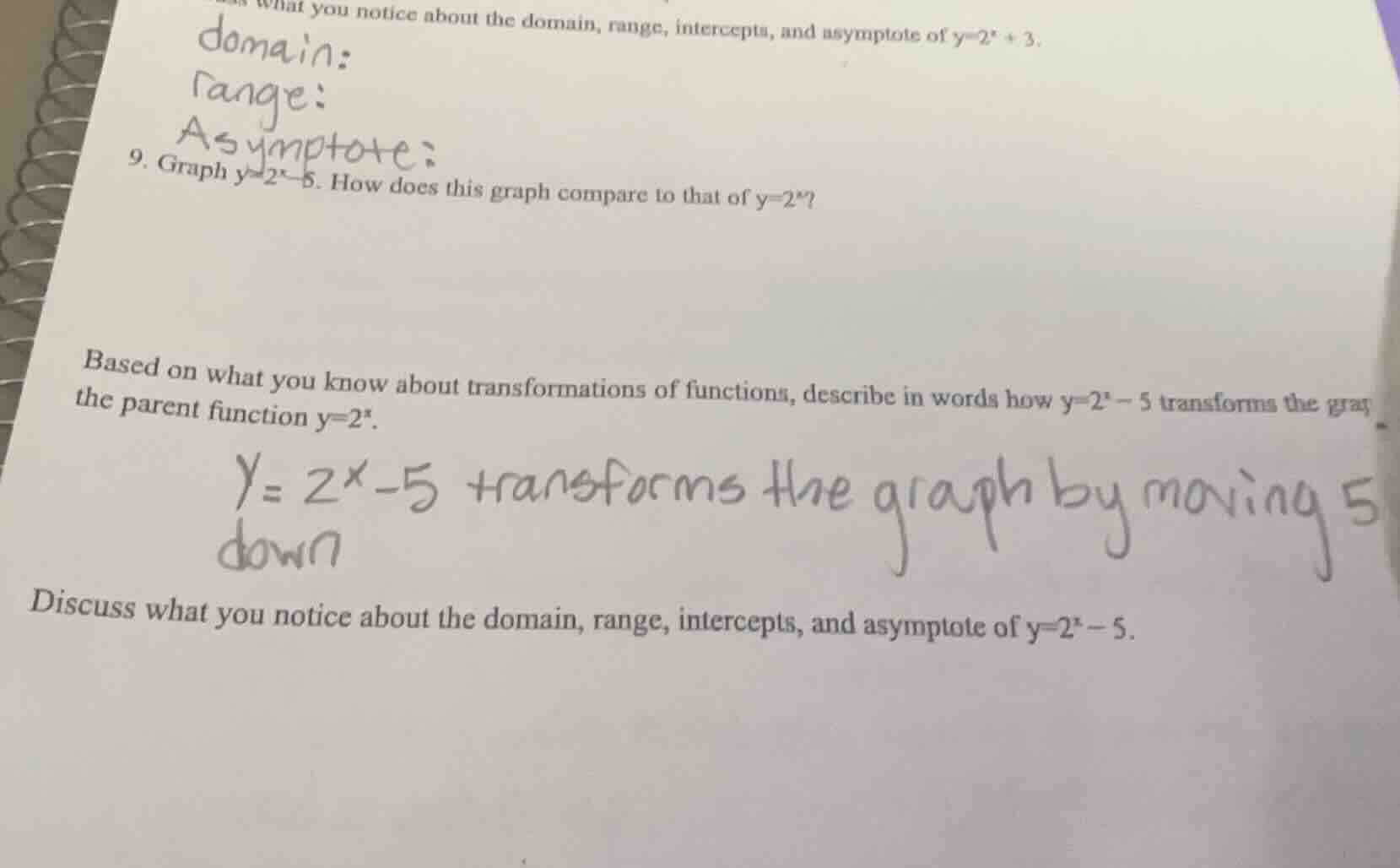
what you notice about the domain, range, intercepts, and asymptote of $y=2^x + 3$.domain:range:asymptote:9. graph $y=2^x - 5$. how does this graph compare to that of $y=2^x$?based on what you know about transformations of functions, describe in words how $y=2^x - 5$ transforms the graph of the parent function $y=2^x$.$y= 2^x -5$ transforms the graph by moving 5 downdiscuss what you notice about the domain, range, intercepts, and asymptote of $y=2^x - 5$.
Step1: Find domain of $y=2^x -5$
Exponential functions accept all real $x$.
Domain: $(-\infty, \infty)$
Step2: Find range of $y=2^x -5$
For $y=2^x$, range is $(0, \infty)$. Subtract 5:
Range: $(-5, \infty)$
Step3: Find x-intercept
Set $y=0$, solve for $x$:
$0=2^x -5 \implies 2^x=5 \implies x=\log_2 5$
Step4: Find y-intercept
Set $x=0$, solve for $y$:
$y=2^0 -5=1-5=-4$
Step5: Find horizontal asymptote
As $x\to-\infty$, $2^x\to0$, so $y\to0-5=-5$.
Asymptote: $y=-5$

Snap & solve any problem in the app
Get step-by-step solutions on Sovi AI
Photo-based solutions with guided steps
Explore more problems and detailed explanations
- Domain: All real numbers, or $(-\infty, \infty)$
- Range: All real numbers greater than -5, or $(-5, \infty)$
- Intercepts: x-intercept at $(\log_2 5, 0)$, y-intercept at $(0, -4)$
- Asymptote: Horizontal asymptote at $y=-5$