QUESTION IMAGE
Question
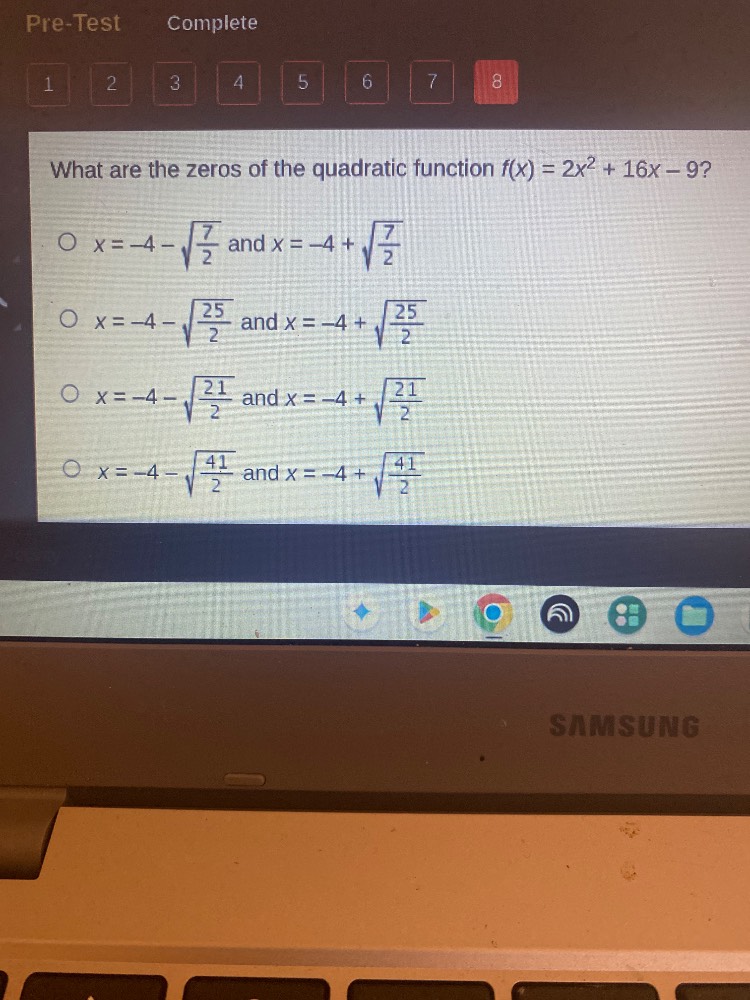
what are the zeros of the quadratic function $f(x) = 2x^2 + 16x - 9$?
\\(\circ\\) $x = -4 - \sqrt{\frac{7}{2}}$ and $x = -4 + \sqrt{\frac{7}{2}}$
\\(\circ\\) $x = -4 - \sqrt{\frac{25}{2}}$ and $x = -4 + \sqrt{\frac{25}{2}}$
\\(\circ\\) $x = -4 - \sqrt{\frac{21}{2}}$ and $x = -4 + \sqrt{\frac{21}{2}}$
\\(\circ\\) $x = -4 - \sqrt{\frac{41}{2}}$ and $x = -4 + \sqrt{\frac{41}{2}}$
Step1: Recall the quadratic formula
The quadratic formula for a quadratic equation \(ax^2 + bx + c = 0\) is \(x=\frac{-b\pm\sqrt{b^2 - 4ac}}{2a}\). For the function \(f(x)=2x^2 + 16x - 9\), we have \(a = 2\), \(b = 16\), and \(c=-9\).
Step2: Calculate the discriminant \(\Delta=b^2 - 4ac\)
Substitute the values of \(a\), \(b\), and \(c\) into the discriminant formula:
\[
\]
Step3: Simplify the square - root of the discriminant
We know that \(x=\frac{-b\pm\sqrt{\Delta}}{2a}\), first simplify \(\sqrt{\Delta}=\sqrt{328}\). We can factor \(328 = 4\times82=4\times2\times41\), so \(\sqrt{328}=\sqrt{4\times82}=2\sqrt{82}\)? Wait, no, wait, let's recalculate the discriminant. Wait, \(a = 2\), \(b = 16\), \(c=-9\). Then \(b^{2}-4ac=16^{2}-4\times2\times(-9)=256 + 72 = 328\)? Wait, no, 42(-9)=-72, so - 4ac=-42(-9)=72. So 256 + 72 = 328. But 328=482=42*41, so \(\sqrt{328}=2\sqrt{82}\)? Wait, no, maybe I made a mistake. Wait, let's use the method of completing the square.
Starting with \(f(x)=2x^{2}+16x - 9=0\), divide both sides by 2: \(x^{2}+8x-\frac{9}{2}=0\).
Complete the square: \(x^{2}+8x + 16=\frac{9}{2}+16\).
\((x + 4)^{2}=\frac{9 + 32}{2}=\frac{41}{2}\times2\)? Wait, \(\frac{9}{2}+16=\frac{9 + 32}{2}=\frac{41}{2}\)? Wait, no, 16=\frac{32}{2}, so \(\frac{9}{2}+\frac{32}{2}=\frac{41}{2}\). So \((x + 4)^{2}=\frac{41}{2}\). Then take the square root of both sides: \(x + 4=\pm\sqrt{\frac{41}{2}}\), so \(x=-4\pm\sqrt{\frac{41}{2}}\).
Wait, let's go back to the quadratic formula. \(x=\frac{-b\pm\sqrt{b^{2}-4ac}}{2a}=\frac{-16\pm\sqrt{256+72}}{4}=\frac{-16\pm\sqrt{328}}{4}\). Simplify \(\sqrt{328}=\sqrt{4\times82}=2\sqrt{82}\)? No, 328 = 4×82=4×2×41, so \(\sqrt{328}=2\sqrt{82}\), then \(\frac{-16\pm2\sqrt{82}}{4}=\frac{-8\pm\sqrt{82}}{2}\). Wait, this is different from the previous result. Wait, I see my mistake in completing the square. Let's do it again.
\(2x^{2}+16x-9 = 0\)
\(2x^{2}+16x=9\)
\(x^{2}+8x=\frac{9}{2}\)
\(x^{2}+8x + 16=\frac{9}{2}+16\)
\((x + 4)^{2}=\frac{9+32}{2}=\frac{41}{2}\)
Ah! Here we go. So \((x + 4)^{2}=\frac{41}{2}\), then \(x + 4=\pm\sqrt{\frac{41}{2}}\), so \(x=-4\pm\sqrt{\frac{41}{2}}\). So the zeros are \(x=-4-\sqrt{\frac{41}{2}}\) and \(x=-4+\sqrt{\frac{41}{2}}\)

Snap & solve any problem in the app
Get step-by-step solutions on Sovi AI
Photo-based solutions with guided steps
Explore more problems and detailed explanations
\(x=-4-\sqrt{\frac{41}{2}}\) and \(x=-4+\sqrt{\frac{41}{2}}\) (the last option: \(x=-4-\sqrt{\frac{41}{2}}\) and \(x=-4+\sqrt{\frac{41}{2}}\))