QUESTION IMAGE
Question
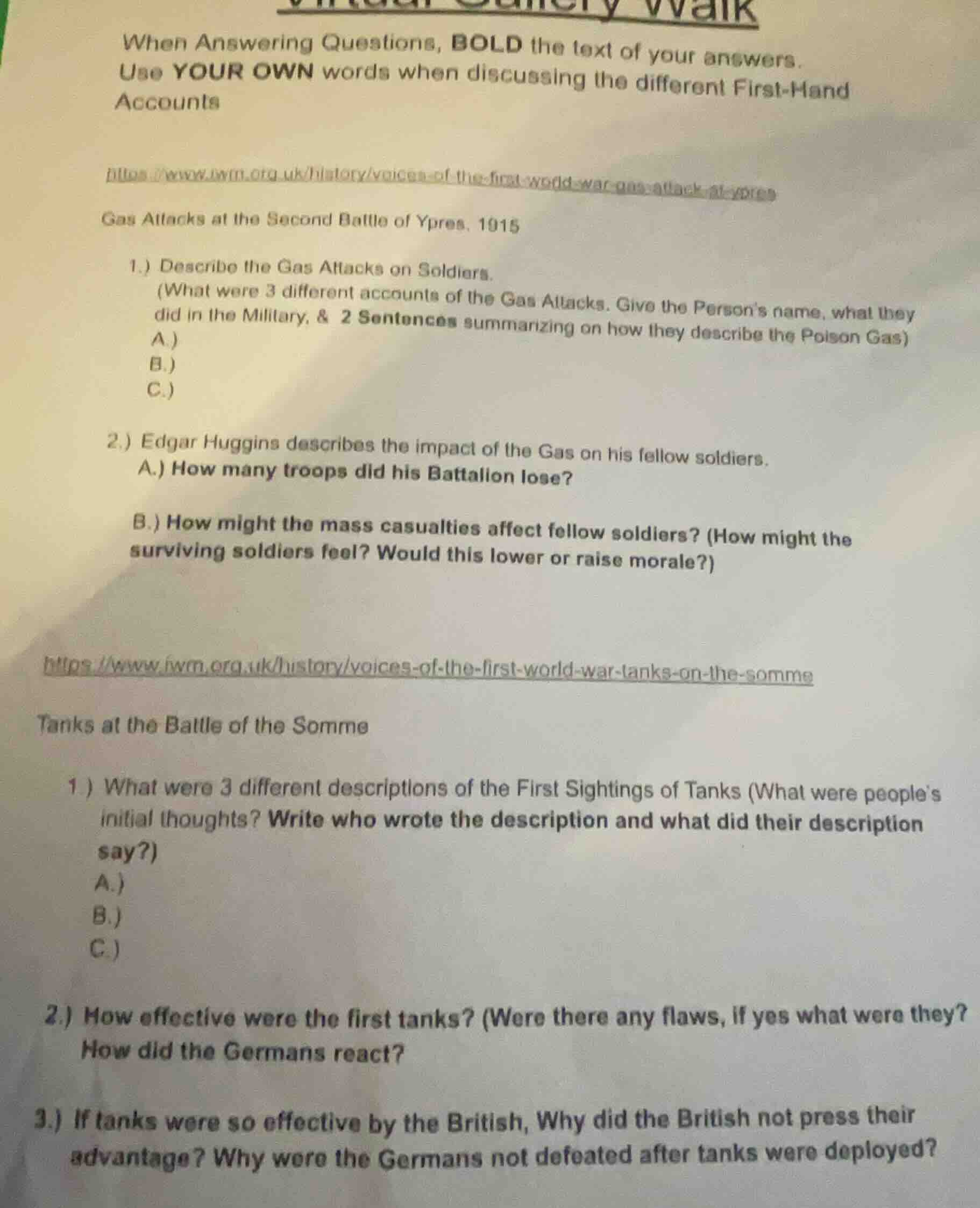
when answering questions, bold the text of your answers. use your own words when discussing the different first-hand accounts
https://www.iwm.org.uk/history/voices-of-the-first-world-war-gas-attack-at-ypres
gas attacks at the second battle of ypres, 1915
1.) describe the gas attacks on soldiers. (what were 3 different accounts of the gas attacks. give the person’s name, what they did in the military, & 2 sentences summarizing on how they describe the poison gas)
a.)
b.)
c.)
2.) edgar huggins describes the impact of the gas on his fellow soldiers.
a.) how many troops did his battalion lose?
b.) how might the mass casualties affect fellow soldiers? (how might the surviving soldiers feel? would this lower or raise morale?)
https://www.iwm.org.uk/history/voices-of-the-first-world-war-tanks-on-the-somme
tanks at the battle of the somme
1.) what were 3 different descriptions of the first sightings of tanks (what were people’s initial thoughts? write who wrote the description and what did their description say?)
a.)
b.)
c.)
2.) how effective were the first tanks? (were there any flaws, if yes what were they? how did the germans react?
3.) if tanks were so effective by the british, why did the british not press their advantage? why were the germans not defeated after tanks were deployed?
To answer these questions, you'll need to access the provided links (from the Imperial War Museum website) to gather information from the first - hand accounts. Here's a guide on how to tackle each part:
Part 1: Gas Attacks at the Second Battle of Ypres, 1915
Question 1: Describe the Gas Attacks on Soldiers
- Step 1: Access the link
Go to https://www.iwm.org.uk/history/voices - of - the - first - world - war - gas - attack - at - ypres.
- Step 2: Identify 3 first - hand accounts
Look for different soldiers' or military personnel's accounts. For each account:
- Note the person's name and their military role (e.g., private, officer, etc.).
- Summarize in 2 sentences how they describe the poison gas. For example, they might talk about the color, smell, how it affected their breathing, or the chaos it caused.
Question 2: Edgar Huggins describes the impact of the Gas on his fellow soldiers
- Sub - question A: How many troops did his Battalion lose?
Find Edgar Huggins' account on the gas attack page. Look for the specific number of troops his battalion lost.
- Sub - question B: How might the mass casualties affect fellow soldiers?
Think about the psychological and practical impact. Surviving soldiers might feel grief for their fallen comrades, fear for their own lives, and a sense of helplessness. Mass casualties could lower morale as soldiers see the high cost of the attack and worry about their own survival.
Part 2: Tanks at the Battle of the Somme
Question 1: What were 3 different descriptions of the First Sightings of Tanks
- Step 1: Access the link
Go to https://www.iwm.org.uk/history/voices - of - the - first - world - war - tanks - on - the - somme.
- Step 2: Identify 3 first - hand accounts
For each account:
- Note the author's name and their description of the initial sight of tanks. They might talk about the appearance of the tanks (e.g., like a strange metal monster), their movement, or how it made them feel (e.g., hopeful, confused).
Question 2: How effective were the first tanks? (Were there any flaws, If yes what were they? How did the Germans react?)
- Effectiveness: Look for how the tanks performed in battle. Did they break through enemy lines, cause panic among the enemy, or help in advancing?
- Flaws: Check if the accounts mention problems like mechanical breakdowns, slow speed, or vulnerability to certain weapons.
- German reaction: Find out if the Germans were surprised, how they tried to counter the tanks (e.g., with anti - tank weapons, changing their tactics), or if they retreated.
Question 3: If tanks were so effective by the British, Why did the British not press their advantage? Why were the Germans not defeated after tanks were deployed?
- British not pressing advantage: Consider factors like the number of tanks (maybe there were too few), mechanical issues (tanks breaking down), lack of follow - up infantry, or strategic mistakes.
- Germans not defeated: Think about the Germans' ability to adapt (e.g., developing counter - measures), the overall scale of the war (other fronts, resources), and the fact that the tank technology was still in its early stages with limitations.
Since these questions require accessing external sources (the IWM website) for specific historical data, you'll need to visit the links and extract the relevant information to provide complete answers.

Snap & solve any problem in the app
Get step-by-step solutions on Sovi AI
Photo-based solutions with guided steps
Explore more problems and detailed explanations
To answer these questions, you'll need to access the provided links (from the Imperial War Museum website) to gather information from the first - hand accounts. Here's a guide on how to tackle each part:
Part 1: Gas Attacks at the Second Battle of Ypres, 1915
Question 1: Describe the Gas Attacks on Soldiers
- Step 1: Access the link
Go to https://www.iwm.org.uk/history/voices - of - the - first - world - war - gas - attack - at - ypres.
- Step 2: Identify 3 first - hand accounts
Look for different soldiers' or military personnel's accounts. For each account:
- Note the person's name and their military role (e.g., private, officer, etc.).
- Summarize in 2 sentences how they describe the poison gas. For example, they might talk about the color, smell, how it affected their breathing, or the chaos it caused.
Question 2: Edgar Huggins describes the impact of the Gas on his fellow soldiers
- Sub - question A: How many troops did his Battalion lose?
Find Edgar Huggins' account on the gas attack page. Look for the specific number of troops his battalion lost.
- Sub - question B: How might the mass casualties affect fellow soldiers?
Think about the psychological and practical impact. Surviving soldiers might feel grief for their fallen comrades, fear for their own lives, and a sense of helplessness. Mass casualties could lower morale as soldiers see the high cost of the attack and worry about their own survival.
Part 2: Tanks at the Battle of the Somme
Question 1: What were 3 different descriptions of the First Sightings of Tanks
- Step 1: Access the link
Go to https://www.iwm.org.uk/history/voices - of - the - first - world - war - tanks - on - the - somme.
- Step 2: Identify 3 first - hand accounts
For each account:
- Note the author's name and their description of the initial sight of tanks. They might talk about the appearance of the tanks (e.g., like a strange metal monster), their movement, or how it made them feel (e.g., hopeful, confused).
Question 2: How effective were the first tanks? (Were there any flaws, If yes what were they? How did the Germans react?)
- Effectiveness: Look for how the tanks performed in battle. Did they break through enemy lines, cause panic among the enemy, or help in advancing?
- Flaws: Check if the accounts mention problems like mechanical breakdowns, slow speed, or vulnerability to certain weapons.
- German reaction: Find out if the Germans were surprised, how they tried to counter the tanks (e.g., with anti - tank weapons, changing their tactics), or if they retreated.
Question 3: If tanks were so effective by the British, Why did the British not press their advantage? Why were the Germans not defeated after tanks were deployed?
- British not pressing advantage: Consider factors like the number of tanks (maybe there were too few), mechanical issues (tanks breaking down), lack of follow - up infantry, or strategic mistakes.
- Germans not defeated: Think about the Germans' ability to adapt (e.g., developing counter - measures), the overall scale of the war (other fronts, resources), and the fact that the tank technology was still in its early stages with limitations.
Since these questions require accessing external sources (the IWM website) for specific historical data, you'll need to visit the links and extract the relevant information to provide complete answers.