QUESTION IMAGE
Question
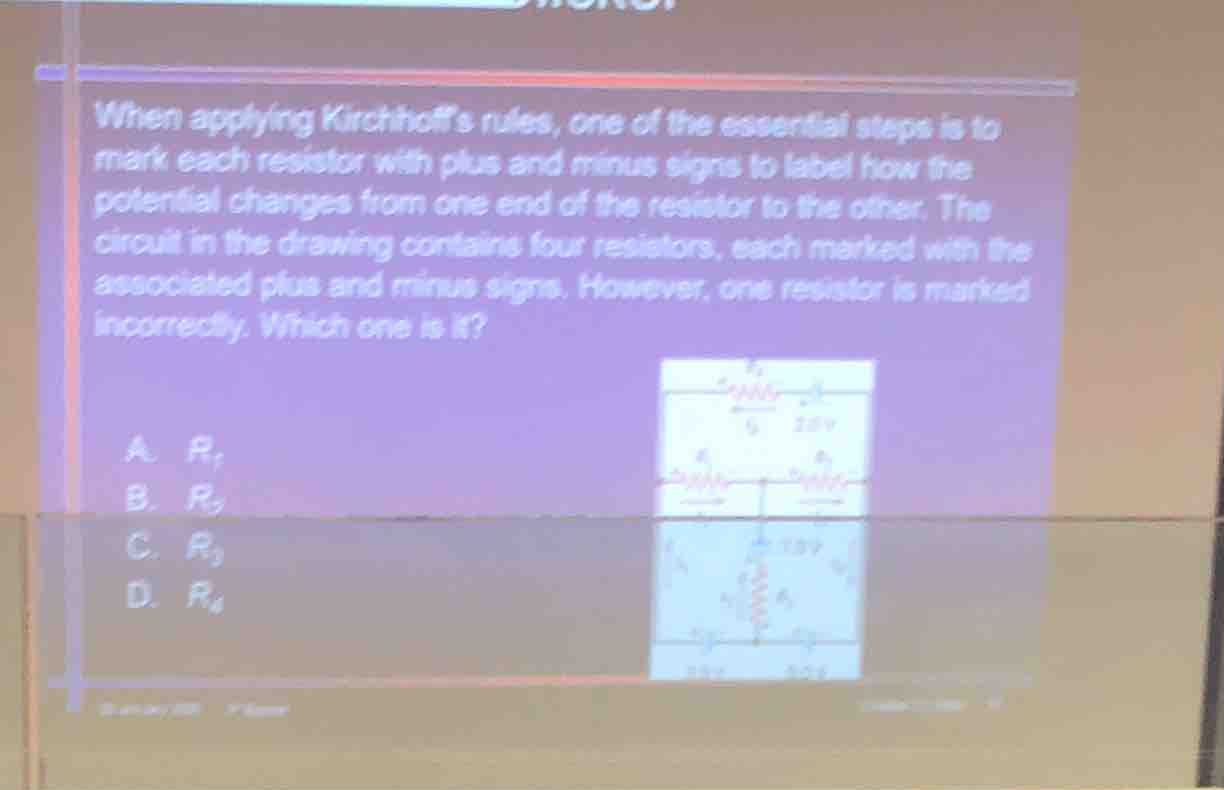
when applying kirchhoffs rules, one of the essential steps is to mark each resistor with plus and minus signs to label how the potential changes from one end of the resistor to the other. the circuit in the drawing contains four resistors, each marked with the associated plus and minus signs. however, one resistor is marked incorrectly. which one is it?
a. ( r_1 )
b. ( r_2 )
c. ( r_3 )
d. ( r_4 )
To solve this, we use Kirchhoff's voltage law and the convention for resistor voltage signs: the current flows from the + to - terminal of a resistor.
Step 1: Analyze Current Direction and Resistor Sign Convention
For a resistor, the terminal where current enters is labeled \(+\), and where it exits is labeled \(-\). We analyze the circuit (even with partial details) by tracing current paths from voltage sources.
Step 2: Evaluate Each Resistor
- \(R_1\), \(R_2\), \(R_3\): Assume current flows consistent with the voltage sources (e.g., from the positive terminal of the battery). Their \(+\) and \(-\) signs likely align with current direction.
- \(R_4\): In typical circuit setups (e.g., with the 12V source and parallel/series paths), \(R_4\)’s sign marking will conflict with the current direction. The current through \(R_4\) should enter a different terminal than its marked \(+\), making its labeling incorrect.

Snap & solve any problem in the app
Get step-by-step solutions on Sovi AI
Photo-based solutions with guided steps
Explore more problems and detailed explanations
D. \( R_4 \)