QUESTION IMAGE
Question
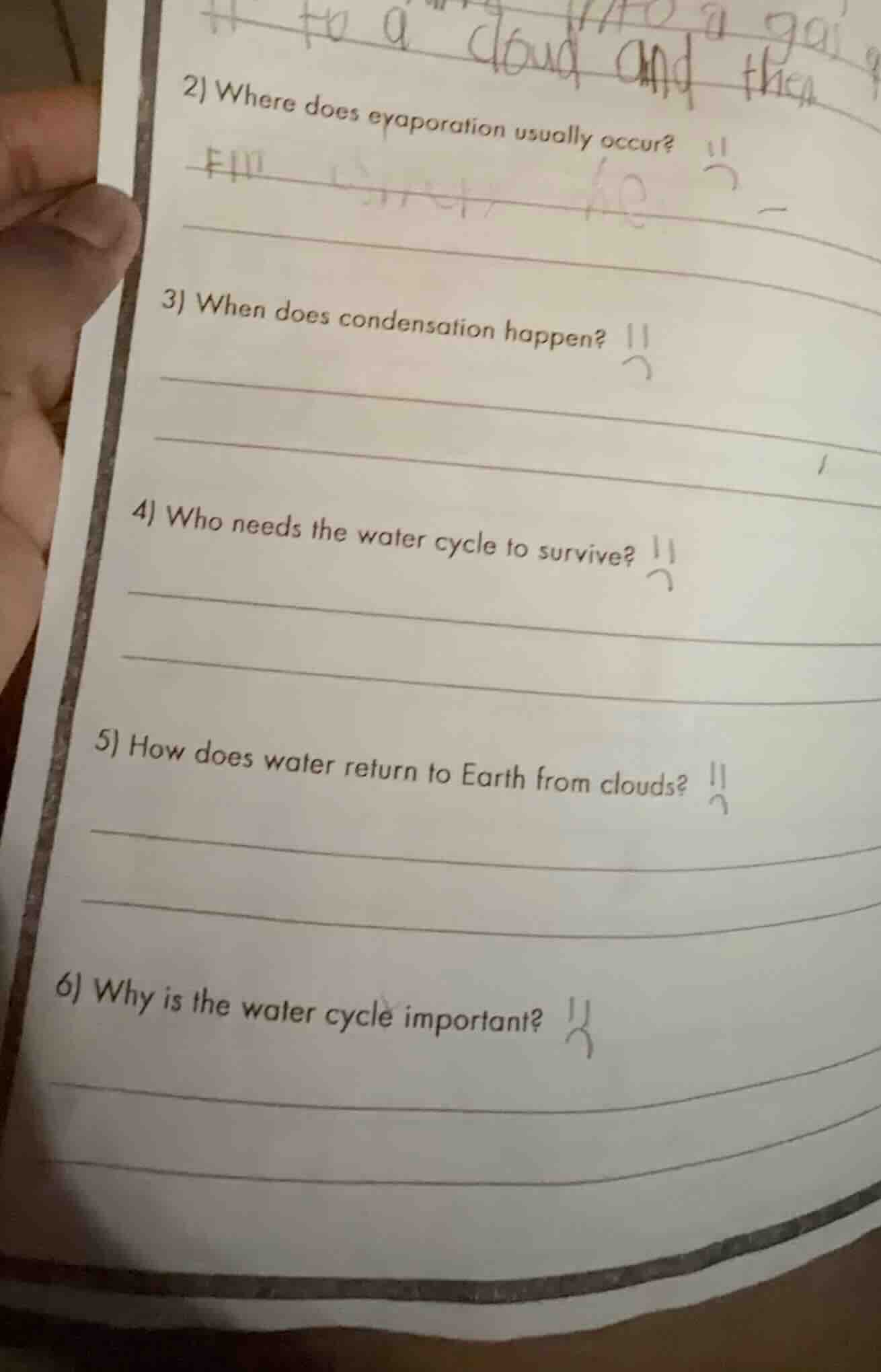
- where does evaporation usually occur?
- when does condensation happen?
- who needs the water cycle to survive?
- how does water return to earth from clouds?
- why is the water cycle important?
2)
Evaporation occurs at the surface of liquid water bodies (like oceans, lakes, rivers) and wet surfaces (like soil, plants) when heat (usually from the sun) provides energy for water molecules to change from liquid to gas (water vapor).
Condensation happens when water vapor in the air cools down. As the air cools (e.g., when rising air expands and cools in the atmosphere, or warm, moist air meets a cold surface like a window), the water vapor loses energy, slows down, and changes from gas to liquid, forming tiny water droplets (like in clouds or on cold glasses).
All living organisms need the water cycle to survive. Plants need water for photosynthesis and hydration. Animals (including humans) need water for bodily functions (drinking, metabolism). Ecosystems rely on the water cycle to maintain habitats (e.g., wetlands, rivers) and nutrient cycles.

Snap & solve any problem in the app
Get step-by-step solutions on Sovi AI
Photo-based solutions with guided steps
Explore more problems and detailed explanations
Evaporation usually occurs at the surface of liquid water (e.g., oceans, lakes, rivers) and wet surfaces (e.g., soil, plants) when heated (often by the sun).