QUESTION IMAGE
Question
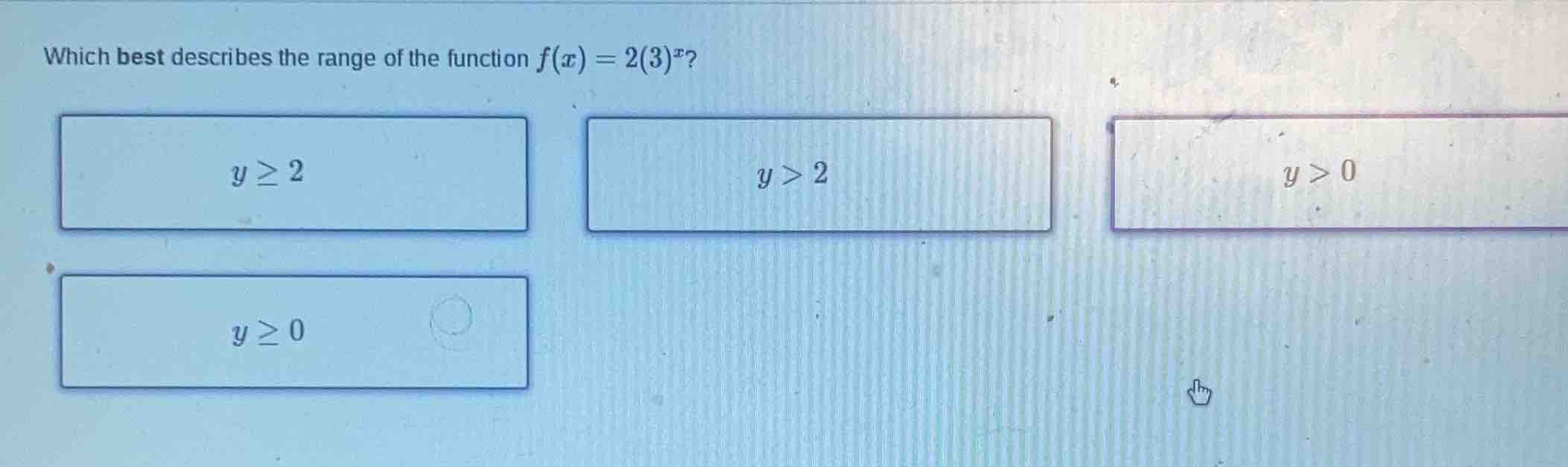
which best describes the range of the function $f(x) = 2(3)^x$? $y \geq 2$ $y > 2$ $y > 0$ $y \geq 0$
Step1: Analyze the exponential function \(3^x\)
The exponential function \(y = 3^x\) has a range of \(y>0\) because for any real number \(x\), \(3^x\) is always positive. When \(x = 0\), \(3^0=1\); as \(x\) approaches \(-\infty\), \(3^x\) approaches \(0\) but never reaches \(0\); as \(x\) approaches \(+\infty\), \(3^x\) approaches \(+\infty\).
Step2: Analyze the function \(f(x)=2(3)^x\)
We multiply the function \(3^x\) by \(2\). Multiplying a positive number (since \(3^x>0\)) by \(2\) will still result in a positive number. So \(f(x)=2(3)^x>0\) for all real \(x\). When \(x = 0\), \(f(0)=2(3)^0 = 2\), so the function can take the value \(2\) and all values greater than \(0\) (since as \(x\) decreases, \(f(x)\) approaches \(0\) but never reaches \(0\), and as \(x\) increases, \(f(x)\) increases without bound). Wait, no, actually, let's re - examine. The range of \(3^x\) is \(y>0\). So when we multiply by \(2\), the range of \(2\times3^x\) is \(y = 2\times3^x>0\) (because if \(3^x>0\), then \(2\times3^x>0\)). But when \(x = 0\), \(y = 2\), and as \(x\) becomes negative, \(3^x=\frac{1}{3^{\vert x\vert}}\), so \(2\times3^x=\frac{2}{3^{\vert x\vert}}\), which approaches \(0\) as \(\vert x\vert\) increases. So the range is \(y>0\)? Wait, no, when \(x = 0\), \(y = 2\), and for \(x>0\), \(y>2\), for \(x<0\), \(0

Snap & solve any problem in the app
Get step-by-step solutions on Sovi AI
Photo-based solutions with guided steps
Explore more problems and detailed explanations
\(y > 0\) (the option with \(y>0\))