QUESTION IMAGE
Question
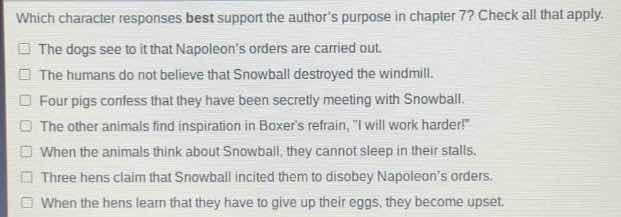
which character responses best support the author’s purpose in chapter 7? check all that apply. the dogs see to it that napoleon’s orders are carried out. the humans do not believe that snowball destroyed the windmill. four pigs confess that they have been secretly meeting with snowball. the other animals find inspiration in boxer’s refrain, “i will work harder!” when the animals think about snowball, they cannot sleep in their stalls. three hens claim that snowball incited them to disobey napoleon’s orders. when the hens learn that they have to give up their eggs, they become upset.
To determine which character responses support the author’s purpose in chapter 7 (from Animal Farm), we analyze each option:
- "The dogs see to it that Napoleon’s orders are carried out."
Napoleon uses the dogs as enforcers to maintain control, showing his authoritarian rule—supports the theme of oppression and control.
- "The humans do not believe that Snowball destroyed the windmill."
Human disbelief is irrelevant to Napoleon’s manipulation of the animals, so this does not support the purpose.
- "Four pigs confess that they have been secretly meeting with Snowball."
Forced confessions (likely false) are part of Napoleon’s purge to eliminate dissent, illustrating his tyranny—supports the purpose.
- "The other animals find inspiration in Boxer’s refrain, 'I will work harder!'"
Boxer’s blind loyalty reinforces the theme of exploitation (he is later betrayed), but the “inspiration” here is part of the system’s manipulation. However, the key purpose of chapter 7 is Napoleon’s purges and oppression, so this is less direct than the confessions/purges.
- "When the animals think about Snowball, they cannot sleep in their stalls."
Snowball is a scapegoat, but this focuses on the animals’ fear rather than Napoleon’s active manipulation (like purges/confessions), so it is less central.
- "Three hens claim that Snowball incited them to disobey Napoleon’s orders."
Blaming Snowball for dissent (via false claims) is part of Napoleon’s propaganda to justify his purges—supports the purpose.
- "When the hens learn that they have to give up their eggs, they become upset."
This is about a separate conflict (egg production) and not the central theme of purges/oppression in chapter 7, so it does not support the purpose.
- The dogs enforcing Napoleon’s orders show his authoritarian control.
- Pigs’ false confessions illustrate Napoleon’s purge of dissent.
- Hens blaming Snowball (false) supports Napoleon’s propaganda/tyranny.

Snap & solve any problem in the app
Get step-by-step solutions on Sovi AI
Photo-based solutions with guided steps
Explore more problems and detailed explanations
- The dogs see to it that Napoleon’s orders are carried out.
- Four pigs confess that they have been secretly meeting with Snowball.
- Three hens claim that Snowball incited them to disobey Napoleon’s orders.