QUESTION IMAGE
Question
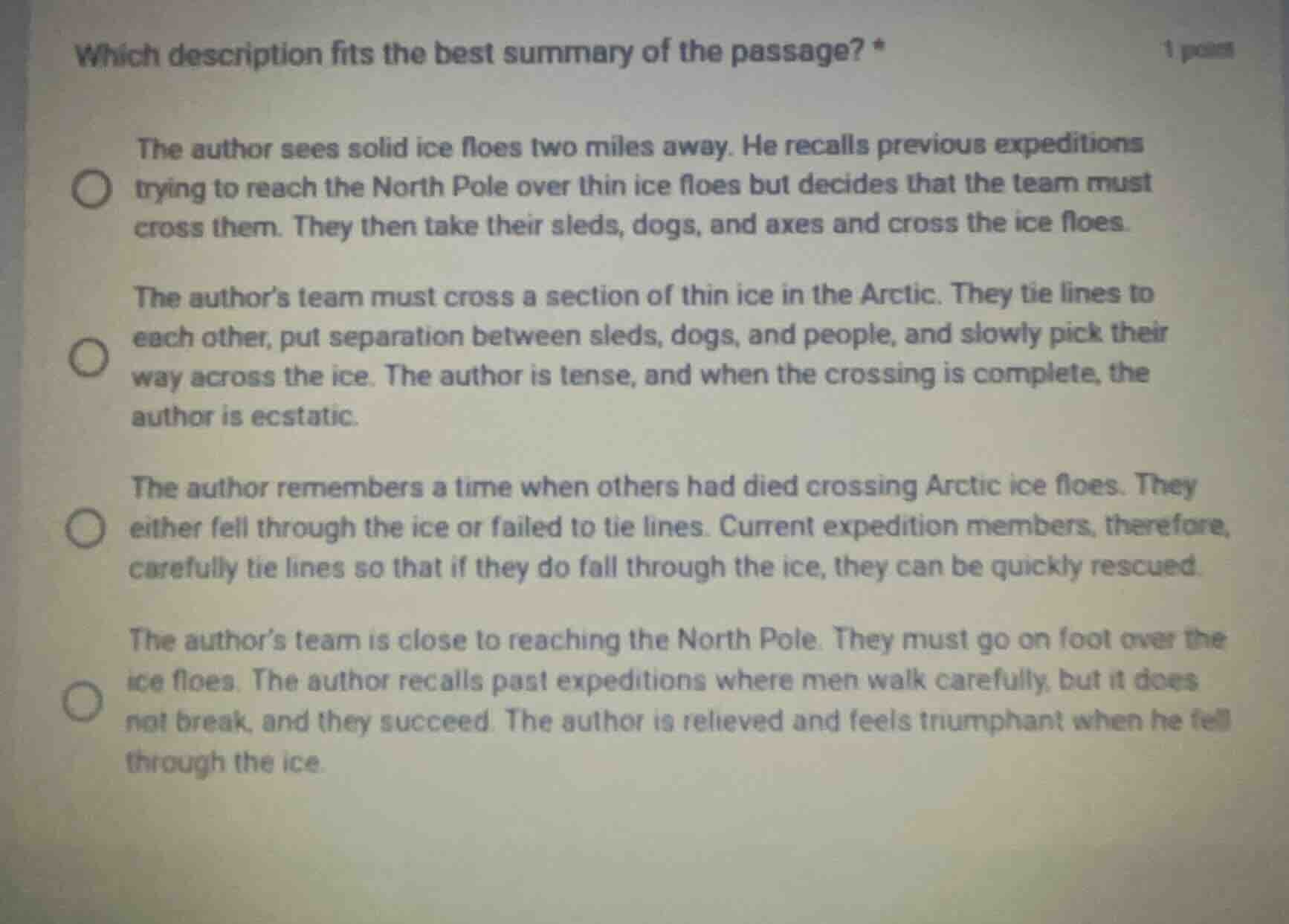
which description fits the best summary of the passage? *
the author sees solid ice floes two miles away. he recalls previous expeditions trying to reach the north pole over thin ice floes but decides that the team must cross them. they then take their sleds, dogs, and axes and cross the ice floes.
the author’s team must cross a section of thin ice in the arctic. they tie lines to each other, put separation between sleds, dogs, and people, and slowly pick their way across the ice. the author is tense, and when the crossing is complete, the author is ecstatic.
the author remembers a time when others had died crossing arctic ice floes. they either fell through the ice or failed to tie lines. current expedition members, therefore, carefully tie lines so that if they do fall through the ice, they can be quickly rescued.
the author’s team is close to reaching the north pole. they must go on foot over the ice floes. the author recalls past expeditions where men walk carefully, but it does not break, and they succeed. the author is relieved and feels triumphant when he fell through the ice.
To determine the best summary, we analyze each option:
- First option: Incorrect. The original passage (implied by the options) likely focuses on the tension and careful crossing, not just recalling past expeditions and deciding to cross, then taking items and crossing.
- Second option: Correct. It captures the key elements: the team must cross thin ice, their actions (tying lines, separating sleds/dogs/people, moving slowly), the author's tension, and ecstatic feeling after completion.
- Third option: Incorrect. The passage doesn't seem to focus on others dying and the current team tying lines for rescue; it's more about the team's own crossing.
- Fourth option: Incorrect. The author feeling triumphant when falling through ice is illogical and not supported, and the recall of past expeditions is misrepresented.

Snap & solve any problem in the app
Get step-by-step solutions on Sovi AI
Photo-based solutions with guided steps
Explore more problems and detailed explanations
B. The author’s team must cross a section of thin ice in the Arctic. They tie lines to each other, put separation between sleds, dogs, and people, and slowly pick their way across the ice. The author is tense, and when the crossing is complete, the author is ecstatic.