QUESTION IMAGE
Question
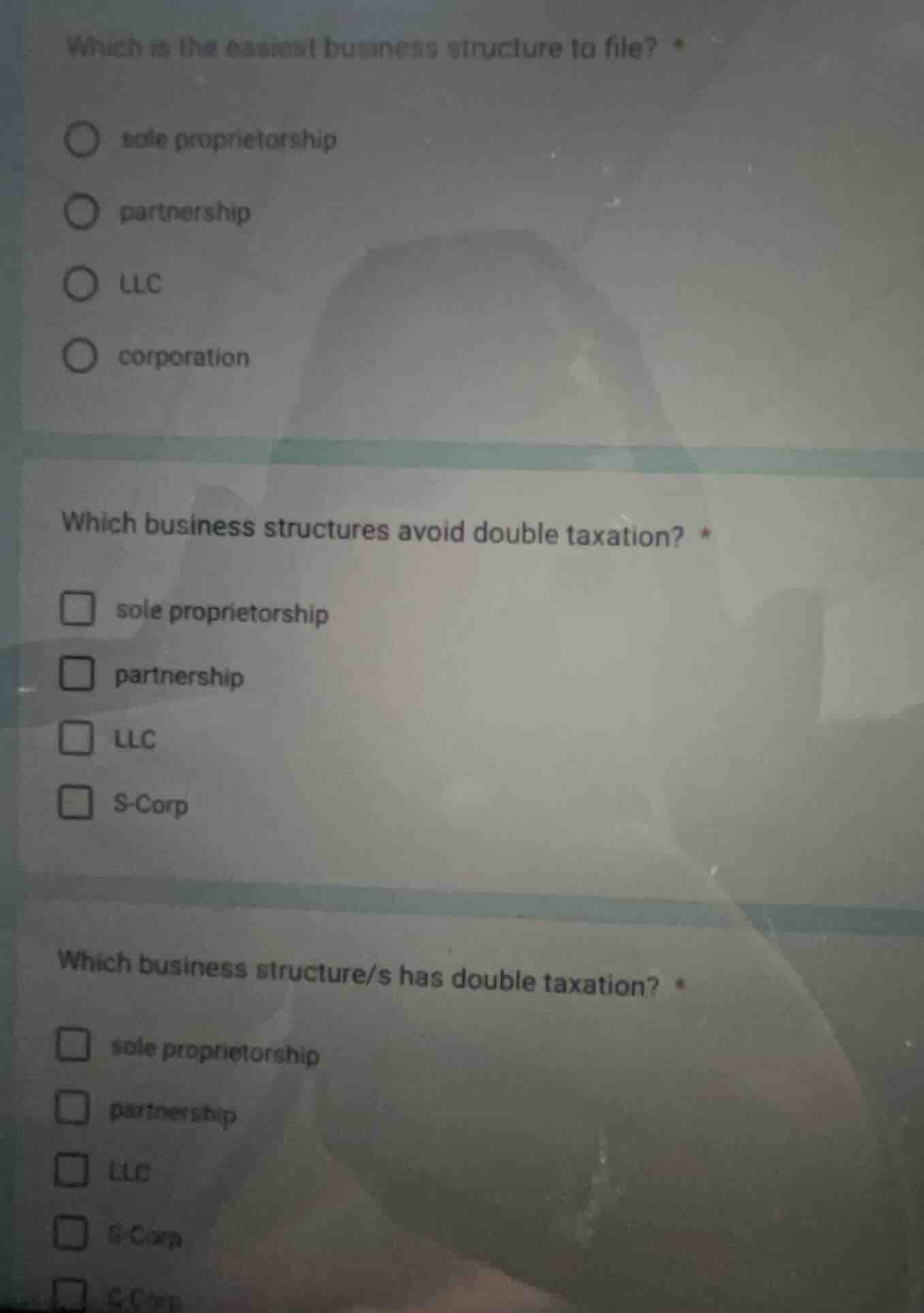
which is the easiest business structure to file? *
○ sole proprietorship
○ partnership
○ llc
○ corporation
which business structures avoid double taxation? *
□ sole proprietorship
□ partnership
□ llc
□ s - corp
which business structure/s has double taxation? *
□ sole proprietorship
□ partnership
□ llc
□ s - corp
□ c - corp
First Question: Which is the easiest business structure to file?
Sole proprietorship has the simplest legal and tax filing requirements as it has no formal legal structure separate from the owner, unlike partnerships, LLCs, or corporations which have more complex paperwork and regulations.
- Sole proprietorship: Income is taxed only at the individual (owner) level, no separate business tax.
- Partnership: Profits pass through to partners and are taxed at individual levels, no double taxation.
- LLC: By default, taxed as a pass - through entity (like sole prop or partnership) so income is taxed at owner level, avoiding double taxation (can also choose corporate tax but usually avoids double tax in default).
- S - Corp: Is a pass - through entity, income is taxed at shareholder (owner) level, avoiding double taxation.
Corporations (C - Corps) are subject to double taxation (taxed at corporate level and then at shareholder level when dividends are paid), but these four (sole prop, partnership, LLC, S - Corp) avoid it.
C - Corporations (often just called corporations in general business context) are subject to double taxation. The corporation is taxed on its profits at the corporate tax rate, and then when profits are distributed as dividends to shareholders, the shareholders are taxed again on that income at their individual tax rates. Sole proprietorships, partnerships, LLCs (in default pass - through taxation), and S - Corps do not have this double taxation.

Snap & solve any problem in the app
Get step-by-step solutions on Sovi AI
Photo-based solutions with guided steps
Explore more problems and detailed explanations
A. sole proprietorship