QUESTION IMAGE
Question
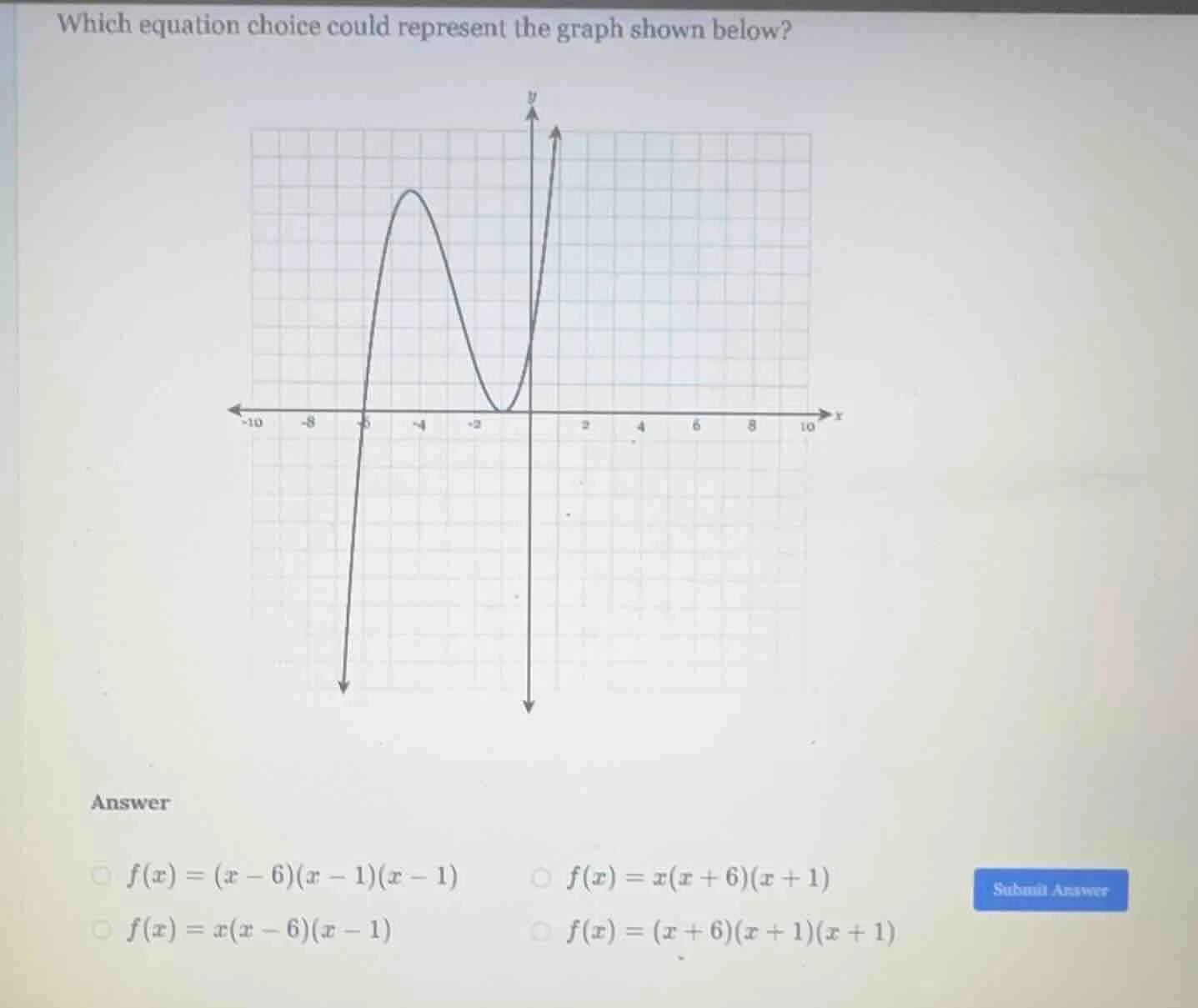
which equation choice could represent the graph shown below?
answer
$f(x) = (x - 6)(x - 1)(x - 1)$
$f(x) = x(x - 6)(x - 1)$
$f(x) = x(x + 6)(x + 1)$
$f(x) = (x + 6)(x + 1)(x + 1)$
Step1: Identify x-intercepts
The graph intersects the x - axis at \(x=-6\) (crossing) and touches at \(x = - 1\) (a repeated root, since the graph touches the axis and turns around, indicating a multiplicity of 2) and \(x = 0\)? Wait, no, looking at the graph, the roots: one root is at \(x=-6\) (crossing), and a double root at \(x=-1\) (since the graph touches the x - axis there, so the factor \((x + 1)\) has multiplicity 2), and also, wait, the graph passes through the origin? Wait, no, let's re - examine. Wait, the graph has a root at \(x=-6\) (crossing), and a double root at \(x=-1\) (touching the axis), and also, when \(x = 0\), what's the value? Wait, no, let's check the options.
The general form of a polynomial with roots \(r_1,r_2,\cdots,r_n\) is \(f(x)=a(x - r_1)(x - r_2)\cdots(x - r_n)\), where \(a\) is a leading coefficient. If a root has an even multiplicity, the graph touches the x - axis at that root; if odd, it crosses.
Looking at the options:
Option 1: \(f(x)=(x - 6)(x - 1)(x - 1)\) has roots at \(x = 6\), \(x = 1\) (double root). But our graph has a root at \(x=-6\), so this is wrong.
Option 2: \(f(x)=x(x + 6)(x + 1)\) has roots at \(x = 0\), \(x=-6\), \(x=-1\). The multiplicities are all 1. But our graph touches the x - axis at one point (indicating a double root), so this is wrong.
Option 3: \(f(x)=x(x - 6)(x - 1)\) has roots at \(x = 0\), \(x = 6\), \(x = 1\). Not matching the roots of the graph.
Option 4: \(f(x)=(x + 6)(x + 1)(x + 1)\) has a root at \(x=-6\) (multiplicity 1, so the graph crosses the x - axis here) and a root at \(x=-1\) (multiplicity 2, so the graph touches the x - axis here), which matches the behavior of the given graph (crosses at \(x=-6\), touches at \(x=-1\)). Also, the leading coefficient: when we expand \((x + 6)(x + 1)^2=(x + 6)(x^2+2x + 1)=x^3+2x^2+x+6x^2+12x + 6=x^3+8x^2+13x + 6\), the leading coefficient is positive, so as \(x
ightarrow\infty\), \(f(x)
ightarrow\infty\) and as \(x
ightarrow-\infty\), \(f(x)
ightarrow-\infty\), which matches the end - behavior of the graph (as \(x
ightarrow\infty\), \(y
ightarrow\infty\); as \(x
ightarrow-\infty\), \(y
ightarrow-\infty\)).
Step2: Verify end - behavior and root behavior
- Root behavior: For \(f(x)=(x + 6)(x + 1)^2\), root at \(x=-6\) (multiplicity 1, crosses x - axis), root at \(x=-1\) (multiplicity 2, touches x - axis). This matches the graph's behavior (crosses at \(x=-6\), touches at \(x=-1\)).
- End - behavior: The degree of the polynomial is 3 (since \((x + 6)\) is degree 1 and \((x + 1)^2\) is degree 2, total degree \(1 + 2=3\)). For a cubic polynomial with a positive leading coefficient (the coefficient of \(x^3\) in \((x + 6)(x + 1)^2\) is 1, positive), as \(x
ightarrow\infty\), \(f(x)
ightarrow\infty\) and as \(x
ightarrow-\infty\), \(f(x)
ightarrow-\infty\), which matches the given graph.

Snap & solve any problem in the app
Get step-by-step solutions on Sovi AI
Photo-based solutions with guided steps
Explore more problems and detailed explanations
\(f(x)=(x + 6)(x + 1)(x + 1)\) (the fourth option: \(f(x)=(x + 6)(x + 1)(x + 1)\))