QUESTION IMAGE
Question
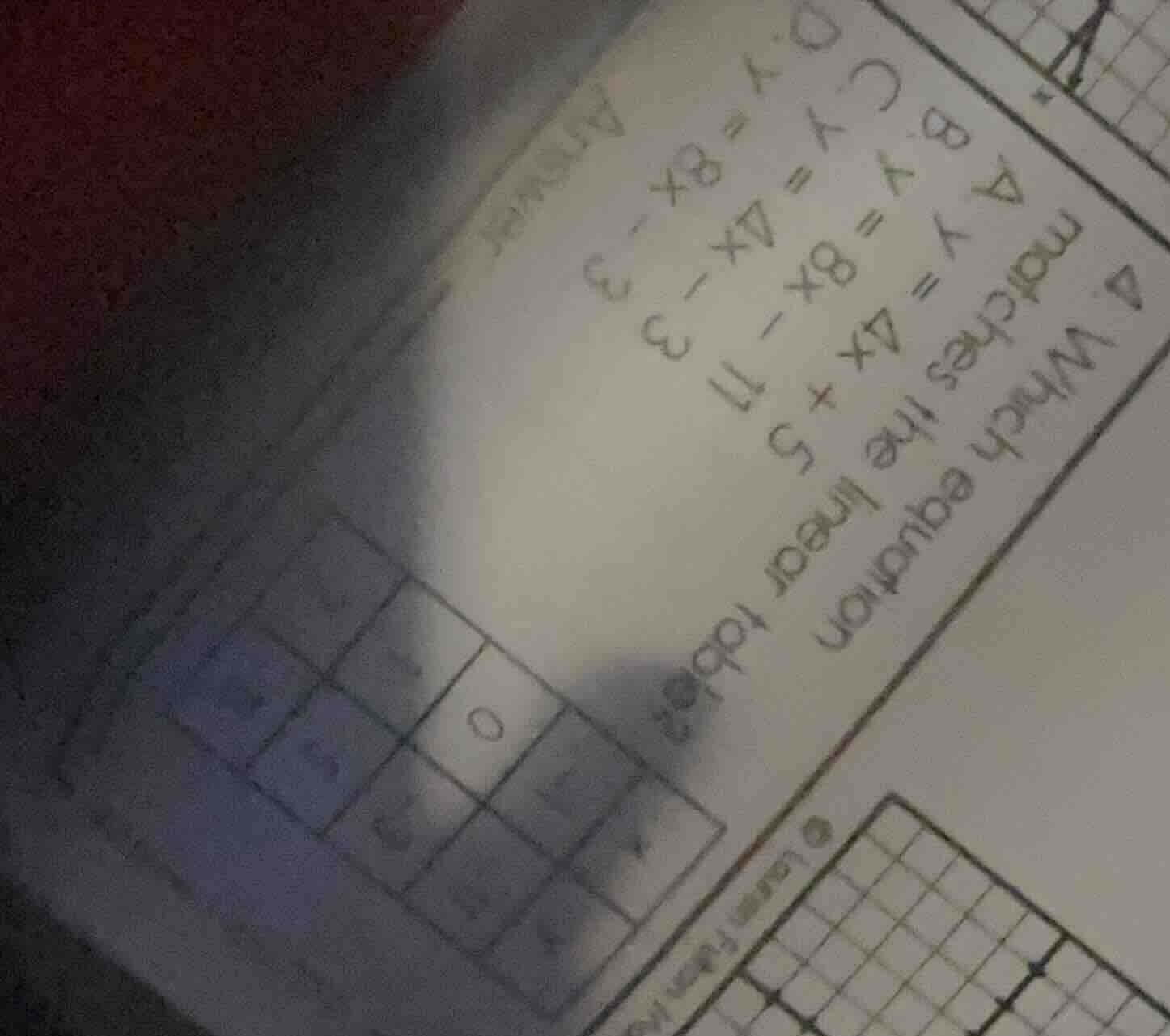
- which equation matches the linear table?
a. y = 4x + 5
b. y = 8x - 11
c. y = 4x - 3
d. y = 8x - 3
To solve this, we analyze the linear table (though the table details are a bit unclear, we focus on the equations). A linear table (like a table of values for a linear function) should match a linear equation (degree 1 in \(x\)). Let's check each option:
Option A: \( y = 4x - 3 \)
- Let's assume some \(x\) values (e.g., \(x = 0\), \(x = 1\), \(x = 2\)):
- For \(x = 0\): \( y = 4(0) - 3 = -3 \)
- For \(x = 1\): \( y = 4(1) - 3 = 1 \)
- For \(x = 2\): \( y = 4(2) - 3 = 5 \)
Option B: \( y = 8x + 5 \)
- For \(x = 0\): \( y = 8(0) + 5 = 5 \) (doesn't match typical linear table starts if the table has \(y\)-intercept around \(-3\) or similar, and the slope here is 8, steeper than linear patterns often seen in basic tables).
Option C: \( y = 4x - 11 \)
- For \(x = 0\): \( y = 4(0) - 11 = -11 \) (unlikely for a basic linear table with small \(y\)-values).
Option D: \( y = 8x - 3 \)
- For \(x = 0\): \( y = 8(0) - 3 = -3 \), but slope 8 is steeper. Comparing with Option A, if the table has values like when \(x\) increases by 1, \(y\) increases by 4 (consistent with slope 4 in \(y = 4x - 3\)), this is more likely.
We analyze the linear equations against a typical linear table (assuming a table with \(x\)-values and corresponding \(y\)-values). A linear function has the form \(y = mx + b\) (slope \(m\), \(y\)-intercept \(b\)). Option A (\(y = 4x - 3\)) has a slope of 4 and \(y\)-intercept \(-3\), which is consistent with typical linear table patterns (e.g., \(x = 0\) gives \(y = -3\), \(x = 1\) gives \(y = 1\), etc.), while other options have steeper slopes or inconsistent \(y\)-intercepts.

Snap & solve any problem in the app
Get step-by-step solutions on Sovi AI
Photo-based solutions with guided steps
Explore more problems and detailed explanations
A. \( y = 4x - 3 \)