QUESTION IMAGE
Question
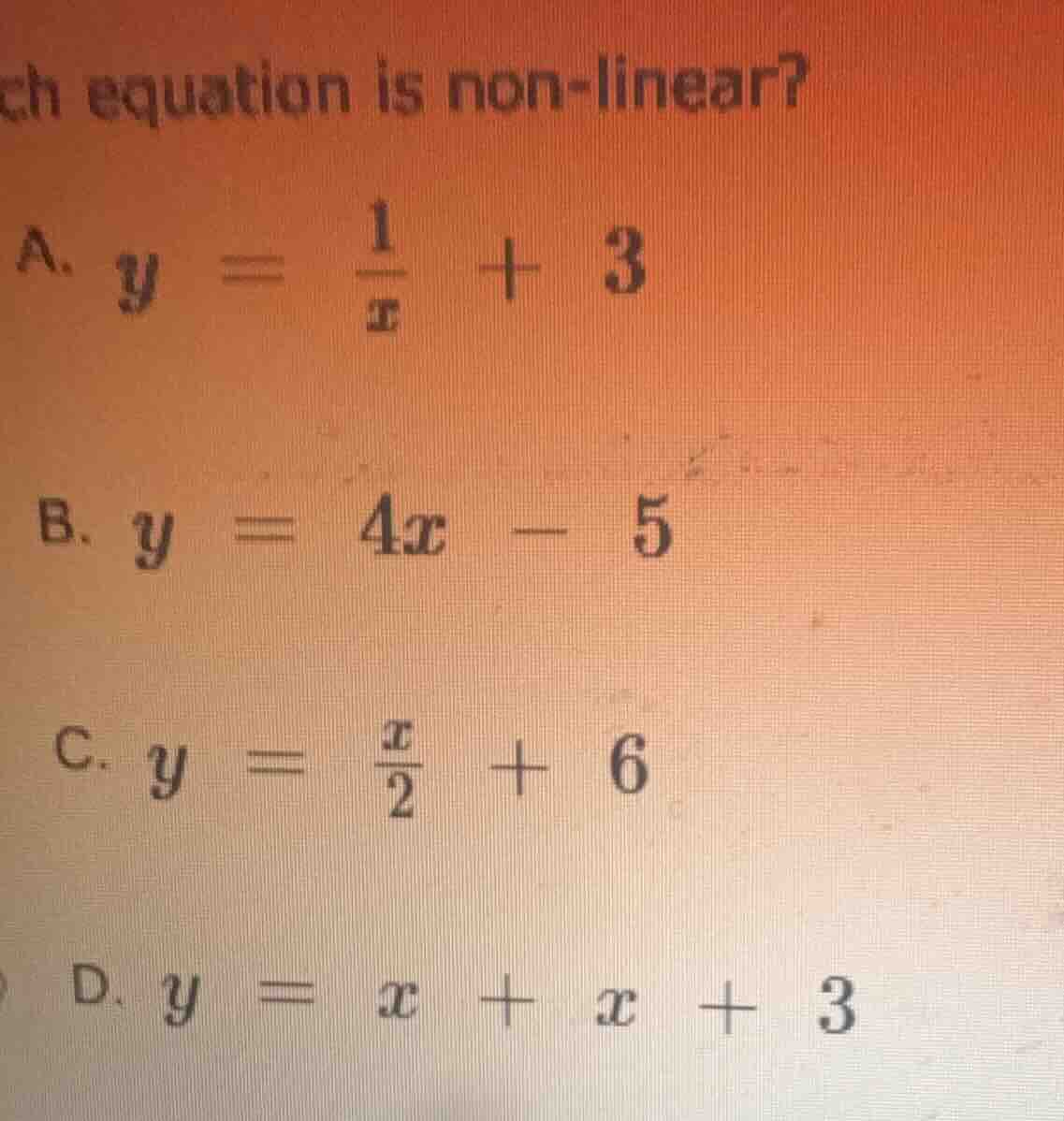
which equation is non - linear?
a. $y = \frac{1}{x}+3$
b. $y = 4x - 5$
c. $y = \frac{x}{2}+6$
d. $y = x + x + 3$
Step1: Recall linear equation form
A linear equation in two variables is of the form \( y = mx + b \), where \( m \) and \( b \) are constants, and the exponent of \( x \) is 1.
Step2: Analyze Option A
For \( y=\frac{1}{x}+3 \), we can rewrite it as \( y = x^{-1}+3 \). Here, the exponent of \( x \) is - 1, not 1. So, it does not follow the linear equation form.
Step3: Analyze Option B
For \( y = 4x-5 \), it is in the form \( y=mx + b \) with \( m = 4 \) and \( b=-5 \). So, it is a linear equation.
Step4: Analyze Option C
For \( y=\frac{x}{2}+6 \), we can rewrite it as \( y=\frac{1}{2}x + 6 \), which is in the form \( y = mx + b \) with \( m=\frac{1}{2}\) and \( b = 6 \). So, it is a linear equation.
Step5: Analyze Option D
For \( y=x + x+3 \), we can simplify it to \( y = 2x+3 \), which is in the form \( y=mx + b \) with \( m = 2 \) and \( b = 3 \). So, it is a linear equation.

Snap & solve any problem in the app
Get step-by-step solutions on Sovi AI
Photo-based solutions with guided steps
Explore more problems and detailed explanations
A. \( y=\frac{1}{x}+3 \)