QUESTION IMAGE
Question
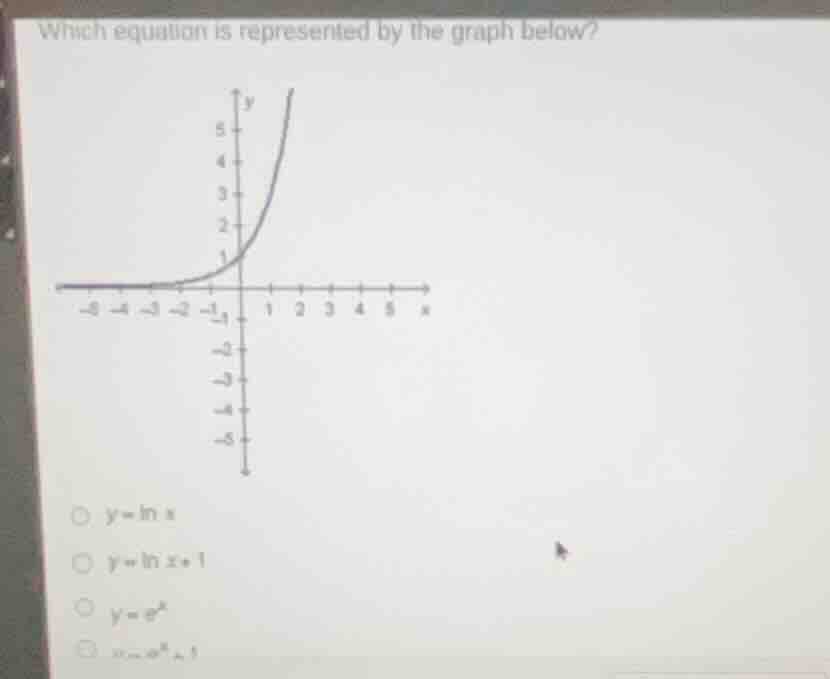
which equation is represented by the graph below?
options:
○ ( y = ln x )
○ ( y = ln x + 1 )
○ ( y = e^x )
○ ( y = e^x + 1 )
Step1: Analyze the shape of the graph
The graph shown is an exponential growth curve, which is characteristic of the function \( y = e^x \). Let's check the other options:
- \( y=\ln x \) is a logarithmic function, its domain is \( x>0 \) and it increases slowly, and the graph starts from the right of the y - axis, which does not match the given graph.
- \( y = \ln x+1 \) is also a logarithmic function, with the same domain and general shape issues as \( y=\ln x \).
- For the function \( y = e^x \), when \( x = 0 \), \( y=e^0=1 \), which matches the y - intercept of the graph (the graph passes through (0,1)). Also, the exponential function \( y = e^x \) has a horizontal asymptote as \( x
ightarrow-\infty \) (approaching y = 0), which is consistent with the given graph.
- The last option (assuming it's \( y=e^x + 1\) or a mis - written form) would have a y - intercept of \( y=e^0 + 1=2 \) when \( x = 0 \), which does not match the graph's y - intercept of 1.
Step2: Confirm the function
By checking the key points (like the y - intercept \( x = 0,y = 1\)) and the general shape (exponential growth, horizontal asymptote as \( x
ightarrow-\infty \)), we can see that the function \( y = e^x \) matches the graph.

Snap & solve any problem in the app
Get step-by-step solutions on Sovi AI
Photo-based solutions with guided steps
Explore more problems and detailed explanations
\( y = e^x \) (the third option in the given choices)