QUESTION IMAGE
Question
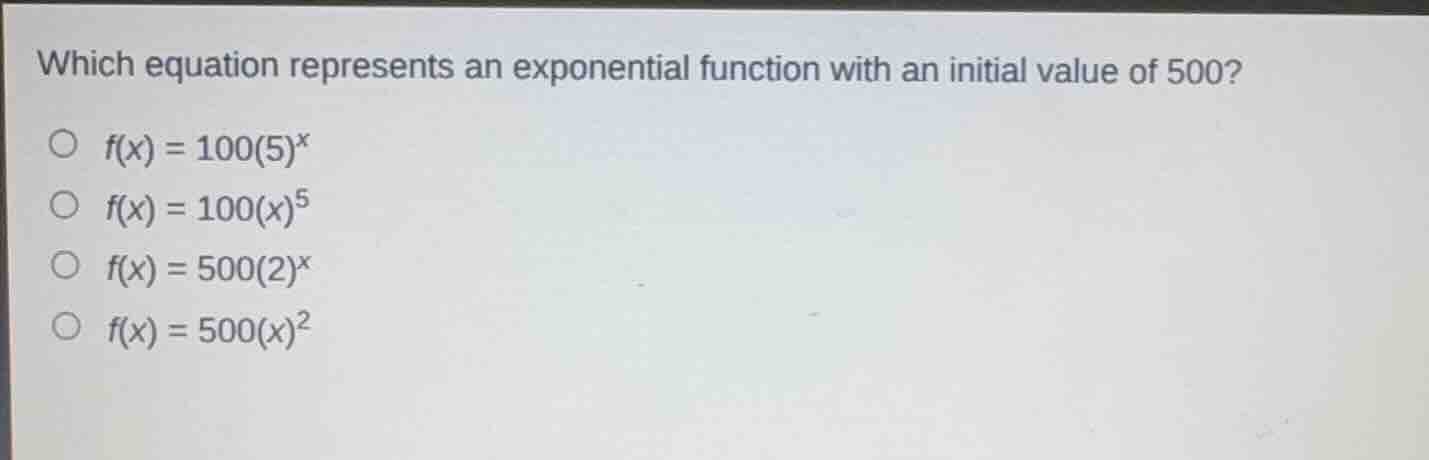
which equation represents an exponential function with an initial value of 500?
\\( f(x) = 100(5)^x \\)
\\( f(x) = 100(x)^5 \\)
\\( f(x) = 500(2)^x \\)
\\( f(x) = 500(x)^2 \\)
Step1: Recall exponential function form
The general form of an exponential function is \( f(x) = a(b)^x \), where \( a \) is the initial value (when \( x = 0 \)) and \( b>0, b
eq1 \).
Step2: Analyze each option
- For \( f(x)=100(5)^x \): When \( x = 0 \), \( f(0)=100(5)^0 = 100(1)=100 \), initial value is 100, not 500.
- For \( f(x)=100(x)^5 \): This is a polynomial function (power function), not exponential (exponent should be the variable, base a constant).
- For \( f(x)=500(2)^x \): When \( x = 0 \), \( f(0)=500(2)^0=500(1) = 500 \), and it is in the form \( a(b)^x \) with \( a = 500 \), \( b = 2 \), so it's an exponential function with initial value 500.
- For \( f(x)=500(x)^2 \): This is a polynomial function (quadratic), not exponential.

Snap & solve any problem in the app
Get step-by-step solutions on Sovi AI
Photo-based solutions with guided steps
Explore more problems and detailed explanations
C. \( f(x) = 500(2)^x \)