QUESTION IMAGE
Question
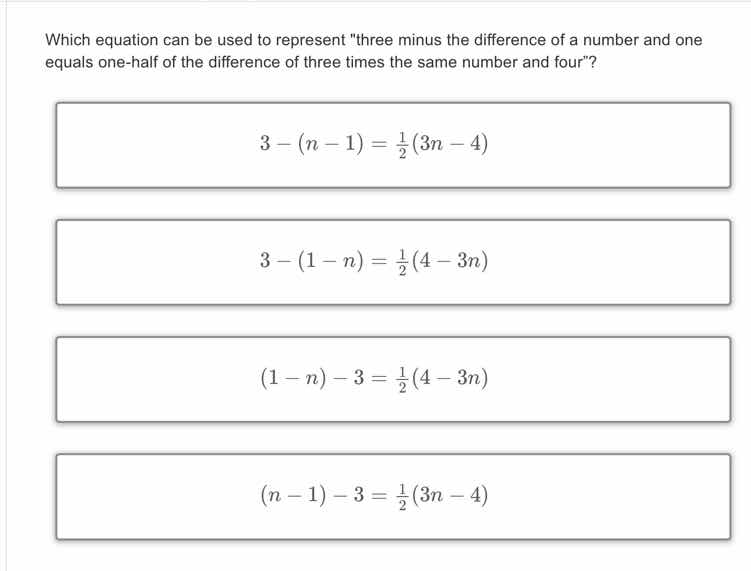
which equation can be used to represent \three minus the difference of a number and one equals one - half of the difference of three times the same number and four\?
$3 - (n - 1) = \frac{1}{2}(3n - 4)$
$3 - (1 - n) = \frac{1}{2}(4 - 3n)$
$(1 - n) - 3 = \frac{1}{2}(4 - 3n)$
$(n - 1) - 3 = \frac{1}{2}(3n - 4)$
Step1: Analyze "three minus the difference of a number and one"
Let the number be \( n \). The difference of the number and one is \( n - 1 \). Then "three minus this difference" is \( 3-(n - 1) \).
Step2: Analyze "one - half of the difference of three times the same number and four"
Three times the number is \( 3n \). The difference of three times the number and four is \( 3n - 4 \). One - half of this difference is \( \frac{1}{2}(3n - 4) \).
Step3: Form the equation
Putting the two parts together, the equation is \( 3-(n - 1)=\frac{1}{2}(3n - 4) \).

Snap & solve any problem in the app
Get step-by-step solutions on Sovi AI
Photo-based solutions with guided steps
Explore more problems and detailed explanations
\( 3-(n - 1)=\frac{1}{2}(3n - 4) \) (the first option)