QUESTION IMAGE
Question
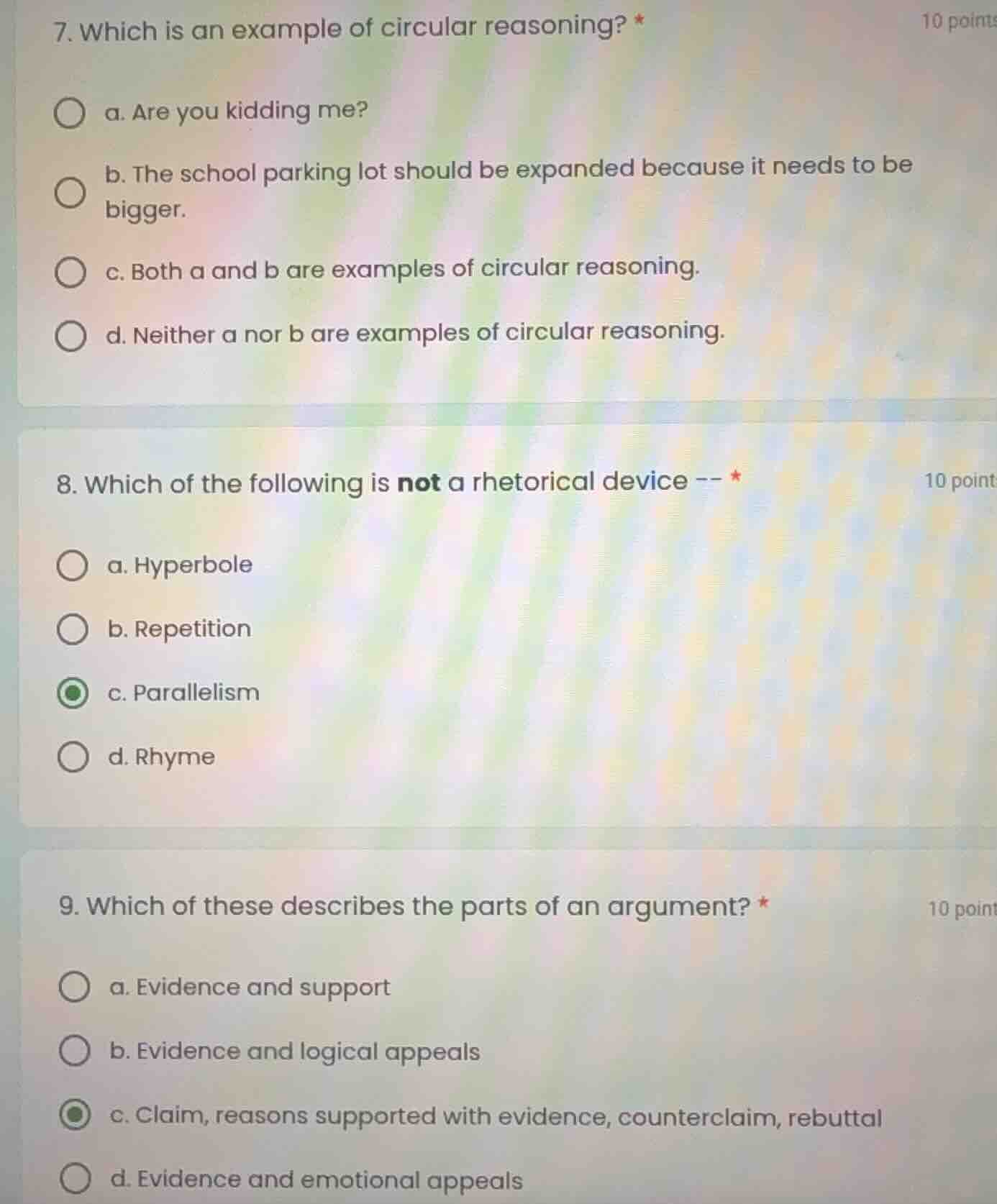
- which is an example of circular reasoning? *
a. are you kidding me?
b. the school parking lot should be expanded because it needs to be bigger.
c. both a and b are examples of circular reasoning.
d. neither a nor b are examples of circular reasoning.
- which of the following is not a rhetorical device -- *
a. hyperbole
b. repetition
c. parallelism
d. rhyme
- which of these describes the parts of an argument? *
a. evidence and support
b. evidence and logical appeals
c. claim, reasons supported with evidence, counterclaim, rebuttal
d. evidence and emotional appeals
For Question 7:
Circular reasoning uses the conclusion as its own premise. Option a is a rhetorical question, not circular reasoning. Option b restates the claim ("should be expanded") as the reason ("needs to be bigger"), which is circular reasoning.
For Question 8:
Hyperbole, repetition, and rhyme are all recognized rhetorical devices. Parallelism is a grammatical and structural technique for clarity, not a rhetorical device focused on persuasive or stylistic effect in the same category.
For Question 9:
A complete argument includes a core claim, supporting reasons with evidence, addressing opposing views (counterclaim), and refuting them (rebuttal). The other options only list partial components or appeals, not the full structure of an argument.

Snap & solve any problem in the app
Get step-by-step solutions on Sovi AI
Photo-based solutions with guided steps
Explore more problems and detailed explanations
- b. The school parking lot should be expanded because it needs to be bigger.
- c. Parallelism
- c. Claim, reasons supported with evidence, counterclaim, rebuttal