QUESTION IMAGE
Question
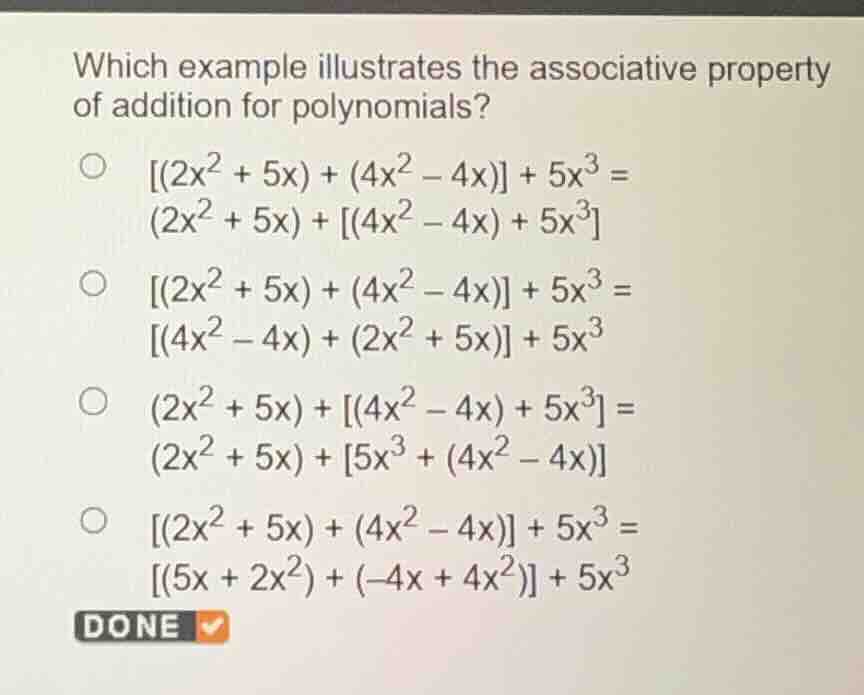
which example illustrates the associative property of addition for polynomials?
(2x² + 5x) + (4x² − 4x) + 5x³ = (2x² + 5x) + (4x² − 4x) + 5x³
(2x² + 5x) + (4x² − 4x) + 5x³ = (4x² − 4x) + (2x² + 5x) + 5x³
(2x² + 5x) + (4x² − 4x) + 5x³ = (2x² + 5x) + 5x³ + (4x² − 4x)
(2x² + 5x) + (4x² − 4x) + 5x³ = (5x + 2x²) + (−4x + 4x²) + 5x³
done
The associative property of addition states that for any numbers (or polynomials) \(a\), \(b\), and \(c\), \((a + b)+c=a+(b + c)\). This means we are changing the grouping of the addends without changing the order of the terms.
- For the first option: \([(2x^{2}+5x)+(4x^{2}-4x)] + 5x^{3}=(2x^{2}+5x)+[(4x^{2}-4x)+5x^{3}]\) shows that we are regrouping the polynomials \((2x^{2}+5x)\), \((4x^{2}-4x)\), and \(5x^{3}\) which follows the associative property.
- The second option shows the commutative property (changing the order of \((2x^{2}+5x)\) and \((4x^{2}-4x)\)) not associative.
- The third option also shows the commutative property (changing the order of \((4x^{2}-4x)\) and \(5x^{3}\)) not associative.
- The fourth option shows rearranging terms within the polynomials (using commutative property on the terms inside) not associative.

Snap & solve any problem in the app
Get step-by-step solutions on Sovi AI
Photo-based solutions with guided steps
Explore more problems and detailed explanations
\(\boldsymbol{[(2x^{2}+5x)+(4x^{2}-4x)] + 5x^{3}=(2x^{2}+5x)+[(4x^{2}-4x)+5x^{3}]}\) (the first option)