QUESTION IMAGE
Question
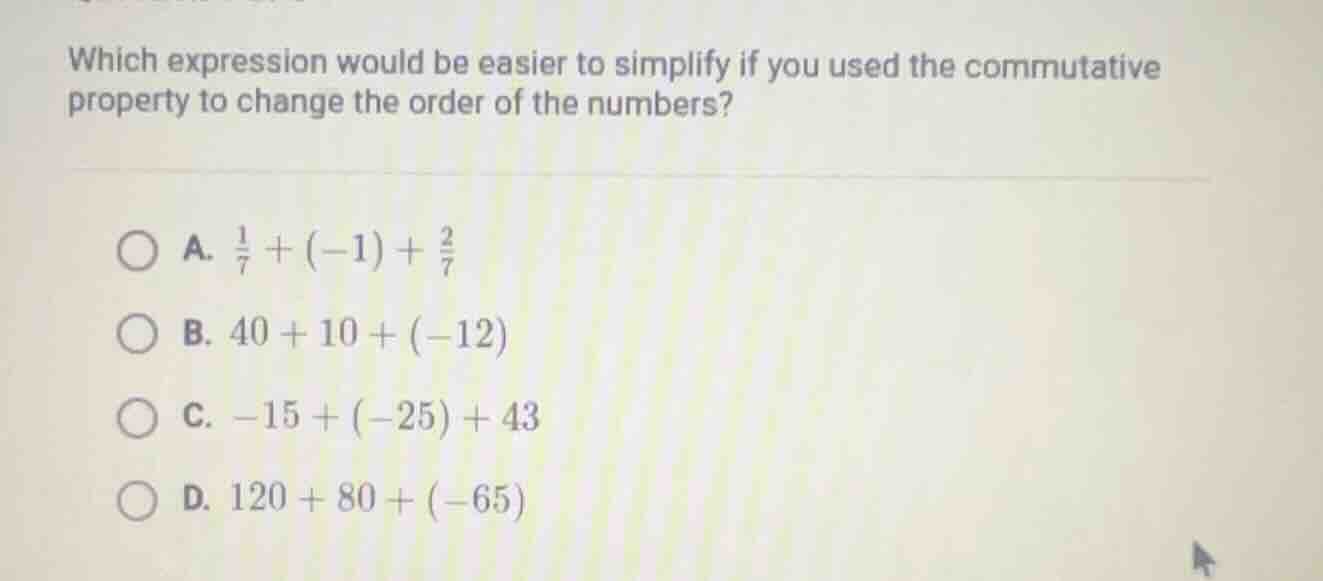
which expression would be easier to simplify if you used the commutative property to change the order of the numbers?
a. $\frac{1}{7}+(-1)+\frac{2}{7}$
b. $40 + 10+(-12)$
c. $-15+(-25)+43$
d. $120 + 80+(-65)$
Step1: Recall the commutative property
The commutative property of addition states that \(a + b = b + a\). We want to find an expression where rearranging the terms using this property makes simplification easier, usually by grouping like terms (e.g., fractions with the same denominator, or integers that add up to a multiple of 10, etc.).
Step2: Analyze Option A
The expression is \(\frac{1}{7}+(-1)+\frac{2}{7}\). Using the commutative property, we can rearrange the terms to group the fractions: \(\frac{1}{7}+\frac{2}{7}+(-1)\). Now, we can add the fractions first: \(\frac{1 + 2}{7}+(-1)=\frac{3}{7}+(-1)\), which is easier to simplify than the original order.
Step3: Analyze Option B
The expression is \(40 + 10+(-12)\). The first two terms are already easy to add (\(40 + 10 = 50\)), so rearranging doesn't make it much easier.
Step4: Analyze Option C
The expression is \(-15+(-25)+43\). The first two terms are negative integers, but adding them first (\(-15-25=-40\)) and then adding 43 is straightforward, and rearranging doesn't provide a significant simplification advantage.
Step5: Analyze Option D
The expression is \(120 + 80+(-65)\). The first two terms are already easy to add (\(120 + 80 = 200\)), so rearranging doesn't make it much easier.

Snap & solve any problem in the app
Get step-by-step solutions on Sovi AI
Photo-based solutions with guided steps
Explore more problems and detailed explanations
A. \(\frac{1}{7}+(-1)+\frac{2}{7}\)