QUESTION IMAGE
Question
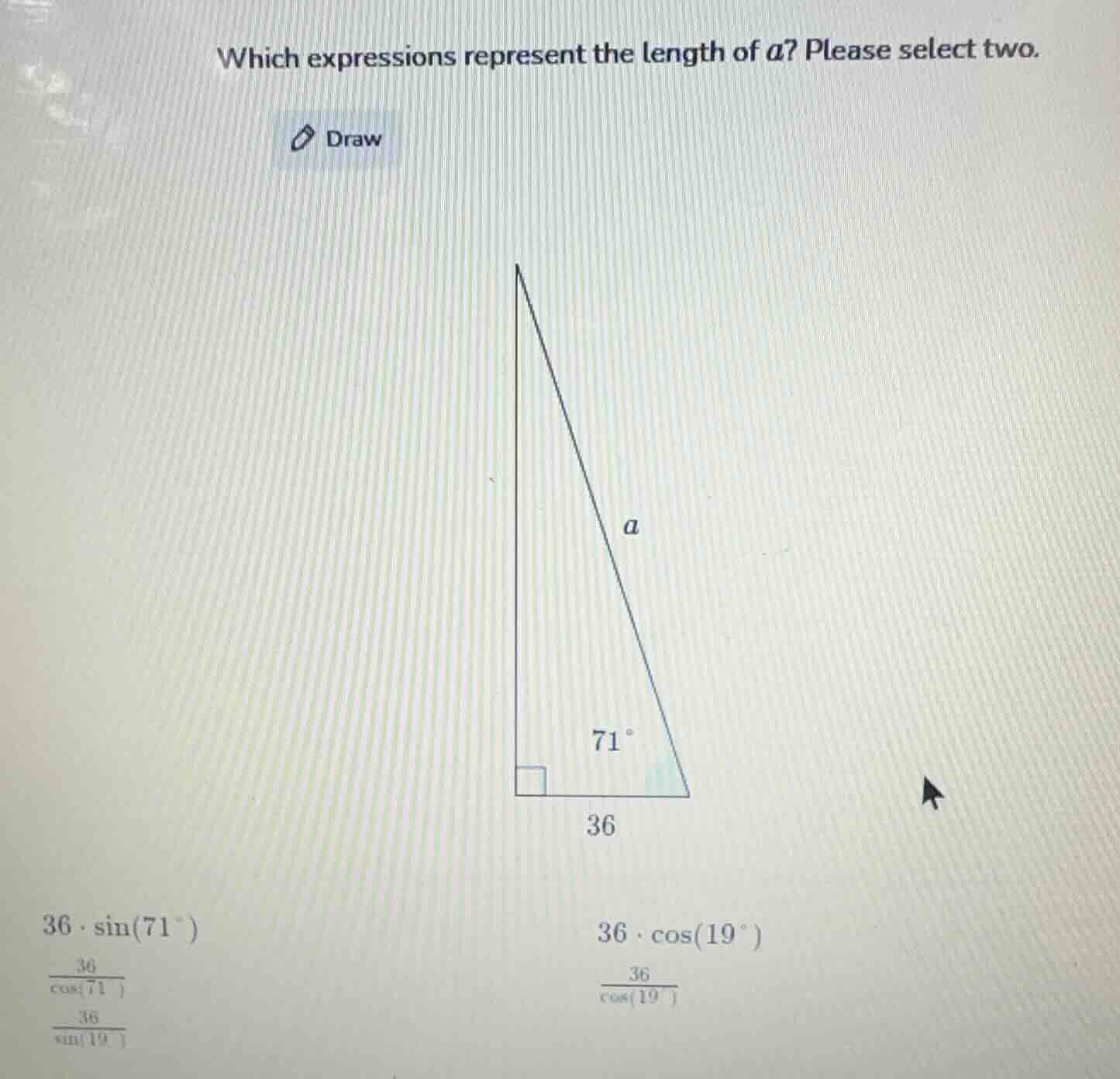
which expressions represent the length of a? please select two. 36·sin(71°) 36·cos(19°) 36/cos(71°) 36/cos(19°) 36/sin(19°)
Step1: Analyze the right triangle
We have a right triangle with one angle \(71^\circ\), the adjacent side to \(71^\circ\) is \(36\), and \(a\) is the hypotenuse. Also, the other non - right angle is \(19^\circ\) (since \(90 - 71=19\)).
Step2: Use trigonometric ratios
For the \(71^\circ\) angle:
The cosine of an angle in a right triangle is defined as \(\cos\theta=\frac{\text{adjacent}}{\text{hypotenuse}}\). For \(\theta = 71^\circ\), \(\cos(71^\circ)=\frac{36}{a}\), so we can solve for \(a\) by cross - multiplying: \(a=\frac{36}{\cos(71^\circ)}\).
For the \(19^\circ\) angle:
The sine of an angle in a right triangle is defined as \(\sin\theta=\frac{\text{opposite}}{\text{hypotenuse}}\), and the cosine of an angle is \(\cos\theta=\frac{\text{adjacent}}{\text{hypotenuse}}\). Also, we know that \(\cos(19^\circ)=\sin(71^\circ)\) (because \(\cos(90 - x)=\sin(x)\)). We can also use the sine of \(19^\circ\): \(\sin(19^\circ)=\frac{36}{a}\), so \(a = \frac{36}{\sin(19^\circ)}\). And we know that \(\cos(19^\circ)=\sin(71^\circ)\), and if we consider the adjacent side to \(19^\circ\) (which is the opposite side to \(71^\circ\)), but another way: since \(\cos(19^\circ)=\sin(71^\circ)\), and from \(\cos(71^\circ)=\frac{36}{a}\), and also \(a=\frac{36}{\sin(19^\circ)}\) (because \(\sin(19^\circ)=\cos(71^\circ)\)). Also, \(\cos(19^\circ)=\sin(71^\circ)\), and if we use the cosine of \(19^\circ\), we know that \(\cos(19^\circ)=\frac{\text{opposite to }71^\circ}{a}\), but the adjacent side to \(71^\circ\) is \(36\), the opposite side to \(71^\circ\) is \(36\tan(71^\circ)\). Wait, let's re - check:
Wait, the two correct expressions:
- From \(\cos(71^{\circ})=\frac{36}{a}\), so \(a = \frac{36}{\cos(71^{\circ})}\)
- Since the other angle is \(19^{\circ}\), \(\sin(19^{\circ})=\frac{36}{a}\) (because the side of length \(36\) is opposite to the \(19^{\circ}\) angle), so \(a=\frac{36}{\sin(19^{\circ})}\)
Also, we know that \(\cos(19^{\circ})=\sin(71^{\circ})\), and if we consider the angle \(19^{\circ}\), the adjacent side to \(19^{\circ}\) is the opposite side to \(71^{\circ}\), but the two correct expressions among the given options are \(\frac{36}{\cos(71^{\circ})}\) and \(\frac{36}{\sin(19^{\circ})}\) (and also \(36\cdot\cos(19^{\circ})\) is equal to \(36\cdot\sin(71^{\circ})\), but let's check the options:
The options are:
- \(36\cdot\sin(71^{\circ})\): \(\sin(71^{\circ})=\frac{\text{opposite}}{a}\), so \(\text{opposite}=a\sin(71^{\circ})\), not \(a\), so this is wrong.
- \(36\cdot\cos(19^{\circ})\): \(\cos(19^{\circ})=\sin(71^{\circ})\), and \(\sin(71^{\circ})=\frac{\text{opposite}}{a}\), so \(\text{opposite}=a\sin(71^{\circ}) = 36\cos(19^{\circ})\), not \(a\), so this is wrong.
- \(\frac{36}{\cos(71^{\circ})}\): Correct as shown above.
- \(\frac{36}{\cos(19^{\circ})}\): Wrong, because \(\cos(19^{\circ})=\sin(71^{\circ})\), and \(\sin(71^{\circ})=\frac{\text{opposite}}{a}\), so \(a=\frac{\text{opposite}}{\sin(71^{\circ})}\), not \(\frac{36}{\cos(19^{\circ})}\)
- \(\frac{36}{\sin(19^{\circ})}\): Correct, because \(\sin(19^{\circ})=\frac{36}{a}\) (since the side of length \(36\) is opposite to the \(19^{\circ}\) angle), so \(a = \frac{36}{\sin(19^{\circ})}\)

Snap & solve any problem in the app
Get step-by-step solutions on Sovi AI
Photo-based solutions with guided steps
Explore more problems and detailed explanations
\(\frac{36}{\cos(71^{\circ})}\), \(\frac{36}{\sin(19^{\circ})}\)