QUESTION IMAGE
Question
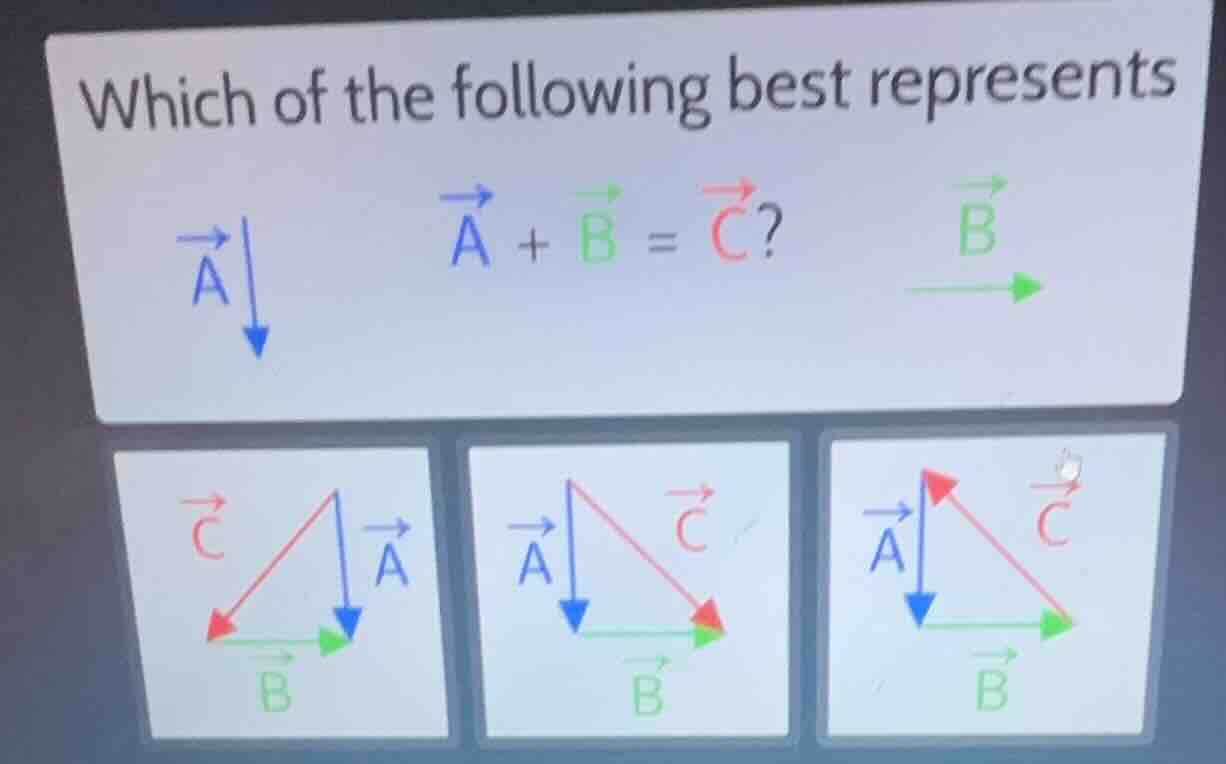
which of the following best represents \\(\vec{a} + \vec{b} = \vec{c}\\)?
To determine which diagram best represents \(\vec{A} + \vec{B} = \vec{C}\), we use the triangle law of vector addition: To add two vectors \(\vec{A}\) and \(\vec{B}\), place the tail of \(\vec{B}\) at the head of \(\vec{A}\). The resultant vector \(\vec{C}\) starts from the tail of \(\vec{A}\) and ends at the head of \(\vec{B}\).
Step 1: Analyze Vector Directions
- \(\vec{A}\) is downward (vertical).
- \(\vec{B}\) is to the right (horizontal).
Step 2: Apply the Triangle Law
For \(\vec{A} + \vec{B}\):
- Draw \(\vec{A}\) (downward).
- Draw \(\vec{B}\) starting from the head of \(\vec{A}\) (to the right).
- The resultant \(\vec{C}\) connects the tail of \(\vec{A}\) to the head of \(\vec{B}\).
Step 3: Evaluate the Diagrams
- First diagram: \(\vec{B}\) starts at the tail of \(\vec{A}\) (incorrect, violates the triangle law).
- Second diagram: \(\vec{B}\) starts at the head of \(\vec{A}\), and \(\vec{C}\) connects the tail of \(\vec{A}\) to the head of \(\vec{B}\) (matches the triangle law).
- Third diagram: \(\vec{C}\) direction is inconsistent with the triangle law (points upward, but \(\vec{A}\) is downward and \(\vec{B}\) is rightward).

Snap & solve any problem in the app
Get step-by-step solutions on Sovi AI
Photo-based solutions with guided steps
Explore more problems and detailed explanations
The second diagram (where \(\vec{A}\) is downward, \(\vec{B}\) is rightward from \(\vec{A}\)’s head, and \(\vec{C}\) connects \(\vec{A}\)’s tail to \(\vec{B}\)’s head).