QUESTION IMAGE
Question
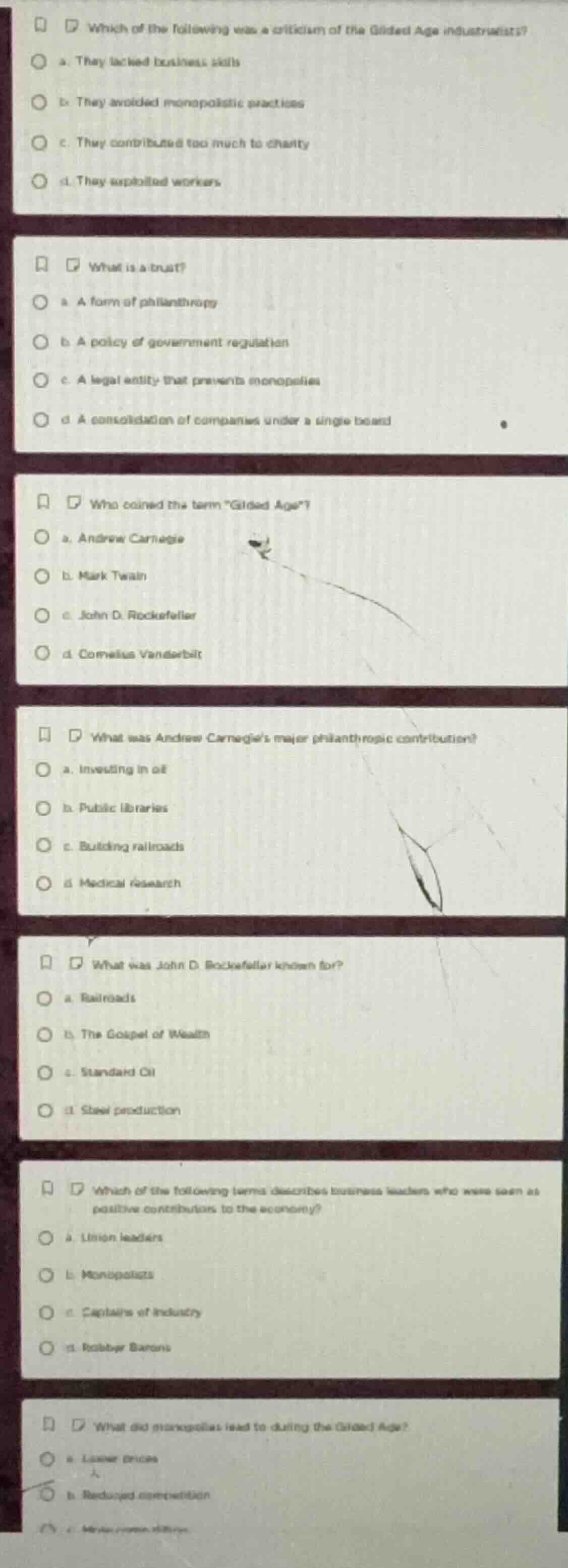
- which of the following was a criticism of the gilded age industrialists?
a. they lacked business skills
b. they avoided monopolistic practices
c. they contributed too much to charity
d. they exploited workers
- what is a trust?
a. a form of philanthropy
b. a policy of government regulation
c. a legal entity that prevents monopolies
d. a consolidation of companies under a single board
- who coined the term \gilded age\?
a. andrew carnegie
b. mark twain
c. john d. rockefeller
d. cornelius vanderbilt
- what was andrew carnegies major philanthropic contribution?
a. investing in oil
b. public libraries
c. building railroads
d. medical research
- what was john d. rockefeller known for?
a. railroads
b. the gospel of wealth
c. standard oil
d. steel production
- which of the following terms describes business leaders who were seen as positive contributors to the economy?
a. union leaders
b. monopolists
c. captains of industry
d. robber barons
- what did monopolies lead to during the gilded age?
a. lower prices
b. reduced competition
c. increased innovation
- Gilded Age industrialists were criticized for low wages, long hours, and poor working conditions for workers.
- A trust is a business structure that merges multiple companies under one governing board to consolidate control.
- Mark Twain co-wrote The Gilded Age: A Tale of Today, coining the term for the era.
- Andrew Carnegie funded the construction of thousands of public libraries across the U.S. and globally.
- John D. Rockefeller built and controlled Standard Oil, a dominant oil monopoly.
- "Captains of Industry" is the positive term for business leaders credited with economic growth, unlike the negative "Robber Barons".
- Monopolies eliminated competition by controlling entire industries during the Gilded Age.

Snap & solve any problem in the app
Get step-by-step solutions on Sovi AI
Photo-based solutions with guided steps
Explore more problems and detailed explanations
- d. They exploited workers
- d. A consolidation of companies under a single board
- b. Mark Twain
- b. Public libraries
- c. Standard Oil
- c. Captains of Industry
- b. Reduced competition