QUESTION IMAGE
Question
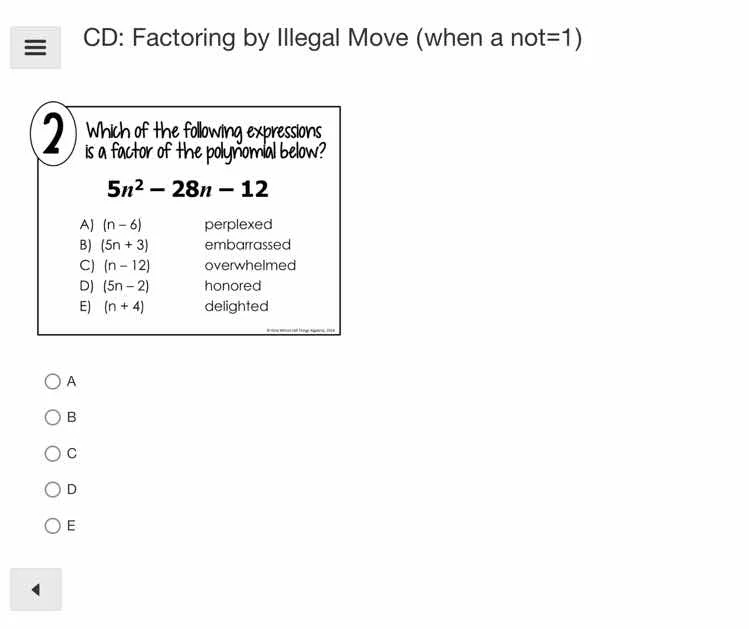
2 which of the following expressions is a factor of the polynomial below? 5n² - 28n - 12 a) (n - 6) perplexed b) (5n + 3) embarrassed c) (n - 12) overwhelmed d) (5n - 2) honored e) (n + 4) delighted
Step1: Factor the quadratic polynomial
To factor \(5n^2 - 28n - 12\), we need to find two numbers that multiply to \(5\times(-12)=-60\) and add up to \(-28\). The numbers are \(-30\) and \(2\) because \(-30\times2 = -60\) and \(-30 + 2=-28\).
Rewrite the middle term using these numbers:
\[
5n^2 - 30n + 2n - 12
\]
Step2: Group and factor
Group the first two terms and the last two terms:
\[
(5n^2 - 30n)+(2n - 12)
\]
Factor out the greatest common factor from each group:
\[
5n(n - 6)+2(n - 6)
\]
Now, factor out the common binomial factor \((n - 6)\):
\[
(5n + 2)(n - 6)
\]
Wait, that doesn't match the options. Wait, maybe I made a mistake. Let's try again. Wait, maybe the numbers are different. Let's check the product \(5\times(-12)=-60\). We need two numbers that multiply to \(-60\) and add to \(-28\). Let's list the factor pairs of \(-60\):
\(1\) and \(-60\) (sum \(-59\))
\(2\) and \(-30\) (sum \(-28\)) Ah, there we go. So the middle term is split as \(-30n + 2n\). Wait, but the original polynomial is \(5n^2 - 28n - 12\). So:
\(5n^2 - 30n + 2n - 12\)
Factor by grouping:
\(5n(n - 6) + 2(n - 6)\)
So that's \((5n + 2)(n - 6)\). But option A is \((n - 6)\), which is a factor. Wait, but let's check the options again. Wait, maybe I made a mistake in the sign. Wait, the polynomial is \(5n^2 - 28n - 12\). Let's use the quadratic formula to find the roots. The roots are \(n=\frac{28\pm\sqrt{(-28)^2 - 4\times5\times(-12)}}{2\times5}=\frac{28\pm\sqrt{784 + 240}}{10}=\frac{28\pm\sqrt{1024}}{10}=\frac{28\pm32}{10}\).
So the roots are \(\frac{28 + 32}{10}=\frac{60}{10}=6\) and \(\frac{28 - 32}{10}=\frac{-4}{10}=-\frac{2}{5}\).
So the factors are \((n - 6)\) and \((n + \frac{2}{5})\). To eliminate the fraction, multiply \((n + \frac{2}{5})\) by \(5\) to get \((5n + 2)\). So the factored form is \((n - 6)(5n + 2)\). But the options are:
A) \((n - 6)\)
B) \((5n + 3)\)
C) \((n - 12)\)
D) \((5n - 2)\)
E) \((n + 4)\)
Wait, but according to the factoring, one factor is \((n - 6)\), which is option A. Wait, but let's check by plugging in the options into the polynomial to see which one is a factor (i.e., when we set the factor to zero, the polynomial should be zero).
Let's test option A: \(n - 6 = 0 \implies n = 6\). Plug \(n = 6\) into \(5n^2 - 28n - 12\):
\(5(36) - 28(6) - 12 = 180 - 168 - 12 = 0\). So \(n = 6\) is a root, so \((n - 6)\) is a factor.
Let's check option D: \(5n - 2 = 0 \implies n = \frac{2}{5}\). Plug into the polynomial:
\(5(\frac{2}{5})^2 - 28(\frac{2}{5}) - 12 = 5(\frac{4}{25}) - \frac{56}{5} - 12 = \frac{4}{5} - \frac{56}{5} - \frac{60}{5} = \frac{4 - 56 - 60}{5} = \frac{-112}{5}
eq 0\).
Option B: \(5n + 3 = 0 \implies n = -\frac{3}{5}\). Plug in:
\(5(-\frac{3}{5})^2 - 28(-\frac{3}{5}) - 12 = 5(\frac{9}{25}) + \frac{84}{5} - 12 = \frac{9}{5} + \frac{84}{5} - \frac{60}{5} = \frac{9 + 84 - 60}{5} = \frac{33}{5}
eq 0\).
Option C: \(n - 12 = 0 \implies n = 12\). Plug in:
\(5(144) - 28(12) - 12 = 720 - 336 - 12 = 372
eq 0\).
Option E: \(n + 4 = 0 \implies n = -4\). Plug in:
\(5(16) - 28(-4) - 12 = 80 + 112 - 12 = 180
eq 0\).
So the only factor among the options is \((n - 6)\), which is option A.
Wait, but earlier when I factored, I got \((n - 6)(5n + 2)\), but option A is \((n - 6)\), which is a factor. So the correct answer is A.

Snap & solve any problem in the app
Get step-by-step solutions on Sovi AI
Photo-based solutions with guided steps
Explore more problems and detailed explanations
A. (n - 6)