QUESTION IMAGE
Question
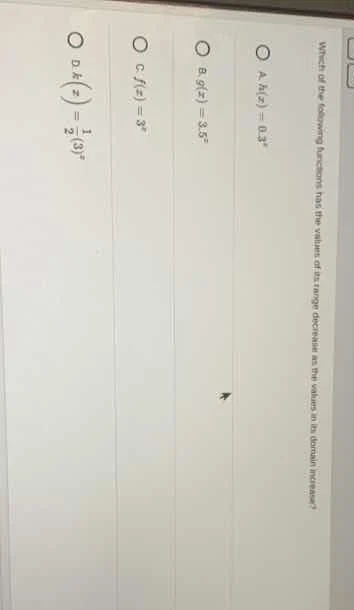
which of the following functions has the values of ( y ) decreasing as ( x ) values increase?
a ( h(x) = 0.3^x )
b ( g(x) = 3.5^x )
c ( f(x) = 8^x )
d ( k(x) = left( \frac{1}{2}(3)
ight)^x )
To determine which function has values that are decreasing as \( x \) increases, we analyze the base of each exponential function \( y = a^x \):
- For an exponential function \( y = a^x \), if \( 0 < a < 1 \), the function is decreasing (as \( x \) increases, \( y \) decreases). If \( a > 1 \), the function is increasing (as \( x \) increases, \( y \) increases).
Analyze each option:
- Option A: \( h(x) = 0.3^x \)
The base \( a = 0.3 \), and \( 0 < 0.3 < 1 \). Thus, \( h(x) \) is a decreasing exponential function.
- Option B: \( g(x) = 3.5^x \)
The base \( a = 3.5 \), and \( 3.5 > 1 \). Thus, \( g(x) \) is an increasing exponential function.
- Option C: \( f(t) = 8^t \)
The base \( a = 8 \), and \( 8 > 1 \). Thus, \( f(t) \) is an increasing exponential function.
- Option D: \( k(x) = \frac{1}{2}(3)^x \)
The base \( a = 3 \), and \( 3 > 1 \). Thus, \( k(x) \) is an increasing exponential function (the coefficient \( \frac{1}{2} \) only scales the graph vertically, not the direction of change).
Only \( h(x) = 0.3^x \) has a base between \( 0 \) and \( 1 \), so its values decrease as \( x \) increases.

Snap & solve any problem in the app
Get step-by-step solutions on Sovi AI
Photo-based solutions with guided steps
Explore more problems and detailed explanations
A. \( h(x) = 0.3^x \)