QUESTION IMAGE
Question
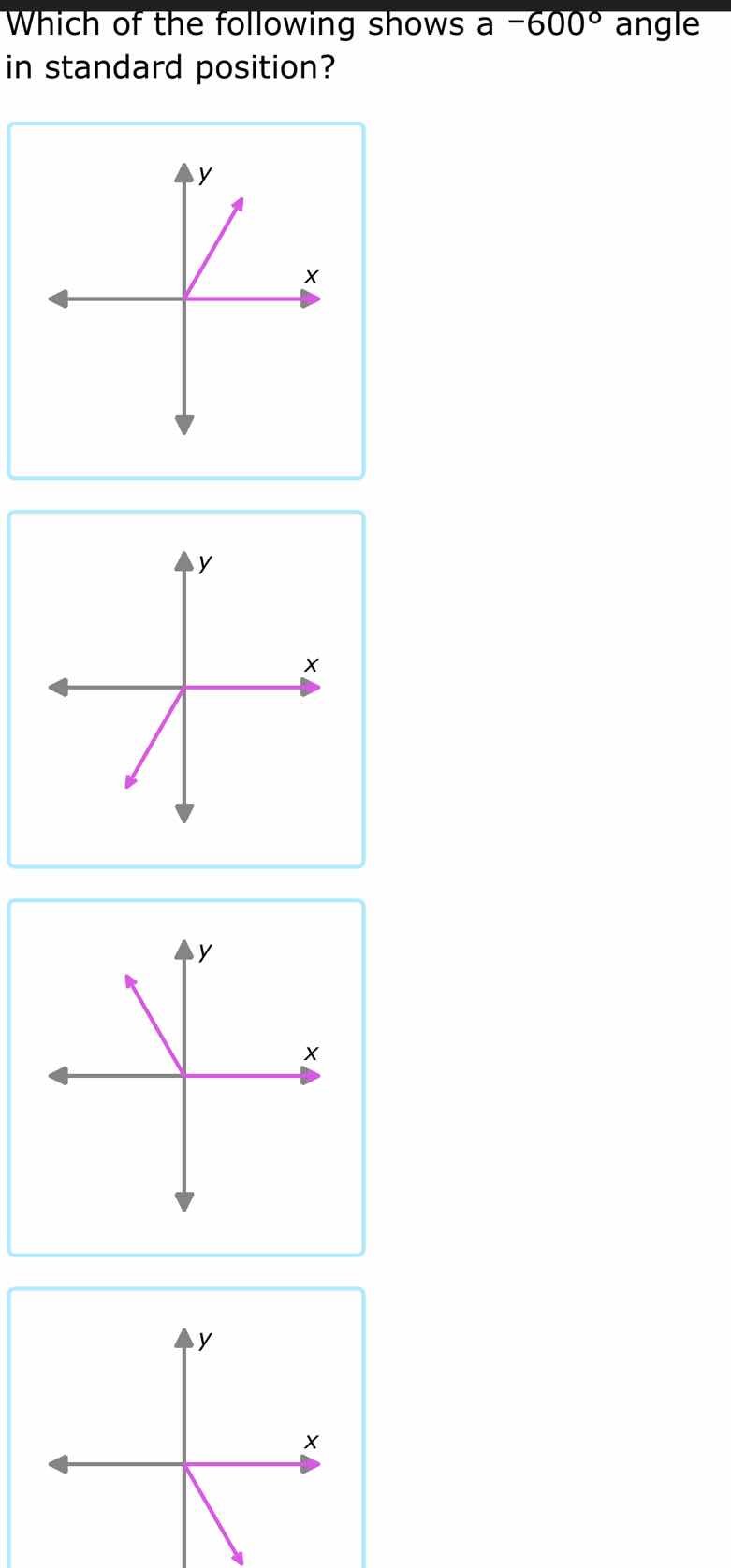
which of the following shows a -600° angle in standard position? (four coordinate plane figures with angles are shown)
Step1: Find coterminal angle
To find the coterminal angle of \(-600^\circ\), we add multiples of \(360^\circ\) until we get an angle between \(0^\circ\) and \(360^\circ\). Let's calculate:
\(-600^\circ + 2\times360^\circ=-600^\circ + 720^\circ = 120^\circ\)
Wait, no, wait. Wait, actually, when dealing with negative angles, we can also add \(360^\circ\) repeatedly. Wait, \(-600^\circ+ 2\times360^\circ = -600 + 720 = 120^\circ\)? Wait, no, that's not right. Wait, let's do it step by step. \(-600^\circ+360^\circ=-240^\circ\), then \(-240^\circ + 360^\circ = 120^\circ\). Wait, but \(120^\circ\) is in the second quadrant (between \(90^\circ\) and \(180^\circ\)). Wait, but let's check again. Wait, maybe I made a mistake. Wait, \(-600^\circ\) is a negative angle, so we rotate clockwise. Let's find the positive coterminal angle. The formula for coterminal angles is \(\theta + 360^\circ k\), where \(k\) is an integer. We want \(\theta\) to be between \(0^\circ\) and \(360^\circ\). So:
\(-600^\circ+ 2\times360^\circ=-600 + 720 = 120^\circ\). Wait, but \(120^\circ\) is in the second quadrant (since \(90^\circ<120^\circ<180^\circ\)). Now let's look at the graphs:
First graph: terminal side in first quadrant (between \(0^\circ\) and \(90^\circ\)) – no.
Second graph: terminal side in third quadrant (between \(180^\circ\) and \(270^\circ\)) – no.
Third graph: terminal side in second quadrant (between \(90^\circ\) and \(180^\circ\)) – yes, because \(120^\circ\) is in second quadrant.
Fourth graph: terminal side in fourth quadrant (between \(270^\circ\) and \(360^\circ\)) – no.
Wait, but wait, maybe my calculation of coterminal angle is wrong. Wait, let's recalculate. \(-600^\circ\). Let's add \(360^\circ\) once: \(-600 + 360 = -240^\circ\). Add again: \(-240 + 360 = 120^\circ\). So \(120^\circ\) is the positive coterminal angle. \(120^\circ\) is in the second quadrant (since it's between \(90^\circ\) and \(180^\circ\)). So the terminal side should be in the second quadrant. Looking at the options:
First graph: first quadrant – no.
Second graph: third quadrant – no.
Third graph: second quadrant (terminal side between \(90^\circ\) and \(180^\circ\)) – yes.
Fourth graph: fourth quadrant – no.
Wait, but let's confirm. Wait, maybe I made a mistake in the coterminal angle. Wait, \(-600^\circ\) is a negative angle, so rotating clockwise \(600^\circ\). Let's convert \(600^\circ\) to how many full circles and remaining degrees. \(600\div360 = 1\) full circle (360°) and \(240^\circ\) remaining. So rotating clockwise 360° (which brings us back to the starting point) and then 240° clockwise. Rotating clockwise 240° is the same as rotating counterclockwise \(360 - 240 = 120^\circ\). So the terminal side is at \(120^\circ\) counterclockwise from the positive x - axis, which is in the second quadrant. So the graph with the terminal side in the second quadrant is the third option (the one with the arrow in the second quadrant, between the negative x - axis and positive y - axis? Wait, no, the third graph: the pink arrow is in the second quadrant (between 90° and 180°), so that's the one.
Wait, let's check the graphs again. The third graph: the terminal side is in the second quadrant (between the positive y - axis and negative x - axis), which is where \(120^\circ\) is (since \(90^\circ<120^\circ<180^\circ\)). So the third graph (the one with the pink arrow in the second quadrant) is the correct one.

Snap & solve any problem in the app
Get step-by-step solutions on Sovi AI
Photo-based solutions with guided steps
Explore more problems and detailed explanations
The third graph (the one with the terminal side in the second quadrant, between the positive \(y\) - axis and negative \(x\) - axis) shows the \(-600^\circ\) angle in standard position. (Assuming the third graph is the one with the arrow in the second quadrant as described in the visual, e.g., the third box with the pink arrow going to the second quadrant)