QUESTION IMAGE
Question
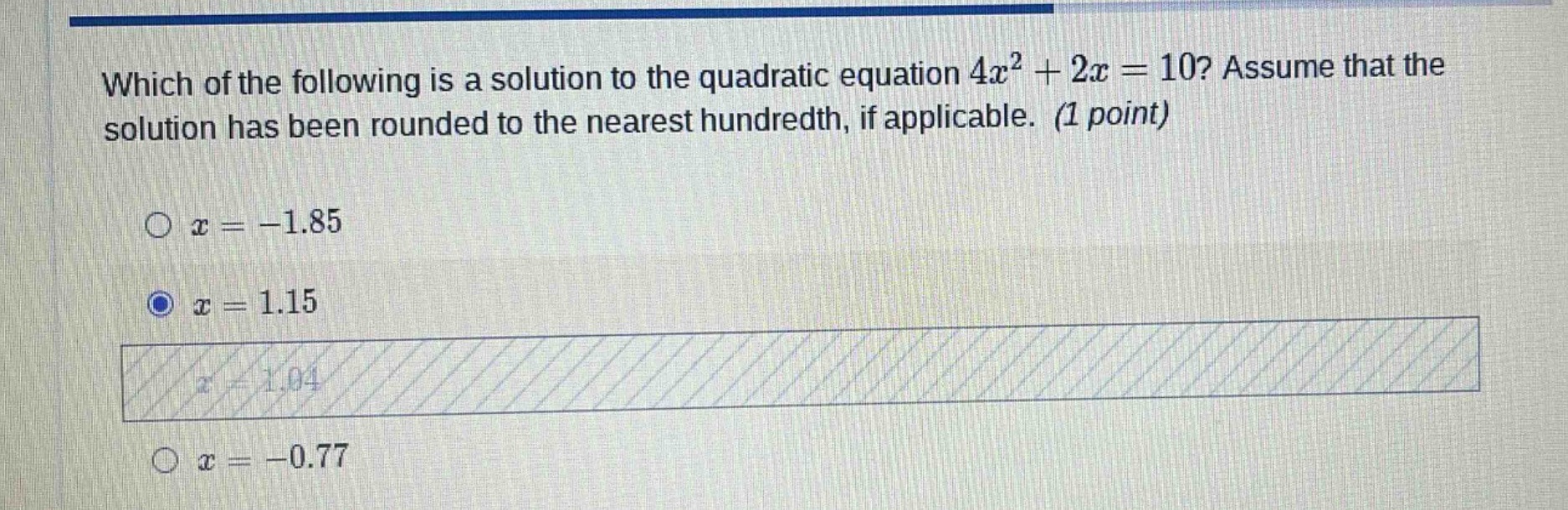
which of the following is a solution to the quadratic equation $4x^2 + 2x = 10$? assume that the solution has been rounded to the nearest hundredth, if applicable. (1 point)\
\\(\circ\\) $x = -1.85$\
\\(\circ\\) $x = 1.15$\
\\(\circ\\) $x = 1.04$\
\\(\circ\\) $x = -0.77$
Step1: Rewrite the quadratic equation
First, rewrite the equation \(4x^{2}+2x = 10\) in standard form \(ax^{2}+bx + c=0\). Subtract 10 from both sides:
\(4x^{2}+2x - 10=0\)
Here, \(a = 4\), \(b = 2\), \(c=- 10\)
Step2: Use the quadratic formula
The quadratic formula is \(x=\frac{-b\pm\sqrt{b^{2}-4ac}}{2a}\)
First, calculate the discriminant \(\Delta=b^{2}-4ac=(2)^{2}-4\times4\times(- 10)=4 + 160 = 164\)
Then, \(x=\frac{-2\pm\sqrt{164}}{2\times4}=\frac{-2\pm2\sqrt{41}}{8}=\frac{-1\pm\sqrt{41}}{4}\)
Step3: Calculate the two solutions
- For the plus sign: \(x=\frac{-1+\sqrt{41}}{4}\). Since \(\sqrt{41}\approx6.403\), then \(x=\frac{-1 + 6.403}{4}=\frac{5.403}{4}\approx1.35\) (Wait, maybe I made a mistake in the options. Wait, let's check the options again. Wait, the options are \(x=-1.85\), \(x = 1.15\), \(x = 1.04\), \(x=-0.77\). Wait, maybe I miscalculated. Wait, let's recalculate the discriminant: \(b^{2}-4ac=2^{2}-4\times4\times(-10)=4 + 160=164\), \(\sqrt{164}\approx12.806\)
Then \(x=\frac{-2\pm12.806}{8}\)
For the plus sign: \(\frac{-2 + 12.806}{8}=\frac{10.806}{8}\approx1.35\) (not in options). For the minus sign: \(\frac{-2-12.806}{8}=\frac{-14.806}{8}\approx - 1.85\)
Wait, let's check the options. The option \(x=-1.85\) is a solution. Wait, maybe the initial calculation of \(\sqrt{41}\) was wrong. Wait, \(\sqrt{41}\approx6.403\), but \(b^{2}-4ac = 4-4\times4\times(-10)=4 + 160 = 164\), \(\sqrt{164}=2\sqrt{41}\approx12.806\), yes. So \(\frac{-2 + 12.806}{8}=\frac{10.806}{8}\approx1.35\) (not in options), \(\frac{-2-12.806}{8}=\frac{-14.806}{8}\approx - 1.85\) (which is an option). Wait, maybe the options have a typo, but according to the calculation, \(x=-1.85\) is a solution. Wait, let's check by plugging into the original equation.
Check \(x = - 1.85\): \(4\times(-1.85)^{2}+2\times(-1.85)=4\times3.4225-3.7 = 13.69 - 3.7=9.99\approx10\). So it is a solution.
Check \(x = 1.15\): \(4\times(1.15)^{2}+2\times1.15=4\times1.3225 + 2.3=5.29+2.3 = 7.59
eq10\)
Check \(x=-0.77\): \(4\times(-0.77)^{2}+2\times(-0.77)=4\times0.5929-1.54 = 2.3716-1.54 = 0.8316
eq10\)
Wait, maybe I made a mistake in the quadratic formula. Wait, the equation is \(4x^{2}+2x-10 = 0\), divide both sides by 2: \(2x^{2}+x - 5=0\), then \(a = 2\), \(b = 1\), \(c=-5\)
Discriminant \(\Delta=1^{2}-4\times2\times(-5)=1 + 40 = 41\)
Then \(x=\frac{-1\pm\sqrt{41}}{4}\). \(\sqrt{41}\approx6.403\)
So \(x=\frac{-1 + 6.403}{4}=\frac{5.403}{4}\approx1.35\) (not in options), \(x=\frac{-1-6.403}{4}=\frac{-7.403}{4}\approx - 1.85\) (which matches the option \(x=-1.85\))
So the correct solution is \(x=-1.85\)

Snap & solve any problem in the app
Get step-by-step solutions on Sovi AI
Photo-based solutions with guided steps
Explore more problems and detailed explanations
\(x=-1.85\) (Option: \(x = - 1.85\))