QUESTION IMAGE
Question
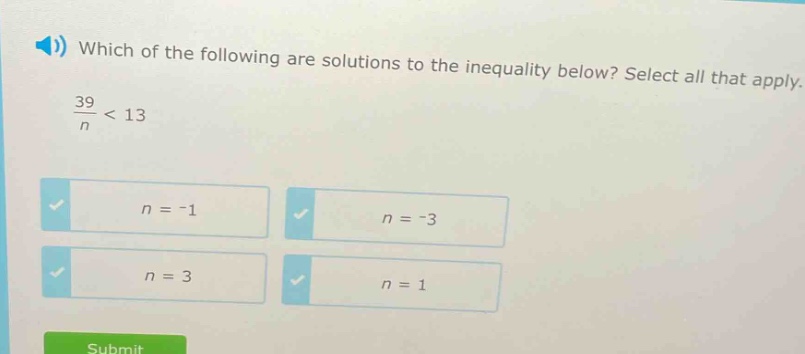
which of the following are solutions to the inequality below? select all that apply.\\(\frac{39}{n} < 13\\)\\(n = -1\\)\\(n = -3\\)\\(n = 3\\)\\(n = 1\\)
Step1: Analyze the inequality for positive \( n \)
When \( n>0 \), we can multiply both sides of \( \frac{39}{n}<13 \) by \( n \) (since \( n \) is positive, the inequality sign remains the same) to get \( 39 < 13n \). Then divide both sides by 13: \( \frac{39}{13}
Step2: Analyze the inequality for negative \( n \)
When \( n<0 \), multiplying both sides of \( \frac{39}{n}<13 \) by \( n \) (since \( n \) is negative, the inequality sign flips) gives \( 39>13n \). Divide both sides by 13: \( 3 > n \). Since \( n \) is negative, any negative \( n \) will satisfy \( 3 > n \) (because negative numbers are less than 3). Let's check \( n=-1 \): \( \frac{39}{-1}=-39 \), and \( -39<13 \) is true. For \( n = -3 \): \( \frac{39}{-3}=-13 \), and \( -13<13 \) is true.
So the correct solutions are \( n=-1 \) and \( n=-3 \), while \( n = 3 \) and \( n = 1 \) are not solutions.

Snap & solve any problem in the app
Get step-by-step solutions on Sovi AI
Photo-based solutions with guided steps
Explore more problems and detailed explanations
A. \( n=-1 \)
B. \( n=-3 \)