QUESTION IMAGE
Question
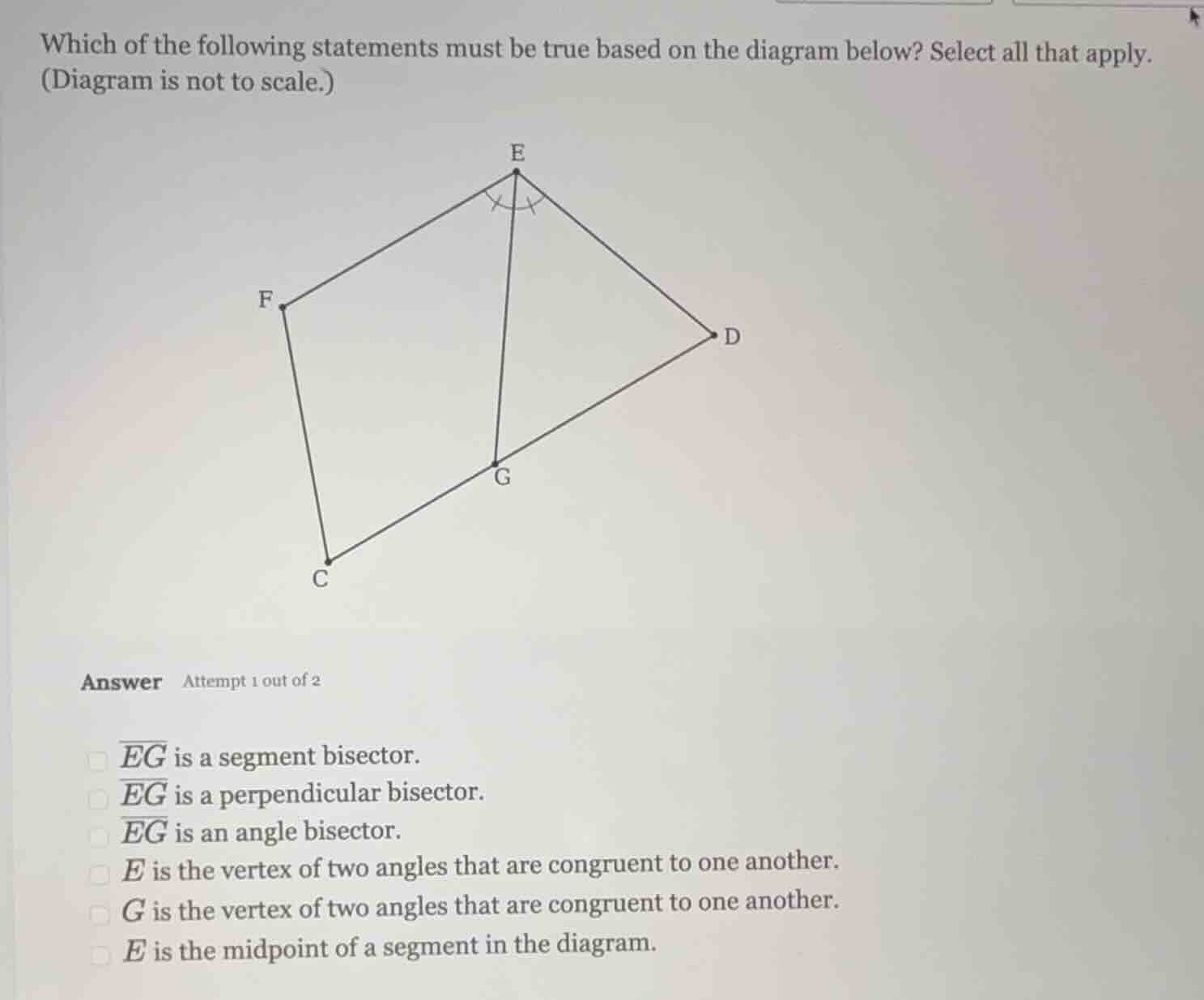
which of the following statements must be true based on the diagram below? select all that apply. (diagram is not to scale.)
answer attempt 1 out of 2
$overline{eg}$ is a segment bisector.
$overline{eg}$ is a perpendicular bisector.
$overline{eg}$ is an angle bisector.
$e$ is the vertex of two angles that are congruent to one another.
$g$ is the vertex of two angles that are congruent to one another.
$e$ is the midpoint of a segment in the diagram.
Brief Explanations
- An angle bisector splits an angle into two congruent angles; the diagram shows $\overline{EG}$ splits $\angle FED$ into two equal angles, so it is an angle bisector.
- The congruent angle marks at $E$ confirm $E$ is the vertex of two congruent angles.
- There is no indication $\overline{EG}$ bisects a segment (no midpoint marks on $\overline{CD}$), so it is not a segment bisector, and no right angle marks mean it cannot be a perpendicular bisector.
- There are no congruent angle marks at $G$, so $G$ is not the vertex of two congruent angles.
- $E$ is an endpoint of segments, not a midpoint.

Snap & solve any problem in the app
Get step-by-step solutions on Sovi AI
Photo-based solutions with guided steps
Explore more problems and detailed explanations
- $\overline{EG}$ is an angle bisector.
- $E$ is the vertex of two angles that are congruent to one another.