QUESTION IMAGE
Question
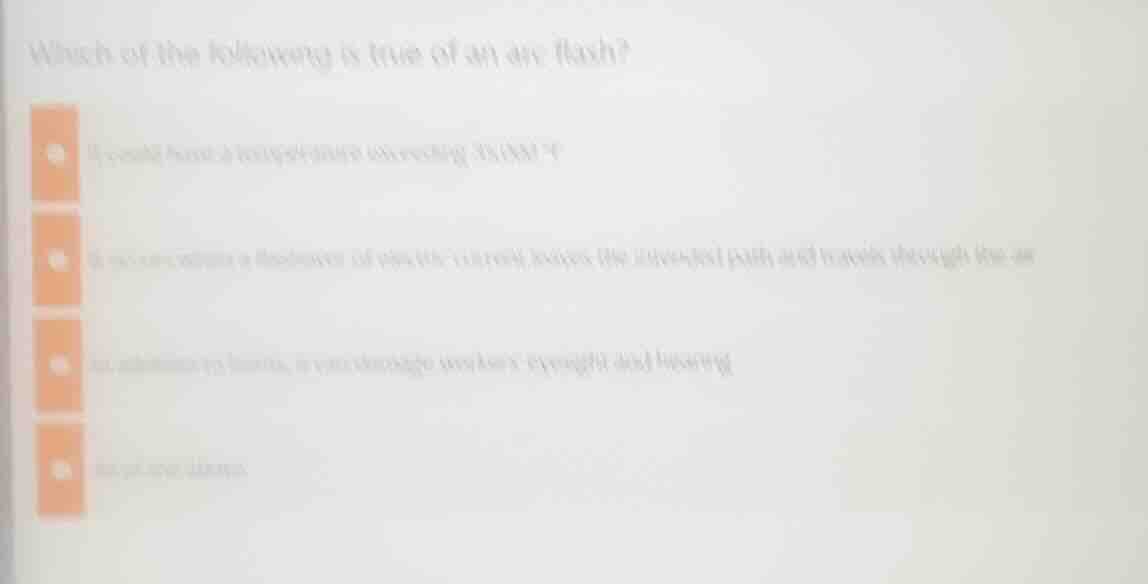
which of the following is true of an arc flash? it could hurt a bystander standing 1000 ft it occurs when a discharge of electric current leaves the intended path and travels through the air in addition to burns, it can damage worker’s eyesight and hearing all of the above
To solve this, we analyze each option based on arc flash knowledge:
Option 1 (partially visible, likely about burns):
Arc flash primarily causes thermal burns (including severe ones), but let's check others.
Option 2 (describes arc flash mechanism):
An arc flash occurs when electric current deviates from its intended path (e.g., due to a fault) and travels through the air (ionizing it, creating an arc). This matches the definition of an arc flash.
Option 3 (vision/hearing damage):
While arc flash can produce intense light/sound, its primary hazard is thermal/electrical burns, not primary vision/hearing damage (though secondary effects might exist, this isn’t the core “true” statement about arc flash’s nature).
Option 4 (no power damage? Unlikely, as arc flash is a fault event that disrupts power and causes damage).
An arc flash occurs when electric current leaves its intended path and travels through the air (due to a fault like a short circuit). This matches the description in the second option. Other options either misstate primary hazards (Option 3) or are inconsistent with arc flash physics (Option 4, and Option 1’s partial claim is less definitive than the mechanism in Option 2).

Snap & solve any problem in the app
Get step-by-step solutions on Sovi AI
Photo-based solutions with guided steps
Explore more problems and detailed explanations
The option (second one, assuming labels like A/B/C/D, e.g., if the second option is labeled as B) that states "It occurs when a discharge of electric current leaves the intended path and travels through the air" (exact wording based on the image’s second option).
(Note: Since the image’s text is partially blurred, the key is identifying the option describing the arc flash mechanism: current deviating from intended path to air. Adjust the label (A/B/C/D) based on the original question’s numbering, e.g., if the second option is B, then "B. It occurs when a discharge of electric current leaves the intended path and travels through the air".)