QUESTION IMAGE
Question
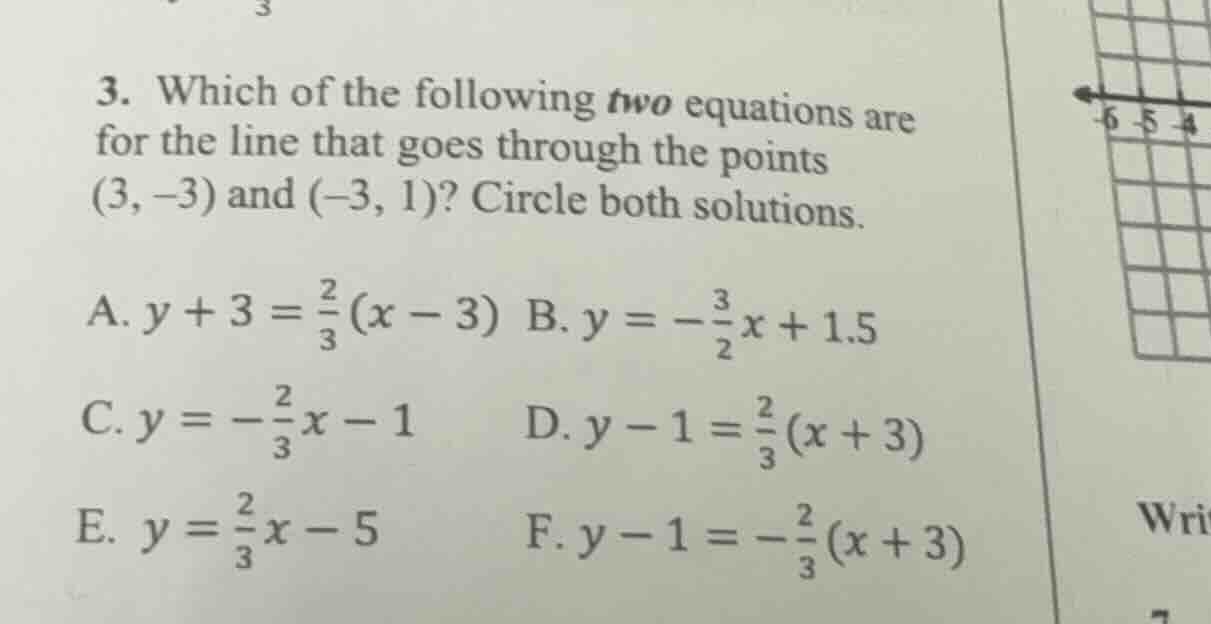
- which of the following two equations are for the line that goes through the points (3, -3) and (-3, 1)? circle both solutions. a. $y + 3 = \frac{2}{3}(x - 3)$ b. $y = -\frac{3}{2}x + 1.5$ c. $y = -\frac{2}{3}x - 1$ d. $y - 1 = \frac{2}{3}(x + 3)$ e. $y = \frac{2}{3}x - 5$ f. $y - 1 = -\frac{2}{3}(x + 3)$
Step1: Calculate the slope
The slope \( m \) between two points \((x_1, y_1)\) and \((x_2, y_2)\) is given by \( m=\frac{y_2 - y_1}{x_2 - x_1} \). For points \((3, -3)\) and \((-3, 1)\), we have \( x_1 = 3,y_1=-3,x_2=-3,y_2 = 1 \). So \( m=\frac{1-(-3)}{-3 - 3}=\frac{4}{-6}=-\frac{2}{3} \).
Step2: Check point - slope form
The point - slope form of a line is \( y - y_1=m(x - x_1) \).
- For point \((3,-3)\): \( y-(-3)=-\frac{2}{3}(x - 3) \), which is \( y + 3=-\frac{2}{3}(x - 3) \)? Wait, no, wait our slope calculation was wrong? Wait, no: \( 1-(-3)=4 \), \( -3 - 3=-6 \), \( \frac{4}{-6}=-\frac{2}{3} \). Wait, but let's check the other point. For point \((-3,1)\), the point - slope form is \( y - 1=-\frac{2}{3}(x+3) \) (since \( y - y_2=m(x - x_2) \), \( y_2 = 1,x_2=-3 \), so \( y - 1=-\frac{2}{3}(x-(-3))=-\frac{2}{3}(x + 3) \)), which is option F. Wait, maybe I made a mistake in slope. Wait, \( (1)-(-3)=4 \), \( (-3)-(3)=-6 \), \( \frac{4}{-6}=-\frac{2}{3} \). Now let's check the slope - intercept form. The slope - intercept form is \( y=mx + b \). Let's use point \((3,-3)\) and \( m =-\frac{2}{3} \). Substitute into \( y=mx + b \): \( -3=-\frac{2}{3}(3)+b \), \( -3=-2 + b \), so \( b=-1 \). So the equation is \( y=-\frac{2}{3}x-1 \), which is option C? Wait, no, this is conflicting. Wait, let's recalculate the slope. \( (y_2 - y_1)=(1)-(-3)=4 \), \( (x_2 - x_1)=(-3)-3=-6 \), \( \frac{4}{-6}=-\frac{2}{3} \). Now, let's check option F: \( y - 1=-\frac{2}{3}(x + 3) \). Let's expand it: \( y-1=-\frac{2}{3}x-2 \), \( y=-\frac{2}{3}x-1 \), which matches the slope - intercept form we found (\( y=-\frac{2}{3}x-1 \), option C? Wait, no, option C is \( y =-\frac{2}{3}x-1 \), option F is \( y - 1=-\frac{2}{3}(x + 3) \). Wait, and let's check option C: plug in \( x = 3 \), \( y=-\frac{2}{3}(3)-1=-2 - 1=-3 \), which matches \((3,-3)\). Plug in \( x=-3 \), \( y=-\frac{2}{3}(-3)-1 = 2-1 = 1 \), which matches \((-3,1)\). Now check option F: \( y - 1=-\frac{2}{3}(x + 3) \). Plug in \( x=-3 \), \( y-1=-\frac{2}{3}(0)\), \( y = 1 \), which is correct. Plug in \( x = 3 \), \( y-1=-\frac{2}{3}(6)=-4 \), \( y=-3 \), which is correct. Wait, what about the other options?
- Option A: \( y + 3=\frac{2}{3}(x - 3) \), slope is \( \frac{2}{3}\), not \( -\frac{2}{3} \), so incorrect.
- Option B: \( y=-\frac{3}{2}x + 1.5 \), slope is \( -\frac{3}{2}\), incorrect.
- Option E: \( y=\frac{2}{3}x-5 \), slope is \( \frac{2}{3}\), incorrect.
- Option F: \( y - 1=-\frac{2}{3}(x + 3) \), correct as we saw.
- Option C: \( y=-\frac{2}{3}x-1 \), correct as we saw. Wait, but earlier when I thought slope was \( -\frac{2}{3} \), let's re - check the slope calculation. \( (1)-(-3)=4 \), \( (-3)-3=-6 \), \( \frac{4}{-6}=-\frac{2}{3} \), correct. Then for point \((3,-3)\), using \( y=mx + b \), \( -3=-\frac{2}{3}(3)+b\Rightarrow - 3=-2 + b\Rightarrow b=-1 \), so \( y=-\frac{2}{3}x-1 \) (option C). For point \((-3,1)\), using point - slope form: \( y - 1=-\frac{2}{3}(x + 3) \) (option F). So the correct options are C and F? Wait, but let's check the original problem again. Wait, maybe I made a mistake in slope. Wait, \( (y_2 - y_1)=(1)-(-3)=4 \), \( (x_2 - x_1)=(-3)-3=-6 \), \( \frac{4}{-6}=-\frac{2}{3} \), correct. So the slope is \( -\frac{2}{3} \).
Wait, let's check option F: \( y - 1=-\frac{2}{3}(x + 3) \), expand it: \( y=-\frac{2}{3}x-2 + 1=-\frac{2}{3}x-1 \), which is the same as option C. So option C is the slope - intercept form and option F is the point - slope form using the point \((-3,1)\).

Snap & solve any problem in the app
Get step-by-step solutions on Sovi AI
Photo-based solutions with guided steps
Explore more problems and detailed explanations
C. \( y =-\frac{2}{3}x-1 \), F. \( y - 1=-\frac{2}{3}(x + 3) \)