QUESTION IMAGE
Question
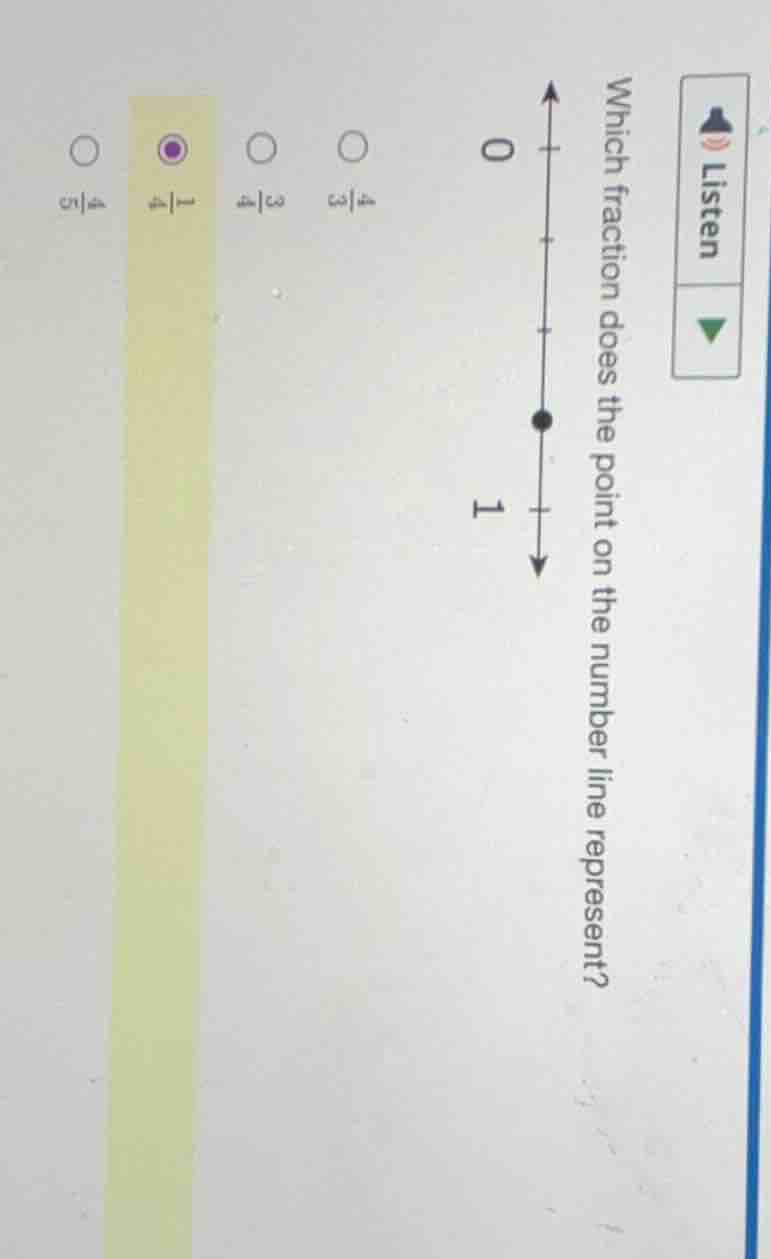
which fraction does the point on the number line represent? 0 1 listen
Step1: Analyze the number line
The number line is between 0 and 1. Let's count the number of intervals. From 0 to 1, we can see how many equal parts it's divided into. Looking at the number line, from 0 to 1, let's check the divisions. Wait, actually, let's see the position of the dot. Let's assume the number line from 0 to 1 is divided into 4 equal parts? Wait, no, wait. Wait, the options are \(\frac{4}{3}\) (which is more than 1, so that's not between 0 and 1), \(\frac{1}{4}\), \(\frac{3}{4}\), \(\frac{4}{5}\). Wait, no, wait the number line has 0, then some marks, then 1. Wait, the dot is at the third mark? Wait, no, let's re-examine. Wait, the number line: 0, then three marks, then 1? Wait, no, maybe the number line from 0 to 1 is divided into 4 equal parts? Wait, no, let's see the options. Wait, the options are \(\frac{4}{3}\) (which is 1 and 1/3, so beyond 1), \(\frac{1}{4}\) (close to 0), \(\frac{3}{4}\) (close to 1), \(\frac{4}{5}\) (also close to 1). Wait, but the dot is between 0 and 1, closer to 1? Wait, no, wait the original number line: 0, then a mark, then a mark, then the dot, then 1? Wait, no, maybe the number line is divided into 4 equal parts? Wait, 0 to 1, divided into 4 parts: each part is 1/4. So the first mark is 1/4, second is 2/4=1/2, third is 3/4, then 1. Wait, the dot is at the third mark? Wait, no, in the image, the dot is at the position which is 3/4? Wait, no, wait the options: the first option is 4/3 (which is wrong, since it's more than 1), then 1/4, 3/4, 4/5. Wait, maybe I misread. Wait, the number line: 0, then three intervals, then 1? Wait, no, let's count the intervals. From 0 to 1, how many spaces? Let's see: 0, then a tick, then a tick, then the dot, then a tick, then 1? Wait, no, maybe the number line is divided into 4 equal parts? Wait, no, let's check the options. The correct fraction: let's see, the dot is at 3/4? Wait, no, wait the original problem: the number line from 0 to 1, with the dot at the third of four parts? Wait, no, maybe the number line is divided into 4 parts, so each part is 1/4. So 0, 1/4, 2/4, 3/4, 1. So the dot is at 3/4? Wait, but the options include 3/4 as one of them. Wait, but the initial selected option was 1/4, but that's wrong. Wait, no, maybe I made a mistake. Wait, let's re-express:
Wait, the number line: 0 is on the top, 1 is below? Wait, no, the arrow is up for 0, down for 1? Wait, no, the number line has 0 at the top, 1 at the bottom? No, that's not standard. Wait, maybe the number line is vertical? 0 at the top, 1 at the bottom, with a dot in between. Let's see the position. From 0 to 1, how many equal parts? Let's see, the distance from 0 to 1 is divided into 4 equal parts? So each part is 1/4. So the first part (from 0) is 1/4, second 2/4=1/2, third 3/4, fourth 1. So the dot is at the third part, which is 3/4? Wait, but the options: the options are 4/3 (which is 1.333, so above 1), 1/4 (0.25), 3/4 (0.75), 4/5 (0.8). Wait, maybe the number line is divided into 5 parts? No, the options have 4/5. Wait, maybe the number line is from 0 to 1, with the dot at 3/4? Wait, but the initial selected option was 1/4, which is wrong. Wait, maybe I misread the number line. Wait, let's look again. The number line: 0, then a mark, then a mark, then the dot, then 1. So from 0 to 1, four intervals? No, three intervals? Wait, 0 to first mark: 1/4, first to second: 1/4, second to dot: 1/4, dot to 1: 1/4. So that's four intervals, meaning the dot is at 3/4. Wait, but the options: 4/3 is invalid (since it's >1), 1/4 is 0.25, 3/4 is 0.75, 4/5 is 0.8. Wait, maybe the number line is…

Snap & solve any problem in the app
Get step-by-step solutions on Sovi AI
Photo-based solutions with guided steps
Explore more problems and detailed explanations
\(\frac{3}{4}\) (corresponding to the option with \(\frac{3}{4}\))