QUESTION IMAGE
Question
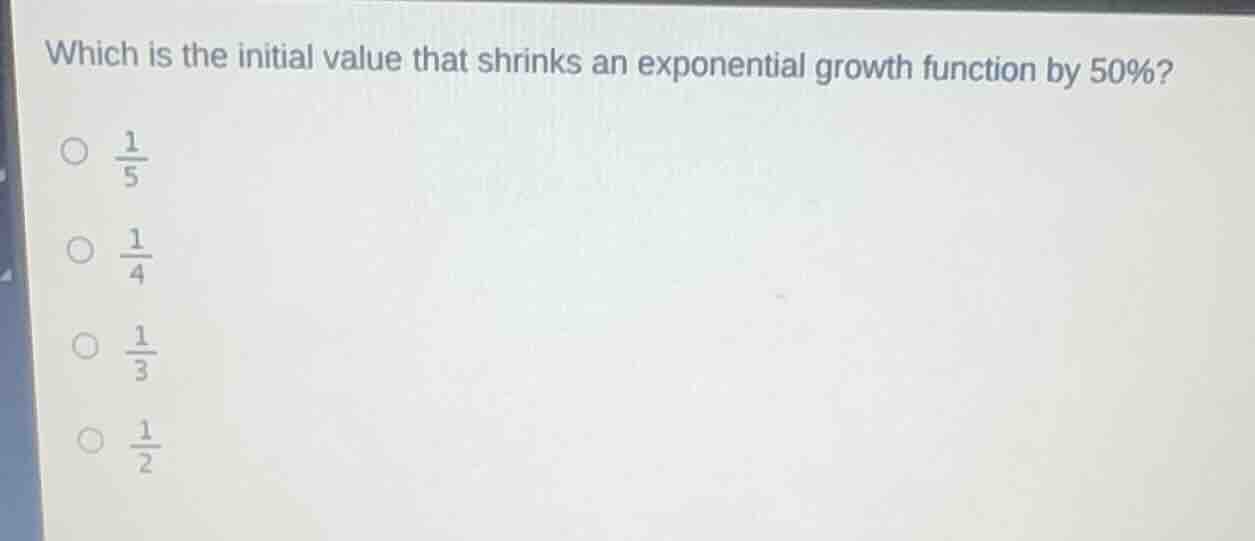
which is the initial value that shrinks an exponential growth function by 50%?
\\(\frac{1}{5}\\)
\\(\frac{1}{4}\\)
\\(\frac{1}{3}\\)
\\(\frac{1}{2}\\)
Step1: Understand the effect of initial value
An exponential growth function is generally in the form \( y = a(1 + r)^x \), where \( a \) is the initial value, \( r \) is the growth rate (\( r>0 \)), and \( x \) is the independent variable. Shrinking the function by 50% means the initial value should be such that the starting amount is 50% (or \( \frac{1}{2} \)) of the original (if we consider the original initial value as 1 for comparison).
Step2: Analyze each option
- For \( \frac{1}{5} \): This would shrink the function to 20% of the original, not 50%.
- For \( \frac{1}{4} \): This would shrink the function to 25% of the original, not 50%.
- For \( \frac{1}{3} \): This would shrink the function to approximately 33.3% of the original, not 50%.
- For \( \frac{1}{2} \): This means the initial value is half of the original, so it shrinks the exponential growth function by 50% (since \( 1-\frac{1}{2}=\frac{1}{2} \) or 50% reduction in the initial amount, which affects the overall function's magnitude).

Snap & solve any problem in the app
Get step-by-step solutions on Sovi AI
Photo-based solutions with guided steps
Explore more problems and detailed explanations
\(\frac{1}{2}\) (the option corresponding to \(\frac{1}{2}\))