QUESTION IMAGE
Question
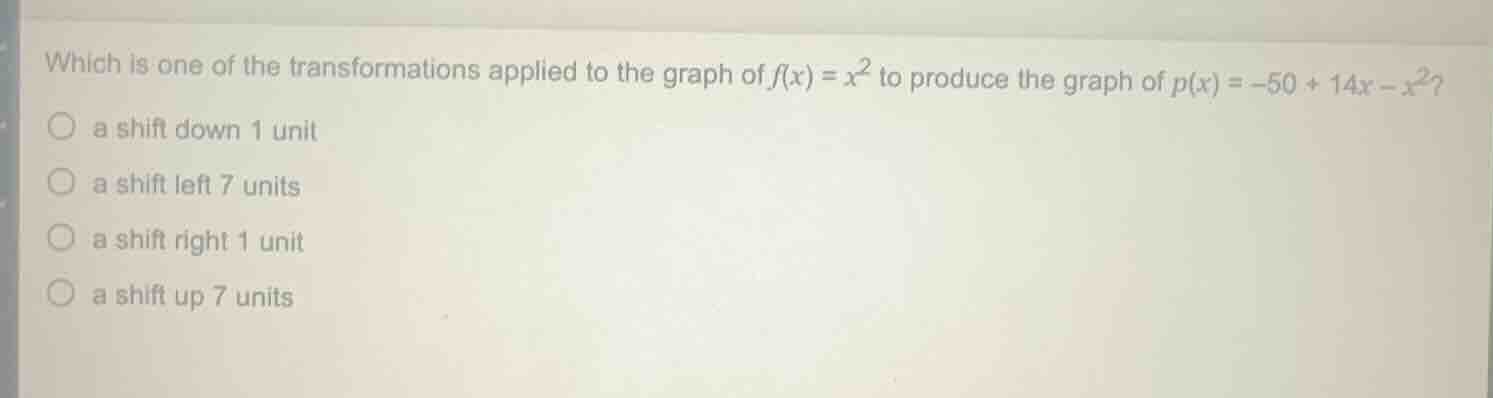
which is one of the transformations applied to the graph of $f(x) = x^2$ to produce the graph of $p(x) = -50 + 14x - x^2$?
- a shift down 1 unit
- a shift left 7 units
- a shift right 1 unit
- a shift up 7 units
Step1: Rewrite \( p(x) \) in vertex form
First, rewrite \( p(x)=-50 + 14x - x^{2} \) in standard quadratic form \( ax^{2}+bx + c \), so \( p(x)=-x^{2}+14x - 50 \).
To complete the square, factor out the coefficient of \( x^{2} \) from the first two terms: \( p(x)=-(x^{2}-14x)-50 \).
Take half of the coefficient of \( x \) (which is \( - 14\)), square it: \( (\frac{-14}{2})^{2}=49 \).
Add and subtract this value inside the parentheses: \( p(x)=-(x^{2}-14x + 49 - 49)-50 \).
Rewrite the expression: \( p(x)=-((x - 7)^{2}-49)-50 \).
Simplify: \( p(x)=-(x - 7)^{2}+49 - 50=-(x - 7)^{2}-1 \).
Step2: Analyze transformations from \( f(x)=x^{2} \)
The function \( f(x)=x^{2} \) has vertex at \( (0,0) \).
The function \( p(x)=-(x - 7)^{2}-1 \) has vertex at \( (7,-1) \).
Comparing the vertices: from \( (0,0) \) to \( (7,-1) \), the \( x \)-coordinate changes from \( 0 \) to \( 7 \) (a shift right by \( 7 \) units? Wait, no, wait the options. Wait, maybe I made a mistake. Wait the options are shift down 1, shift left 7, shift right 1, shift up 7. Wait, let's re - express \( p(x) \) again. Wait, maybe I messed up the sign when completing the square.
Wait, let's start over. \( p(x)=-x^{2}+14x - 50 \). Let's factor out - 1 from the first two terms: \( p(x)=-(x^{2}-14x)-50 \). Now, to complete the square for \( x^{2}-14x \), we take \( x^{2}-14x=(x - 7)^{2}-49 \). So \( p(x)=-((x - 7)^{2}-49)-50=- (x - 7)^{2}+49 - 50=- (x - 7)^{2}-1 \). The vertex of \( f(x)=x^{2} \) is \( (0,0) \), the vertex of \( p(x) \) is \( (7,-1) \). But the options don't have shift right 7. Wait, maybe there is a mistake in my approach. Wait, let's check the original function again. Wait, maybe I should rewrite \( p(x) \) as \( p(x)=-(x^{2}-14x + 50) \). Wait, no, let's use another method. Let's find the vertex form by using the formula for the vertex of a quadratic \( ax^{2}+bx + c \), the x - coordinate of the vertex is \( x=-\frac{b}{2a} \). For \( p(x)=-x^{2}+14x - 50 \), \( a=-1 \), \( b = 14 \), so \( x=-\frac{14}{2\times(-1)} = 7 \). Then \( p(7)=-(7)^{2}+14\times7 - 50=-49 + 98 - 50=-1 \). So the vertex is \( (7,-1) \). The vertex of \( f(x)=x^{2} \) is \( (0,0) \). Now let's look at the options. Wait, the options are:
- a shift down 1 unit: If we consider the vertical shift, from \( y = x^{2} \) to \( y=(x - 7)^{2}-1 \), the vertical shift is down 1 unit. Wait, maybe the question has a typo or I misread the options. Wait, the options are:
Option 1: a shift down 1 unit
Option 2: a shift left 7 units
Option 3: a shift right 1 unit
Option 4: a shift up 7 units
Wait, the vertex of \( f(x)=x^{2} \) is \( (0,0) \), the vertex of \( p(x) \) is \( (7,-1) \). The change in y - coordinate is \( 0-1=-1 \) (shift down 1 unit), and the change in x - coordinate is \( 7 - 0 = 7 \) (shift right 7 units). But since shift right 7 units is not an option, but shift down 1 unit is an option. Let's check the function again. Wait, maybe we can rewrite \( p(x) \) as \( p(x)=-(x^{2}-14x + 50) \), no. Wait, maybe the original function is \( p(x)=-50 + 14x - x^{2} \), let's compare with \( f(x)=x^{2} \). Let's consider the transformation step by step.
Alternatively, let's rewrite \( p(x) \) as \( p(x)=-(x^{2}-14x)-50=-(x^{2}-14x + 49 - 49)-50=-(x - 7)^{2}+49 - 50=-(x - 7)^{2}-1 \). The parent function \( f(x)=x^{2} \). The transformation from \( f(x) \) to \( p(x) \) is: first, reflect over the x - axis (because of the negative sign in front of \( (x - 7)^{2} \)), then shift right 7 units, then shift down 1 unit. Among the given options, "a shift down 1 unit" is one of the transf…

Snap & solve any problem in the app
Get step-by-step solutions on Sovi AI
Photo-based solutions with guided steps
Explore more problems and detailed explanations
a shift down 1 unit