QUESTION IMAGE
Question
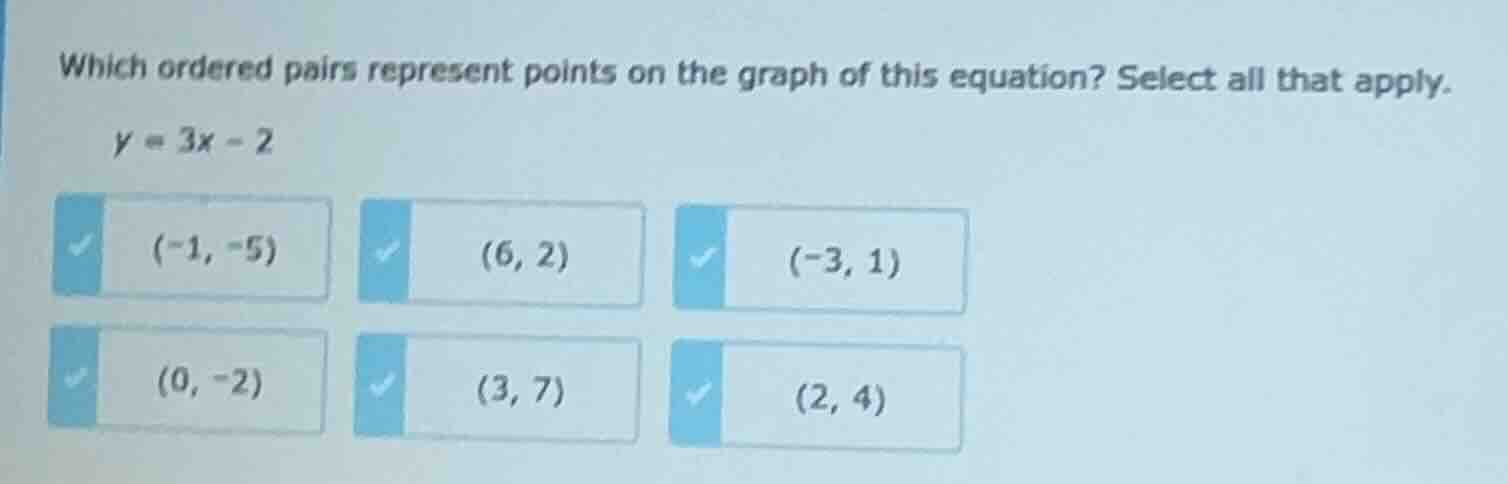
which ordered pairs represent points on the graph of this equation? select all that apply.
$y = 3x - 2$
$(-1, -5)$ $(6, 2)$ $(-3, 1)$
$(0, -2)$ $(3, 7)$ $(2, 4)$
To determine which ordered pairs \((x, y)\) lie on the graph of \(y = 3x - 2\), we substitute the \(x\)-value of each ordered pair into the equation and check if the resulting \(y\)-value matches the given \(y\)-value.
For \((-1, -5)\):
Substitute \(x = -1\) into \(y = 3x - 2\):
\(y = 3(-1) - 2 = -3 - 2 = -5\).
This matches the given \(y\)-value (\(-5\)), so \((-1, -5)\) is on the graph.
For \((6, 2)\):
Substitute \(x = 6\) into \(y = 3x - 2\):
\(y = 3(6) - 2 = 18 - 2 = 16\).
The given \(y\)-value is \(2\), which does not match \(16\). Thus, \((6, 2)\) is not on the graph.
For \((-3, 1)\):
Substitute \(x = -3\) into \(y = 3x - 2\):
\(y = 3(-3) - 2 = -9 - 2 = -11\).
The given \(y\)-value is \(1\), which does not match \(-11\). Thus, \((-3, 1)\) is not on the graph.
For \((0, -2)\):
Substitute \(x = 0\) into \(y = 3x - 2\):
\(y = 3(0) - 2 = 0 - 2 = -2\).
This matches the given \(y\)-value (\(-2\)), so \((0, -2)\) is on the graph.
For \((3, 7)\):
Substitute \(x = 3\) into \(y = 3x - 2\):
\(y = 3(3) - 2 = 9 - 2 = 7\).
This matches the given \(y\)-value (\(7\)), so \((3, 7)\) is on the graph.
For \((2, 4)\):
Substitute \(x = 2\) into \(y = 3x - 2\):
\(y = 3(2) - 2 = 6 - 2 = 4\).
This matches the given \(y\)-value (\(4\)), so \((2, 4)\) is on the graph.
Final Answer:
The ordered pairs on the graph of \(y = 3x - 2\) are:
\(\boldsymbol{(-1, -5)}\), \(\boldsymbol{(0, -2)}\), \(\boldsymbol{(3, 7)}\), \(\boldsymbol{(2, 4)}\)
(Note: \((6, 2)\) and \((-3, 1)\) do not satisfy the equation and should not be selected.)

Snap & solve any problem in the app
Get step-by-step solutions on Sovi AI
Photo-based solutions with guided steps
Explore more problems and detailed explanations
To determine which ordered pairs \((x, y)\) lie on the graph of \(y = 3x - 2\), we substitute the \(x\)-value of each ordered pair into the equation and check if the resulting \(y\)-value matches the given \(y\)-value.
For \((-1, -5)\):
Substitute \(x = -1\) into \(y = 3x - 2\):
\(y = 3(-1) - 2 = -3 - 2 = -5\).
This matches the given \(y\)-value (\(-5\)), so \((-1, -5)\) is on the graph.
For \((6, 2)\):
Substitute \(x = 6\) into \(y = 3x - 2\):
\(y = 3(6) - 2 = 18 - 2 = 16\).
The given \(y\)-value is \(2\), which does not match \(16\). Thus, \((6, 2)\) is not on the graph.
For \((-3, 1)\):
Substitute \(x = -3\) into \(y = 3x - 2\):
\(y = 3(-3) - 2 = -9 - 2 = -11\).
The given \(y\)-value is \(1\), which does not match \(-11\). Thus, \((-3, 1)\) is not on the graph.
For \((0, -2)\):
Substitute \(x = 0\) into \(y = 3x - 2\):
\(y = 3(0) - 2 = 0 - 2 = -2\).
This matches the given \(y\)-value (\(-2\)), so \((0, -2)\) is on the graph.
For \((3, 7)\):
Substitute \(x = 3\) into \(y = 3x - 2\):
\(y = 3(3) - 2 = 9 - 2 = 7\).
This matches the given \(y\)-value (\(7\)), so \((3, 7)\) is on the graph.
For \((2, 4)\):
Substitute \(x = 2\) into \(y = 3x - 2\):
\(y = 3(2) - 2 = 6 - 2 = 4\).
This matches the given \(y\)-value (\(4\)), so \((2, 4)\) is on the graph.
Final Answer:
The ordered pairs on the graph of \(y = 3x - 2\) are:
\(\boldsymbol{(-1, -5)}\), \(\boldsymbol{(0, -2)}\), \(\boldsymbol{(3, 7)}\), \(\boldsymbol{(2, 4)}\)
(Note: \((6, 2)\) and \((-3, 1)\) do not satisfy the equation and should not be selected.)