QUESTION IMAGE
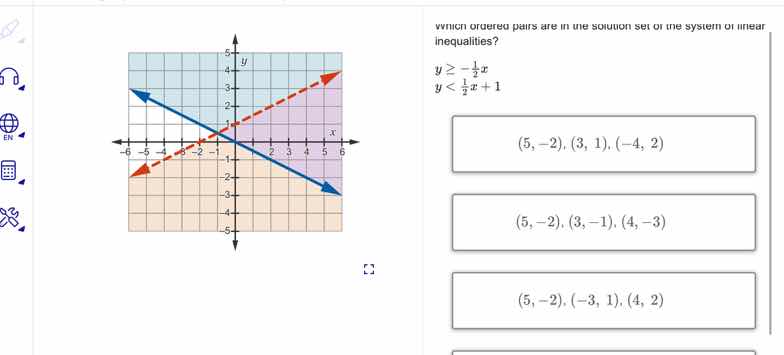
Question
which ordered pairs are in the solution set of the system of linear inequalities?
y ≥ -\frac{1}{3}x
y < \frac{1}{2}x + 1
(5, -2), (3, 1), (-4, 2)
(5, -2), (3, -1), (4, -3)
(5, -2), (-3, 1), (4, 2)
Step1: Check (5, -2) in \( y \geq -\frac{1}{3}x \)
Substitute \( x = 5 \), \( y = -2 \): \( -2 \geq -\frac{1}{3}(5) \) → \( -2 \geq -\frac{5}{3} \) (False, since \( -2 = -\frac{6}{3} < -\frac{5}{3} \)). Wait, maybe miscalculation. Wait, \( -\frac{1}{3}(5)=-\frac{5}{3}\approx -1.67 \), and \( -2 < -1.67 \), so (5,-2) fails first inequality? Wait, maybe I misread. Wait the first inequality is \( y \geq -\frac{1}{3}x \), second \( y < \frac{1}{2}x + 1 \). Let's check each ordered pair in each option.
First, let's take the third option: (5, -2), (-3, 1), (4, 2)
Check (5, -2) in \( y \geq -\frac{1}{3}x \): \( -2 \geq -\frac{5}{3} \)? \( -\frac{5}{3} \approx -1.67 \), \( -2 < -1.67 \) → no. Wait maybe the first option: (5, -2), (3, 1), (-4, 2)
Check (3,1) in \( y \geq -\frac{1}{3}x \): \( 1 \geq -\frac{1}{3}(3)= -1 \) → True. In \( y < \frac{1}{2}x + 1 \): \( 1 < \frac{3}{2} + 1 = 2.5 \) → True.
Check (-4,2) in \( y \geq -\frac{1}{3}x \): \( 2 \geq -\frac{1}{3}(-4)=\frac{4}{3}\approx 1.33 \) → True. In \( y < \frac{1}{2}x + 1 \): \( 2 < \frac{-4}{2} + 1 = -2 + 1 = -1 \)? No, \( 2 < -1 \) is False. Wait, no, \( \frac{1}{2}(-4) +1 = -2 +1 = -1 \), so \( 2 < -1 \) is False. So (-4,2) fails.
Wait third option: (5,-2), (-3,1), (4,2)
Check (-3,1) in \( y \geq -\frac{1}{3}x \): \( 1 \geq -\frac{1}{3}(-3)=1 \) → \( 1 \geq 1 \) → True. In \( y < \frac{1}{2}x + 1 \): \( 1 < \frac{-3}{2} +1 = -0.5 \)? No, \( 1 < -0.5 \) is False. Wait, I must have messed up the inequalities. Wait the first line is dashed (so strict? No, the first inequality is \( y \geq -\frac{1}{3}x \) (solid line), second \( y < \frac{1}{2}x + 1 \) (dashed line). Let's re-express the inequalities:
First inequality: \( y \geq -\frac{1}{3}x \) (region above or on the line \( y = -\frac{1}{3}x \))
Second: \( y < \frac{1}{2}x + 1 \) (region below the line \( y = \frac{1}{2}x + 1 \))
Let's check the third option: (4,2)
In \( y \geq -\frac{1}{3}x \): \( 2 \geq -\frac{4}{3} \) → True (since \( -\frac{4}{3} \approx -1.33 \), 2 > -1.33)
In \( y < \frac{1}{2}(4) +1 = 2 +1 = 3 \) → 2 < 3 → True.
Check (-3,1) in \( y \geq -\frac{1}{3}x \): \( 1 \geq -\frac{1}{3}(-3)=1 \) → 1 ≥ 1 → True.
In \( y < \frac{1}{2}(-3) +1 = -1.5 +1 = -0.5 \)? 1 < -0.5 → False. Wait, no, maybe I mixed up the lines. Wait the blue line is \( y = -\frac{1}{3}x \) (solid), red dashed is \( y = \frac{1}{2}x + 1 \). Let's check (4,2):
\( y = 2 \), \( x=4 \): \( 2 \geq -\frac{4}{3} \) (True), \( 2 < \frac{4}{2} +1 = 3 \) (True).
Check (5,-2): \( y=-2 \), \( x=5 \): \( -2 \geq -\frac{5}{3} \)? \( -\frac{5}{3} \approx -1.67 \), \( -2 < -1.67 \) → False. Wait, maybe the third option's (5,-2) is wrong? Wait no, maybe I made a mistake. Wait the third option is (5, -2), (-3, 1), (4, 2). Wait (5,-2): \( y=-2 \), \( x=5 \): \( -2 \geq -\frac{5}{3} \)? No. Wait the first option: (5, -2), (3, 1), (-4, 2)
Check (5,-2) in \( y < \frac{1}{2}x +1 \): \( -2 < \frac{5}{2} +1 = 3.5 \) → True. But in \( y \geq -\frac{1}{3}x \): \( -2 \geq -\frac{5}{3} \)? No. Wait the second option: (5, -2), (3, -1), (4, -3)
Check (3,-1) in \( y \geq -\frac{1}{3}x \): \( -1 \geq -1 \) (since \( -\frac{1}{3}(3)=-1 \)) → True. In \( y < \frac{3}{2} +1 = 2.5 \) → -1 < 2.5 → True.
Check (4,-3) in \( y \geq -\frac{4}{3} \approx -1.33 \): -3 ≥ -1.33 → False.
Wait the third option: (5, -2) fails first inequality? Wait no, maybe the first inequality is \( y \geq -\frac{1}{3}x \), so for (5,-2): \( -2 \geq -\frac{5}{3} \)? \( -\frac{5}{3} \approx -1.67 \), \( -2 < -1.67 \) → no. Wait maybe the correct option is the third one? Wait no, let's check…

Snap & solve any problem in the app
Get step-by-step solutions on Sovi AI
Photo-based solutions with guided steps
Explore more problems and detailed explanations
(5, -2), (-3, 1), (4, 2) (the third option)