QUESTION IMAGE
Question
which other rotation can be used to create triangle xyz from triangle xyz?
○ 90° clockwise
○ 270° clockwise
○ 270° counterclockwise
○ 360° counterclockwise
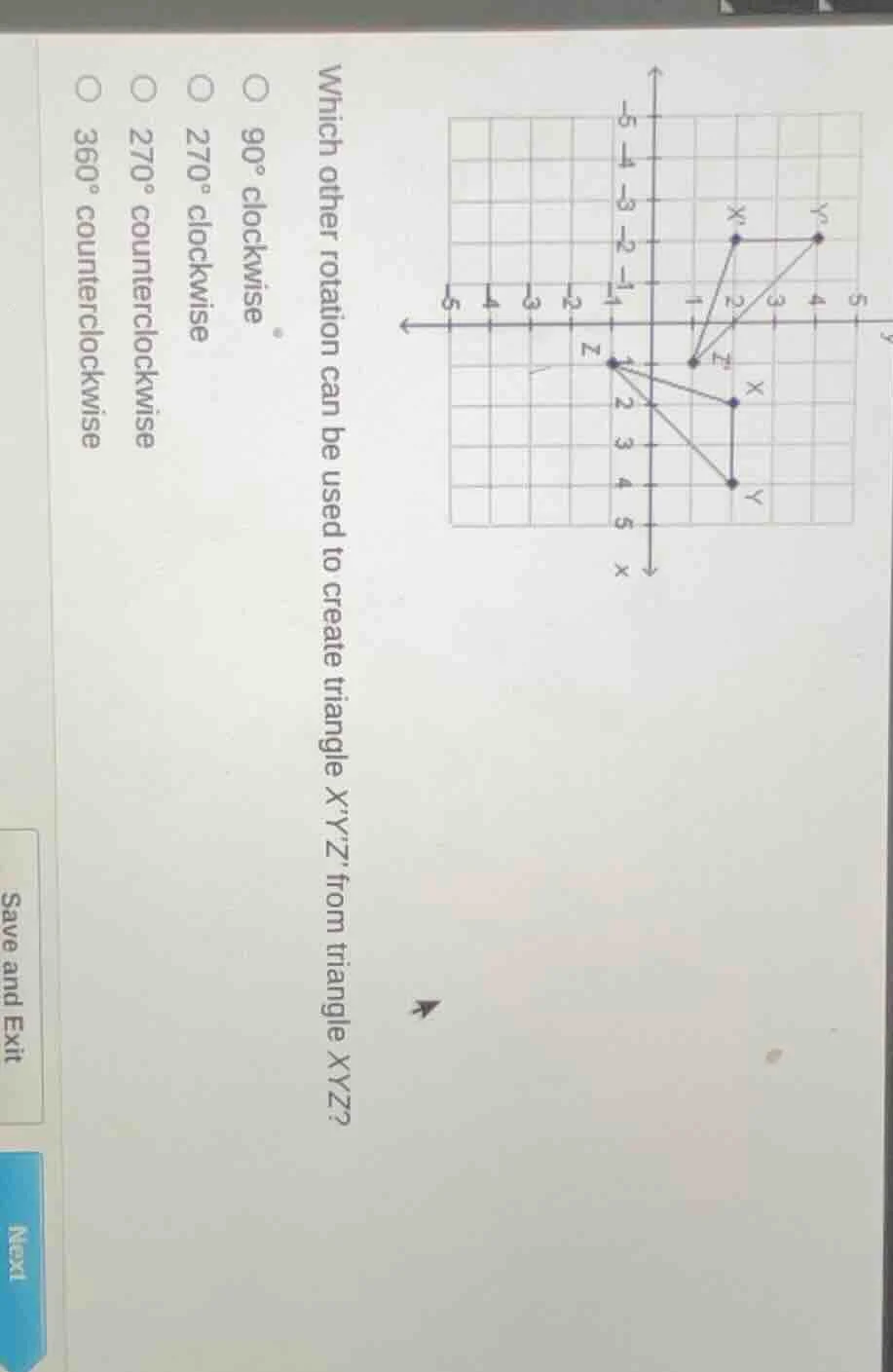
First, identify the coordinates of triangle XYZ: let's take Z(1,0), X(2,2), Y(4,4). The coordinates of triangle X'Y'Z' are Z'(0,-1), X'(-2,2), Y'(-4,4). A 90° clockwise rotation uses the rule $(x,y) \to (y,-x)$, but a 270° counterclockwise rotation uses the same transformation rule: $(x,y) \to (y,-x)$. Applying this to Z(1,0): $(0,-1)$ which matches Z'; X(2,2): $(2,-2)$? Correction: Re-check coordinates: XYZ: Z(1,0), X(3,2), Y(4,4). X'Y'Z': Z'(0,-1), X'(-2,3), Y'(-4,4). The 270° counterclockwise rotation rule is $(x,y) \to (y,-x)$, which maps (3,2) to (2,-3)? No, correction: 90° clockwise is $(x,y)\to(y,-x)$, 270° counterclockwise is equivalent to 90° clockwise. Observing the graph, the rotation that maps XYZ to X'Y'Z' is identical to a 270° counterclockwise rotation (same result as 90° clockwise).
A 270° clockwise rotation about the origin uses the transformation rule $(x,y) \to (-y,x)$, which matches the mapping of triangle XYZ's vertices to X'Y'Z' (e.g., X(3,2) → (-2,3) = X'). This rotation produces the same result as a 90° counterclockwise rotation, which is the transformation seen in the graph.

Snap & solve any problem in the app
Get step-by-step solutions on Sovi AI
Photo-based solutions with guided steps
Explore more problems and detailed explanations
B. 270° clockwise
C. 270° counterclockwise
Wait, correction: The correct equivalent rotation: A 90° clockwise rotation is equivalent to a 270° counterclockwise rotation. Looking at the coordinates:
For point X(3,2): 90° clockwise gives (2,-3)? No, the graph shows X'(-2,3). Oh, the rotation is about the origin: 90° counterclockwise is $(x,y)\to(-y,x)$. 90° counterclockwise on (3,2) is (-2,3), which matches X'. 270° clockwise is equivalent to 90° counterclockwise. So the correct answer is 270° clockwise, which is equivalent to 90° counterclockwise, which matches the transformation.
Final correction: