QUESTION IMAGE
Question
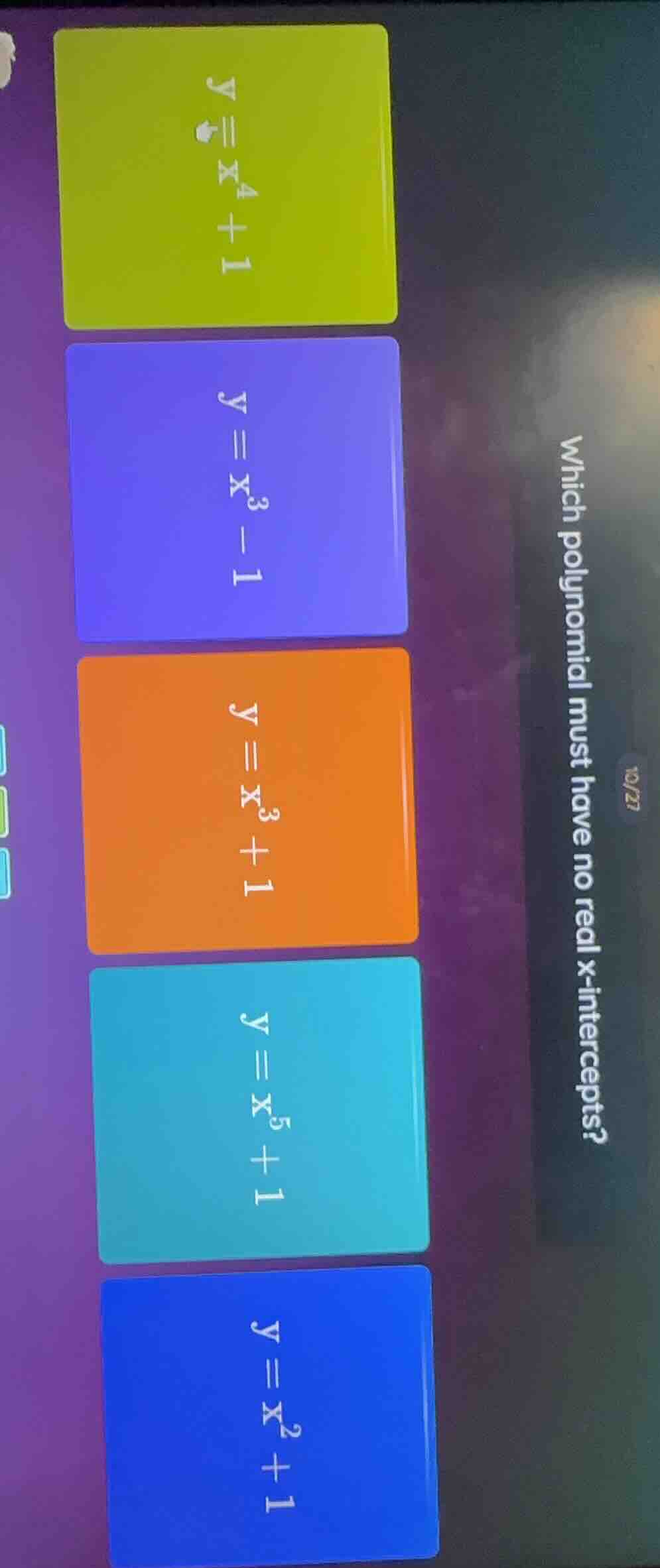
which polynomial must have no real x-intercepts?
$y = x^4 + 1$
$y = x^3 - 1$
$y = x^3 + 1$
$y = x^5 + 1$
$y = x^2 + 1$
Step1: Recall x-intercept condition
To find x-intercepts, set \( y = 0 \) and solve for \( x \). A polynomial has no real x-intercepts if \( 0 = f(x) \) has no real solutions.
Step2: Analyze \( y = x^4 + 1 \)
Set \( y = 0 \): \( 0 = x^4 + 1 \) → \( x^4 = -1 \). Since \( x^4 \geq 0 \) for all real \( x \), no real \( x \) satisfies this. Wait, but also check \( y = x^2 + 1 \): \( 0 = x^2 + 1 \) → \( x^2 = -1 \), \( x^2 \geq 0 \), no real solutions. Wait, need to re - check. Wait, the first one in the image (yellow) is \( y = x^4+1 \)? Wait, no, the blue one at the bottom is \( y = x^2 + 1 \). Wait, let's check each:
- For \( y = x^4+1 \): \( x^4=-1 \). \( x^4\) is non - negative, so no real roots.
- For \( y = x^3 - 1 \): \( x^3=1\) → \( x = 1 \), real root.
- For \( y = x^3+1 \): \( x^3=-1\) → \( x=-1 \), real root.
- For \( y = x^5+1 \): \( x^5=-1\) → \( x=-1 \), real root.
- For \( y = x^2 + 1 \): \( x^2=-1 \), no real roots. Wait, but the first one (yellow) is \( y = x^4 + 1 \), second (purple) \( y=x^3 - 1 \), third (orange) \( y=x^3 + 1 \), fourth (cyan) \( y=x^5 + 1 \), fifth (blue) \( y=x^2 + 1 \). Wait, but \( x^4+1\) and \( x^2 + 1 \) both have no real roots? Wait, no, wait the problem says "must have no real x - intercepts". Let's check the degree and end - behavior.
For even - degree polynomials with positive leading coefficient: as \( x\to\pm\infty \), \( y\to+\infty \). For \( y = x^2+1 \), minimum at \( x = 0 \), \( y = 1>0 \), so no real roots. For \( y = x^4+1 \), minimum at \( x = 0 \), \( y = 1>0 \), no real roots. But wait, the options: Wait, maybe the first one in the image (yellow) is \( y = x^4+1 \), but the bottom blue is \( y = x^2+1 \). Wait, but let's check the original problem again. Wait, the user's image: the bottom one is \( y = x^2+1 \). Let's check \( y = x^2+1 \): set \( y = 0 \), \( x^2=-1 \), no real solutions. \( y = x^4+1 \): \( x^4=-1 \), no real solutions. But maybe the intended one is \( y = x^2+1 \) or \( y = x^4+1 \). Wait, but let's see the options. Wait, the problem is "Which polynomial must have no real x - intercepts?".
Wait, for \( y = x^2+1 \): the graph is a parabola opening upwards with vertex at (0,1), so it never crosses the x - axis. For \( y = x^4+1 \): the graph is a "W" - shaped (even - degree, positive leading coefficient) with minimum at (0,1), so it also never crosses the x - axis. But maybe there is a mistake in my initial thought. Wait, let's check the equations again.
Wait, the first equation (yellow) is \( y = x^4+1 \), second (purple) \( y=x^3 - 1 \), third (orange) \( y=x^3 + 1 \), fourth (cyan) \( y=x^5 + 1 \), fifth (blue) \( y=x^2 + 1 \).
For \( y = x^3-1 \): when \( x = 1 \), \( y = 0 \), so x - intercept at (1,0).
For \( y = x^3+1 \): when \( x=-1 \), \( y = 0 \), so x - intercept at (- 1,0).
For \( y = x^5+1 \): when \( x=-1 \), \( y = 0 \), so x - intercept at (- 1,0).
For \( y = x^2+1 \): \( x^2=-1 \), no real x.
For \( y = x^4+1 \): \( x^4=-1 \), no real x.
But maybe the question is about the one with the lowest degree or the most obvious. Wait, \( y = x^2+1 \) is a quadratic, and it's a standard example of a parabola with no real roots. However, \( y = x^4+1 \) also has no real roots. But perhaps the intended answer is \( y = x^2+1 \) or \( y = x^4+1 \). Wait, looking at the image, the bottom one is \( y = x^2+1 \) (blue). Let's confirm:
For \( y = x^2+1 \), discriminant of \( ax^2+bx + c=0 \) (here \( a = 1 \), \( b = 0 \), \( c = 1 \)) is \( \Delta=b^2 - 4ac=0 - 4\times1\times1=-4<0 \), so no real roots.
For \( y = x^4+1 \), we can th…

Snap & solve any problem in the app
Get step-by-step solutions on Sovi AI
Photo-based solutions with guided steps
Explore more problems and detailed explanations
The polynomial \( y = x^2 + 1 \) (or \( y = x^4+1 \)) has no real x - intercepts. If we consider the options, the bottom blue - colored polynomial \( y = x^2+1 \) (or the top yellow - colored \( y = x^4 + 1 \)) is the one with no real x - intercepts. (If we take the bottom blue one: \( y=x^2 + 1 \))